
-
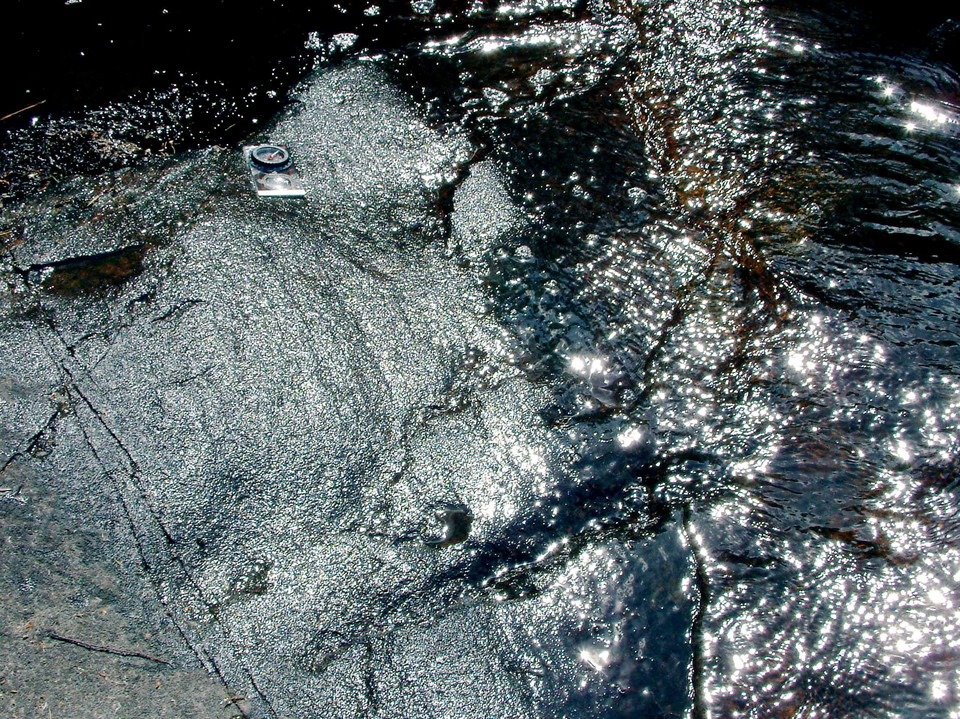
Svagt utbildade isräfflor i diorithällen i strandkanten av Badberget. Räfflorna visar att landisen rört sig från nordväst mot sydost i landskapet, vilket överensstämmer med observationer på andra ställen i trakten (G. Knutsson 2008).
Photo: Gert Knutsson -
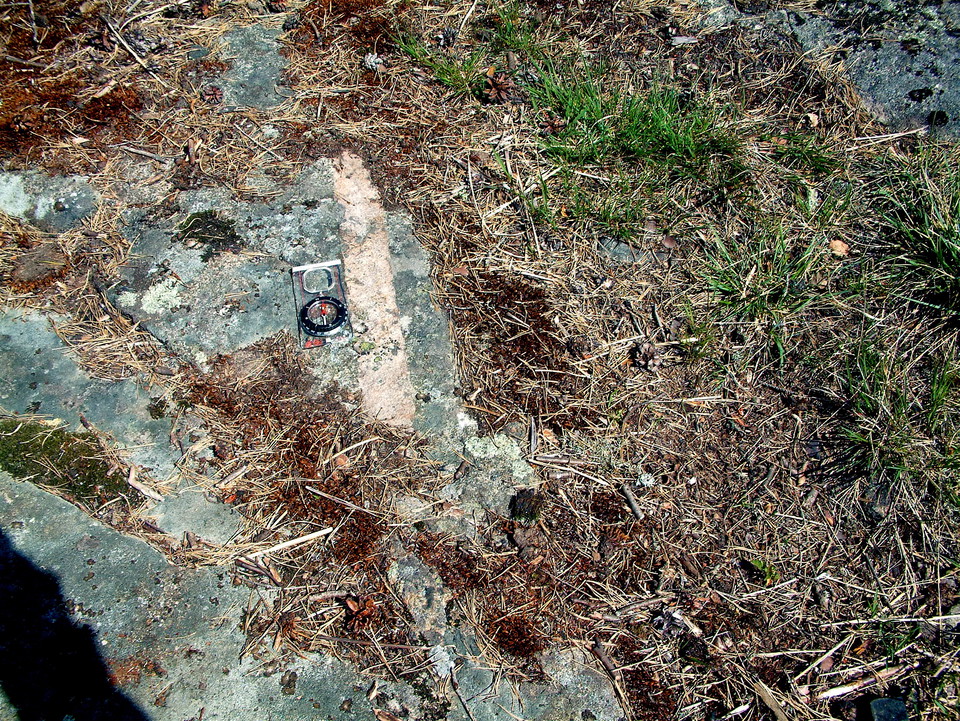
Smal gång av finkornig, ljus, kvartsrik bergart (aplit) i svart, basisk huvudbergart (diorit) vid Badberget (G. Knutsson 2008).
Photo: Gert Knutsson
Dioritberget
- Point of interest
- County: Kalmar län och Öland
- 6863.87 km away from you
Actions
Description
The trail reaches a small bay of Lake Grimmansmåla, where we encounter solid rock for the first time, in the so-called Badberget. The bedrock in the whole area is very old (between 1850 and 1650 million years), so called "urberg", and among the oldest rocks is the diorite, which belongs to the group of "green stones" or basic rocks. They contain little or no quartz, unlike the 'acidic', quartz-rich granites. Diorite is a gray-green or greenish-black, medium-grained rock. The mineral consists of greenish-black hornblende, black mica and a grayish-white to grayish-green feldspar. The greenstones weather more easily and give rise to a more nutrient-rich soil than the granites, which can lead to richer vegetation and less acidic groundwater than in the granite areas. Greenstones are found in a larger belt from Grimmagärde over Rostock and down to Ödevata and in some smaller stretches in the area, e.g. at Algutsboda church and at Emmaboda town (Nilsson & Knutsson 1972).
"Badberget" consists mainly of diorite, although the color and mineral composition vary somewhat. What is completely different in the rock are the narrow passages in a roughly north-south direction of a light (pink), fine-grained, quartz-rich rock called aplite. It was formed later in fractures in the diorite. If you are really sharp, you can see traces of the movement of the land ice on the rocks at the water's edge, known as ice grooves. The direction is 340°, which shows that the land ice moved from northwest to southeast.
Activities And Facilities
- Point of interest
Contact
Email address
Please be aware that some of these texts have been automatically translated.
I’ve been here
I want to go here
Questions & Answers
Ask a question to other Naturkartan users.
Reviews
0 reviews
- 5 :
- 4 :
- 3 :
- 2 :
- 1 :
Users images
No user images yet. Be the first to share!