
-
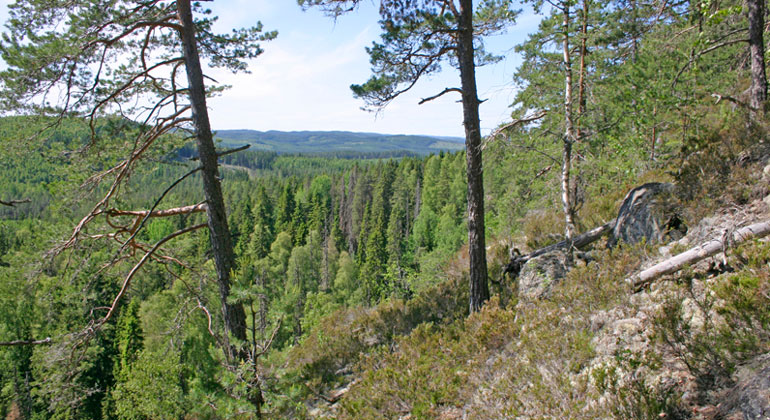
Orkar man sig upp längs den branta leden på berget, får man en fin belöning i den fantastiska utsikten.
Photo: Maria Jons, Länsstyrelsen i Dalarnas län. -
-
-
Tvärstupet, Naturreservat
- Nature reserve
- County: Dalarnas län
Actions
Description
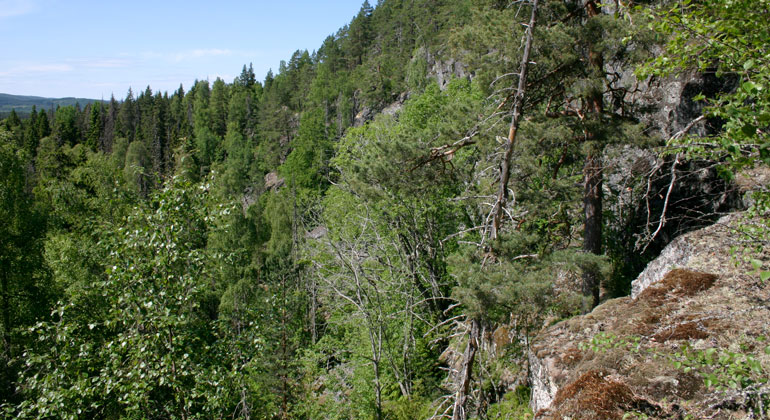
Tvärstupet consists of the southwestern slope of Laggarboberget leading down to Tvärstupstjärnen. In the rocky outcrop of Tvärstupet, there is a stand of linden and hazel trees, as well as other plants that thrive in the warmth of the rock. For example, you can find goat’s beard, black fern, and mullein here. Tvärstupet is what is known as a “southern rock.”
Good to know
To minimize disturbance to birdlife, access to the Tvärstupet Nature Reserve is prohibited during the period March 1–July 31. This means that during this period, the public is prohibited from entering any part of the reserve.
What is a south-facing mountain?
A south-facing mountain has a vertical rock face facing south, east, or west. This creates significant local effects, primarily in the form of higher temperatures. This is particularly important at night, when the rock face releases the heat it has absorbed during the day. This reduces the risk of night frost in spring and fall. As a result, the growing season is longer than in the surrounding area. These favorable conditions mean that several relict species* from warmer periods have persisted on the slope. Examples include the hazel and linden stands growing in the rocky terrain, as well as some sun- and heat-loving species in the field layer, such as goat’s beard, black fern, forked fern, and mullein.
*Relict = a zoological and botanical term referring to a surviving, usually isolated, animal or plant species. In this case, it is believed that the linden trees spread up here during a warmer period.
Significant Elevation Differences
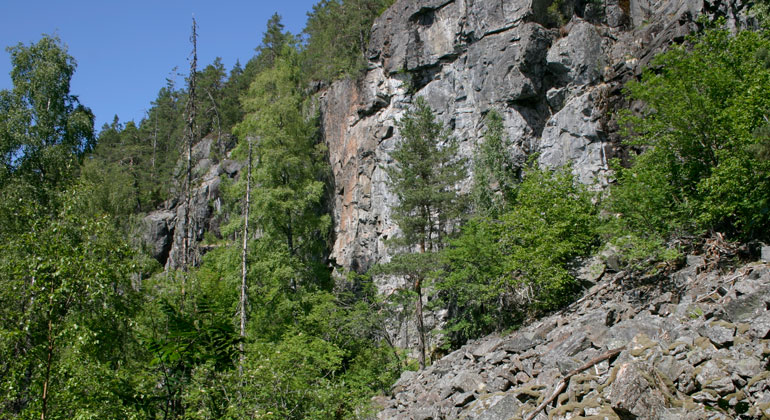
Tvärstupet is a vertical fault scarp approximately 50 meters high with large boulder fields below. A fault is a surface along which one block of rock has moved relative to another block. The block rises, sinks, or moves sideways. The elevation difference between the highest and lowest parts of the reserve is approximately 150 meters over a distance of about 500 meters.
Structure of the Rock Face
From the plateau above the hammer, water seeps through cracks in the bedrock down through the hammer, the rock cavity, and the scree slope to the spruce forest below, where it is encountered as percolating groundwater. The bedrock in the ravine consists mainly of ancient granite, but there are also veins of diabase porphyry, which is a basic and easily weathered rock type. Its salts dissolve in the seepage water and are supplied to the soil and vegetation in the ravine, the rock cavity, and the spruce forest below the cliff. Weathered material accumulates in the rock cavity, and a rich flora therefore grows in the humus soil.
Rich Flora Below the Cliff
The spruce forest below the cliff is permeated by moving groundwater and therefore harbors a rich flora with plants such as hepatica, baneberry, wood sorrel, wood lettuce, and stinking hellebore. The tree layer is dominated by spruce, but closest to the scree slope, there is a significant presence of deciduous trees. There is also a fair amount of hazel in the shrub layer.
Insects and birds of interest here
The insect fauna is very distinctive in this area and includes several relict species on linden and hazel, as well as sun- and heat-loving species with a predominantly southern distribution. An example of the former is the longhorn beetle Exocentrus lusitanus, whose larvae develop exclusively on linden.
Among the birds, the Tengmalm’s owl, Eurasian pygmy owl, spotted woodpecker, and three-toed woodpecker are found near the old deciduous trees below the landslide slope. The chiffchaff, willow warbler, and redstart breed in the old spruce forest, and ravens breed in the pine forest.
The entire reserve has been heavily influenced by human activity, including logging, past grazing, charcoal burning, slash-and-burn farming, and more.
Visitor Information
To visit the reserve, turn onto a gravel road about 2 kilometers south of Koppslahyttan that leads toward Stora Dammsjön. However, this road is blocked by a gate a short distance from the turnoff, but just before the gate there is a place to park on the left side. Please park in a way that does not obstruct passing traffic or disturb local residents. During the summer, the gate is open, and you can park at the turning area.
After walking about two kilometers along the gravel road, you’ll reach a turning area. From here, a forest road heads southeast. This road then merges into the trail that leads to the nature reserve’s information sign. The distance from the turning area to the nature reserve sign is about 700 meters.
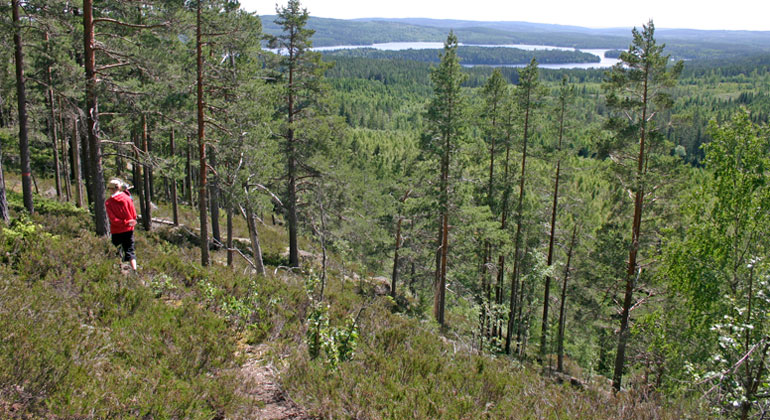
Within the reserve, there is a hiking trail that forms a loop approximately 1.2 km round-trip from the nature reserve sign and up around the cliffs. The trail is steep and challenging, as the terrain is somewhat difficult in certain sections.
Please note that the entire reserve is off-limits during the period March 1–July 31; see above.
Activities And Facilities
- Nature reserve
Facts
Bildades: 1976Storlek: 39haKommun: BorlängeFörvaltare: LänsstyrelsenNatura 2000: Ingår i EU-s nätverk av skyddad natur. Om Natura 2000
Directions
The reserve is located in the municipality of Borlänge, about 4 km southwest of the Romme Alpin ski resort.
Regulations
The following activities are not permitted in the reserve...
- disturbing wildlife (such as taking close-up photographs of bird nests, dens, burrows, or similar; climbing the tree itself or the tree where the animal lives),
- bring dogs that run loose,
- build fires,
- break twigs, cut down, or otherwise damage living or dead trees and shrubs,
- collect seeds or otherwise damage vegetation, for example by digging up flowers, grass, moss, or lichen,
- picking flowers, grass, moss, or lichen,
- picking berries in quantities exceeding those intended for immediate consumption,
- camping or setting up a trailer,
- setting up orienteering checkpoints or marked trails,
- driving motorized vehicles,
- erecting signs, placards, posters, billboards, or inscriptions,
- playing music, the radio, or other sounds in a disruptive manner.
Click on the nature reserve’s name and select the “Documentation” tab to view the documents.
Contact
Address
Email address
Organization logotype

Please be aware that some of these texts have been automatically translated.
I’ve been here
I want to go here
Questions & Answers
Ask a question to other Naturkartan users.
Reviews
0 reviews
- 5 :
- 4 :
- 3 :
- 2 :
- 1 :
Users images
No user images yet. Be the first to share!