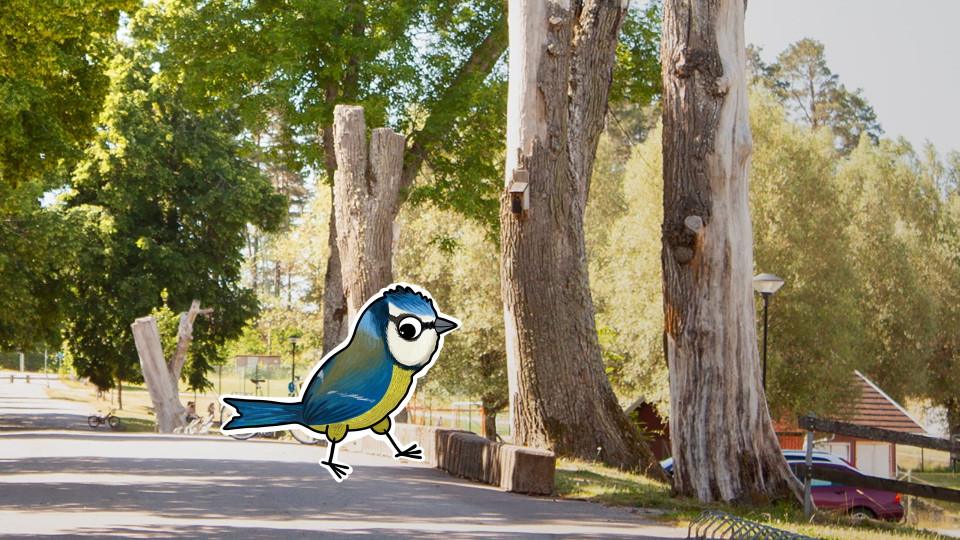
Avenues are scattered throughout our landscape. They usually consist of single or double rows of deciduous trees along a road, but they can also have several rows, occur outside the road network and also consist of conifers. In Åtvidaberg's urban area, the avenues are linked to the road network and consist of deciduous trees. The majority of the avenues were probably planted in the 19th or early 20th century. They have framed the important routes in the landscape, such as the road between Adelsnäs and Åtvidaberg or Linköpingsvägen into Åtvidaberg. The avenues in Åtvidaberg consist mainly of broadleaf trees, with elms being one of the major dominants. Avenues are protected under the Environmental Code, which is why an exemption from legal protection is required for measures that can lead to damage to its natural or cultural environment values.
Unfortunately, the avenues in Åtvidaberg underwent a dramatic change in 2019 to 2021. In 2019, the elm disease struck with full force and killed almost all elms in Åtvidaberg's urban area and many of the trees in the avenues in Åtvidaberg were elms. They were large trees with high natural values. A few avenues consisted almost entirely of elms, but many are mixed. The other tree species are still there. Elm disease led to removal and later replanting. Many of the elms with various cavities were saved as stumps, as were a small number of elms without cavities. Trees with cavities are often associated with high nature values where a large diversity of animals and fungi live on the decomposing wood. Some of the elms that were felled were placed in so-called fauna depots, which are piles of logs, coarse branches or brushwood that have been saved to benefit biodiversity.
Dutch elm disease (Ophiostoma ulmi) is a fungus that has spread almost worldwide. It first arrived in the Netherlands in the early 1900s with imported wood, probably from Asia, and was first found in Sweden in the 1950s. The fungus is spread by elm splinter borers. There are three species of elm splinter borer in Sweden, the greater elm splinter borer, the lesser elm splinter borer and one without a Swedish name (Scolytos scolytos in Latin). Dutch elm disease can also spread via the root system between adjacent trees. The elm splinter borer lives as larvae under the bark of adult, recently dead or dying elms where they develop and pupate. If the elm is affected by Dutch elm disease, the elm splinter borer, once it hatches into a beetle, can carry spores with it. They emerge from the bark and feed on the fine bark of twig tips on elms of all ages. They then mate and the female seeks out suitable elms where it gnaws out a passage under the bark where it lays its eggs. The beetle can spread Dutch elm disease either by gnawing on the bark or by laying its eggs, which means that elms of all ages can be affected.
There is another species of Dutch elm disease that has no Swedish name, it is called Ophiostoma novo-ulmi in Latin. It is more aggressive and came to Sweden in the 1970s. It has not been investigated which of the species killed the elms in Åtvidaberg.
Text for younger readers
Avenues are rows of trees that have been planted, often along roads or in parks around manors and castles. In Åtvidaberg we have many avenues along our roads. Most often it is broadleaf trees that have been planted such as oak, lime, ash and elm. Unfortunately, the elms in Åtvidaberg have died from a very aggressive fungus called elm disease. It has spread all over the world due to timber being brought to Holland in the early 1900s. The wood probably came from Asia and was already infected with Dutch elm disease. Dutch elm disease is harmless to Asian elms, but it is very aggressive to our elms. To restore our beautiful avenues, new trees are being planted instead.