
-
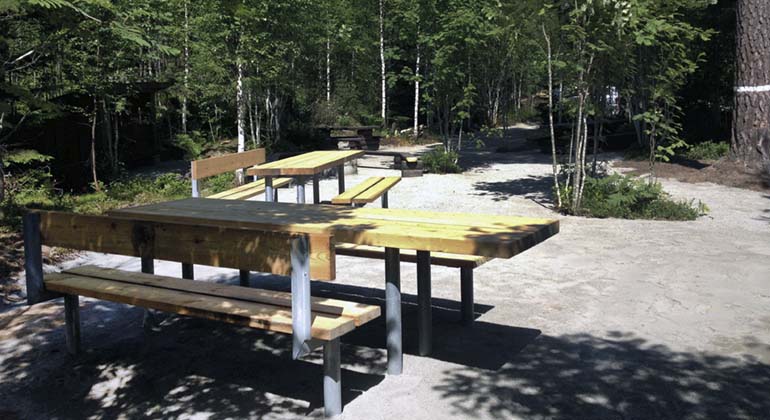
Entré med tillgängliga rastbord och grillplats, Skärmarbodabergen.
Photo: Länsstyrelsen -
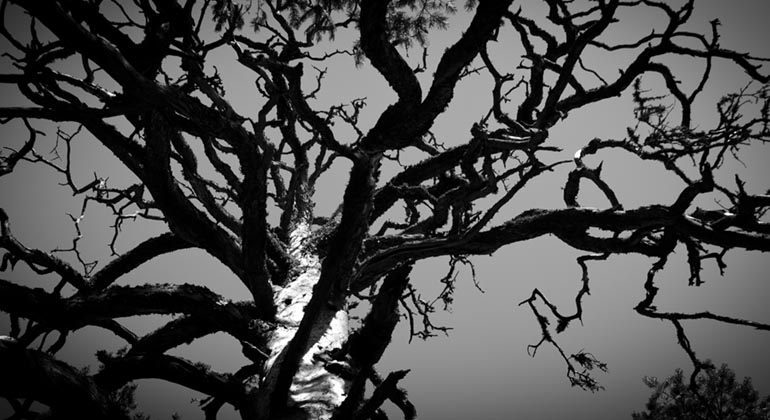
Grenverket i gammal, död tall.
Photo: Kristian Fossmo -
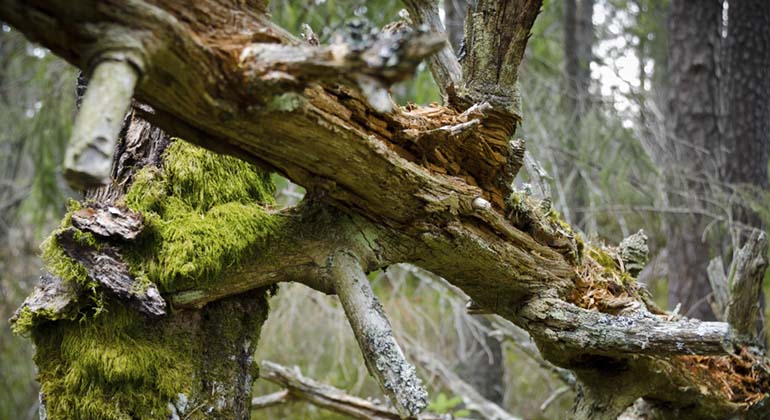
Död ved kryllar av liv, Skärmarbodabergen.
Photo: Kristian Fossmo -
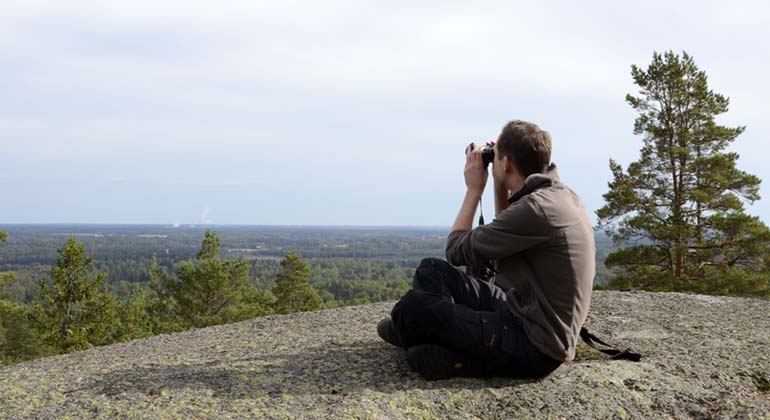
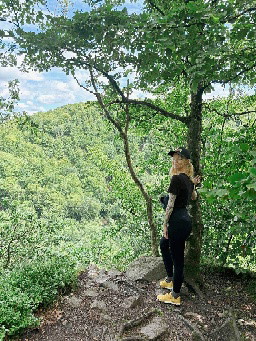
Utsikt från Suggan.
Photo: Elisabeth Karlsson -
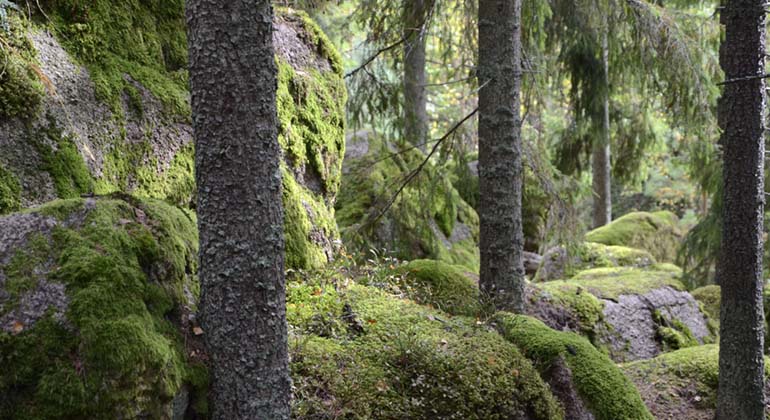
Blockig terräng i Skärmarbodabergen.
Photo: Elisabeth Karlsson -
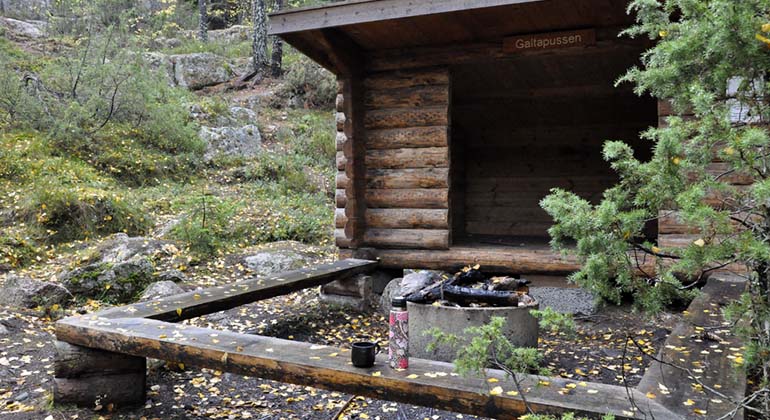
Vindskydd och grillplats vid Galtapussen, Skärmarbodabergen.
Photo: Elisabeth Karlsson
Skärmarbodabergen, Naturreservat
- Nature reserve
- County: Örebro län
Actions
Description
Skärmarbodabergen Nature Reserve is a unique and exciting place. Explore caves, rocky slopes and ancient pines - this is a real adventure land.
Steps in the mountain
The Skärmarboda mountains are home to several rift valleys and so-called fault lines. They were formed many millions of years ago when parts of the earth's crust moved and cracked. Sometimes the ground sank on one side and rose on the other, forming a large step. The whole of Kilsbergen is such a fault line.
A greeting from the ice age
Our last ice age held Scandinavia in its grip for millennia. Both the ice and its meltwater eroded the ground and formed new landscapes. In the Skärmarbodabergen mountains you can see ice-slicked rocks, large individual boulders and, above all, large accumulations of boulders. All of this is the work of the ice.
Here was once an open sea
When the ice sheet was slowly melting, there was open water all the way to present-day Russia. This sea is called the Yoldia Sea after a small clam that lived on the seabed. 11 000 years ago, the entire Skärmarboda mountain range was under water. The sea level here reached a maximum of almost 170 meters above today's level. When the ice melted away and its weight disappeared, the land rose out of the sea again. In fact, this land uplift is still going on today! By 10,000 years ago, the land had risen so much that the seashore was right here on the slopes of the Skärmarboda mountains. The sea waves hit the beach, washing away sand and gravel. Caves formed in the cavities between the boulders. The rocks on the beach were ground round, known as shingle. There are clear shorelines in the form of shingle fields along the entire edge of Kilsberg. In Skärmarbodabergen you can see such a shoreline if you look closely at the path at Galtapussen.
The dead trees are teeming with life
In Skärmarbodabergen, you can experience a forest that looks like forests did in the past, where trees grow and die, fall over and are broken down by insects and fungi. Many species that have been pushed aside in today's tidy and rationally managed forests thrive here. In particular, the dead, very large pine trees that stand alone in sunlit locations are a haven for a wide range of rare insects, fungi, lichens and birds. Only a few small and often twisted pines survive on the highest mountain peaks. In this barren environment, trees grow slowly. A pine tree whose trunk you can grasp with your hand can still be over 100 years old! In the reserve, there are stands of pine trees that are over 400 years old! In some places, the forest resembles a primeval forest. There are plenty of dead trees and branches here, where insects and fungi live and work on decomposition. Among the beetles, there is the scaly flatworm, which looks almost like a piece of wood. It is usually found in old pine trunks that are open and sunny. For it to thrive, the wood must first be decomposed by various ticks, such as the pine tick or the rarer orange-pink salmon tick.
Engine revving?
The insect-rich tree trunks are a tasty smorgasbord for many birds, especially various woodpeckers. Listen, you might hear a woodpecker drumming against a tree trunk. If you're around when it starts to get dark, you might hear the buzzing of the nightjar, reminiscent of the sound of a moped in the distance. It's a bird that's hard to spot during the day but is recognized by its distinctive song.
Traces of mountain farming
The rocky and difficult terrain has made it difficult to carry out forestry here. The more accessible areas have been farmed all the harder until a few decades ago. During the mining era, forests were an important raw material in the Bergslagen. Large quantities of charcoal were needed to smelt the iron ore in the local smelters. The nearest smelter was in Skymhyttan, just west of the nature reserve. Many crofters made a living by producing charcoal in charcoal kilns around the Bergslag forests. Here in the reserve there are remains of several charcoal kilns, known as kolbottnar. Traces of a charcoal hut can often be seen next to the charcoal hut, where the charcoal maker who guarded the mile lived.
Enjoy the berries and edible mushrooms of the forest
You know that you can pick both berries and edible mushrooms for domestic use in the reserve, right? But beware, not all berries are edible, the red squirrel berries are poisonous. Blueberries and crowberries are similar, but crowberries are a little less tasty and drier than blueberries.
Availability
At the entrance, there is parking reserved for people with disabilities. The entrance area is paved, as is the path from the parking lot. At the entrance there are several accessible picnic tables with space for wheelchairs and an accessible barbecue area, also with space for wheelchairs.
Fire and barbecue
Remember that it is only allowed to make fires at designated fireplaces (the entrance and at the windbreak at Galtapussen). Firewood is replenished regularly but we cannot guarantee availability at all times. Remember to burn in moderation, so that there is enough firewood for other visitors. If you want to be sure to be able to make a fire - bring your own firewood (it is not allowed to make a fire with sticks and branches from the forest in the nature reserve).
Paths and shelters
At Galtapussen there is a shelter with a fireplace. Within the reserve there is a total of just over 1 mile of marked path, divided into several path loops with individual color marking. The rocky terrain in the area can be demanding at times. There are several precipices in the area and in wet or icy weather there is a high risk of slipping. Along the trails in the southern Skärmarbodabergen there are audio guides accessible via telephone number or QR code in nine places (or via mp3 files). Brief information on the same sites is also available on small foldable information signs, some of which are adapted for children.
Take the bus to the reserve
Several of Länstrafiken's buses pass near Skärmarbodabergen, lines 300, 401 and 490 stop at the Skärmarboda stop just outside the nature reserve and 401, 406, 420 and 490 at the Lilla mon stop just north of the reserve.
Sign language information
Paths in Skärmarboda mountain
1 (dark blue) Lilla rundan 0,6 km
A mainly easy trail, with a hilly and slightly more difficult section just north of Skärmarbodagrottan. Along the trail, the landscape changes character. From open and barren rocky areas to wetter forest land to more open rocky areas again. Notice how the ice sheet has shaped the landscape: the ice-slicked rounded rocks and the large boulders that the ice has moved with it (drifting boulders). On the barren rocks, mats of various lichens and occasional pine trees grow. Be careful and follow the path, the lichens grow very slowly and cannot tolerate trampling feet. In the wetter parts, where the forest of both pine and spruce closes more tightly, the ground is covered with various mosses. There is a balance track at the entrance. Can you get around without touching the ground? Remember that parents are responsible for their children!
2 (green) Yoldiarundan 2.5 km (total from the entrance 3.1 km)
A relatively easy trail with elements of large boulders and hilly terrain. You pass the small water collection Galtapussen with shelter and barbecue area. In the path you see traces of the former shoreline in the form of rounded stones. At Södra utsikten (approx. 135 meters above sea level) you have a good view of Närkeslätten, all the way to Frövifors! At the Yoldia area, the forest closes in more tightly around large mountain ridges. Can you find your way into the Hall of the Mountain King? In the north, the path runs through open rocky areas with several really old pines and clear fault lines. On your way to and from the entrance you will also pass Lilla rundan (see above).
3 (purple) Bergsrundan 2.2 km (total from the entrance 5.6 km)
A slightly longer trail that is easy to walk after you have passed parts of Yoldiarundan. This is also the quietest trail in the reserve! Between Tandvärkstallen and Busberget you walk completely free from traffic noise. The path leads through alternating large boulders, closed forest areas and open rocky areas. Next to the path you will find Hoglösens stone, which is the largest boulder in the reserve! Also take the opportunity to enjoy the view at the two viewpoints. From Busberget (approx. 145 meters above sea level) you can see road 50 stretching through the landscape towards Lindesberg. From Signalberget, whose highest point is approx. 160 meters above sea level, you have a good view of Närkeslätten. At the bottom in the south stands the mighty Tandvärkstallen, dead for a few years and now a luxury hotel for bugs, fungi and lichens. The path also passes a clear fault line in the west, the so-called Bergsmuren. On your way to and from the entrance you pass parts of both Lilla rundan and Yoldiarundan (see above).
4 (red) Carlannersarundan 1.5 km (from Skymhyttevägen)
A partly very hilly path that, especially in the eastern parts, can be demanding and difficult to walk. On the heights you meet barren rocky areas, where almost only pine trees thrive, while the lower parts offer a more lush coniferous forest. Take a peek into the largest boulder cave in the area: Carlannersagrottan! From Stenmannens tron, a seating-friendly rock formation, the path descends steeply. Be aware of the risk of slipping when it is damp or icy! A little way into the spruce forest you'll find the remains of ancient coal production: coal beds from coal mines and the ruins of a coal hut.
5 (yellow) Utsiktsrundan 2.4 km (from Skymhyttevägen)
A relatively easy trail with the exception of some more difficult parts up and down from Suggan. Once up on Suggan's rounded rocks (about 140 meters above sea level) you have a brilliant view of Järleån's valley, Järle peat bog and all the way to Frövifors. Bring binoculars and look for birds! From the trail you can also go up to Källartjyven's cave and the large blocky area with block caves at several levels, the so-called Trappstegsgrottorna. Also worth seeing is the mighty Lockstenen, which balances over the path south of Suggan.
6 (light blue) Skogsrundan 2.7 km (from Lilla Mon)
A partly easy trail with blocky and hilly parts along the eastern parts of the trail. From Lilla Mon the trail extends south through an old coniferous forest. Notice all the "gnome beards" that drape the branches! These bearded lichens thrive best on old conifers where the air is clean and moist. The eastern part of the trail takes you through open rocky areas up to the primeval mountain Galten. From a height of about 150 meters above sea level, you have a good view of Närkeslätten towards Örebro.
Audio guides about Skärmarbodabergen
**Map of the audio guides
Production:
Production and narrator: Thomas Öberg, Natur i Norr. Co-narrators: Carl Anders Lindstén and Kjell Store.
The audio guide has been partly financed with funds from the European Agricultural Fund for Rural Development Link to another website.
Activities And Facilities
- Nature reserve
Facts
Municipality: Nora
Year established: 2009
Area: 221.7 hectares
Landowner: Sveaskog AB
Manager: County Administrative Board
Reserve creator: County Administrative Board
Directions
Skärmarbodabergen nature reserve is located just west of highway 50, about 20 km north of Örebro. The main entrance is opposite the large roadside rest area in Skärmarboda (on the other side of road 50). There are bus stops close to the reserve, which is served by several regional bus routes. Coordinates of the main entrance: 59.4543176,15.1330293 (WGS84), 6590649.86,507541.92 (SWEREF99).
Regulations
In the nature reserve it is forbidden to:
- Dig, hack, carve, paint or otherwise damage the surface of the earth or solid natural objects,
- Drive a motorized vehicle other than on a public road,
- ride a bicycle or horse other than on a public road
- Felling, removing or otherwise damaging dead standing or fallen trees or bushes,
- Damage vegetation in general, e.g. by digging up plants such as rice, grass, herbs, mosses or lichens.
- Without the permission of the County Administrative Board, put up a permanent board, sign, poster or mark a trail,
- Without the permission of the County Administrative Board, use the area for organized competitions or exercises, camp activities or similar,
- Without the permission of the County Administrative Board, make fires other than in any designated place.
Contact
Email address
Organization logotype
Please be aware that some of these texts have been automatically translated.
I’ve been here 10

I want to go here 4
Questions & Answers
Ask a question to other Naturkartan users.
Reviews
0 reviews
- 5 :
- 4 :
- 3 :
- 2 :
- 1 :
Users images
No user images yet. Be the first to share!