-
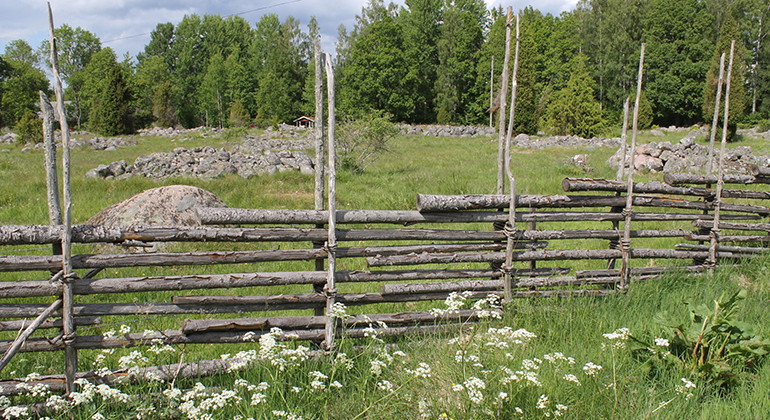
Photo: Anna Lindberg -
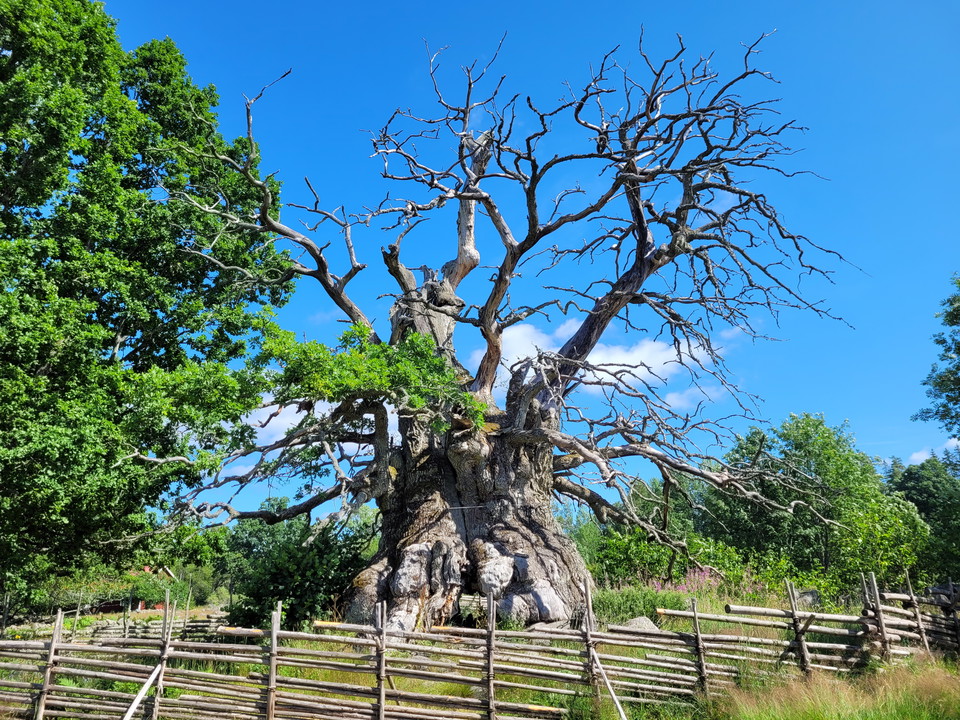
Foto: Coco Dedering -
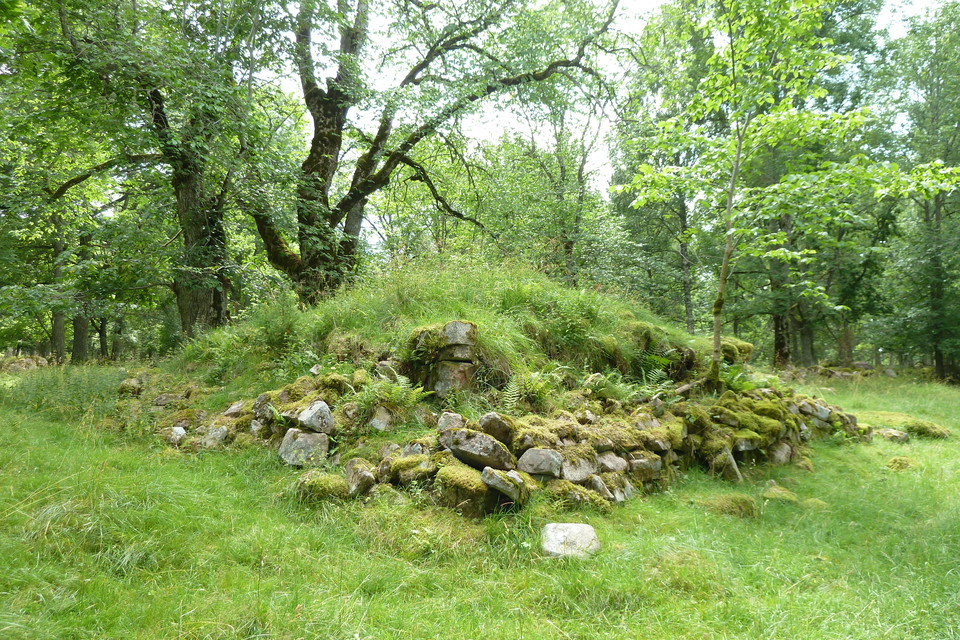
Foto: Anna Lindberg -
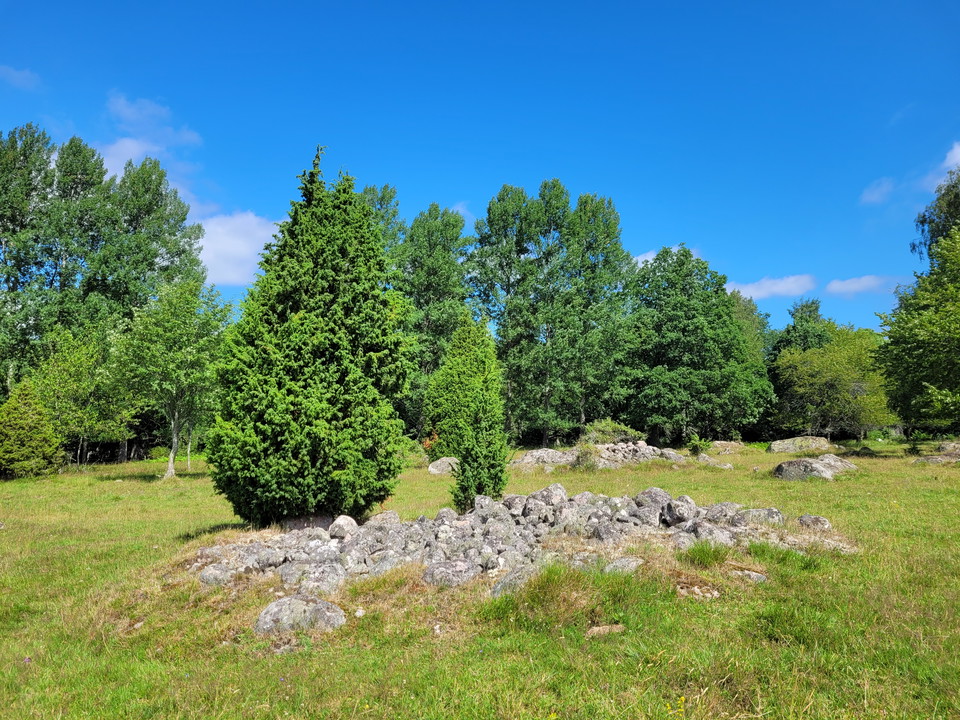
Foto: Coco Dedering -
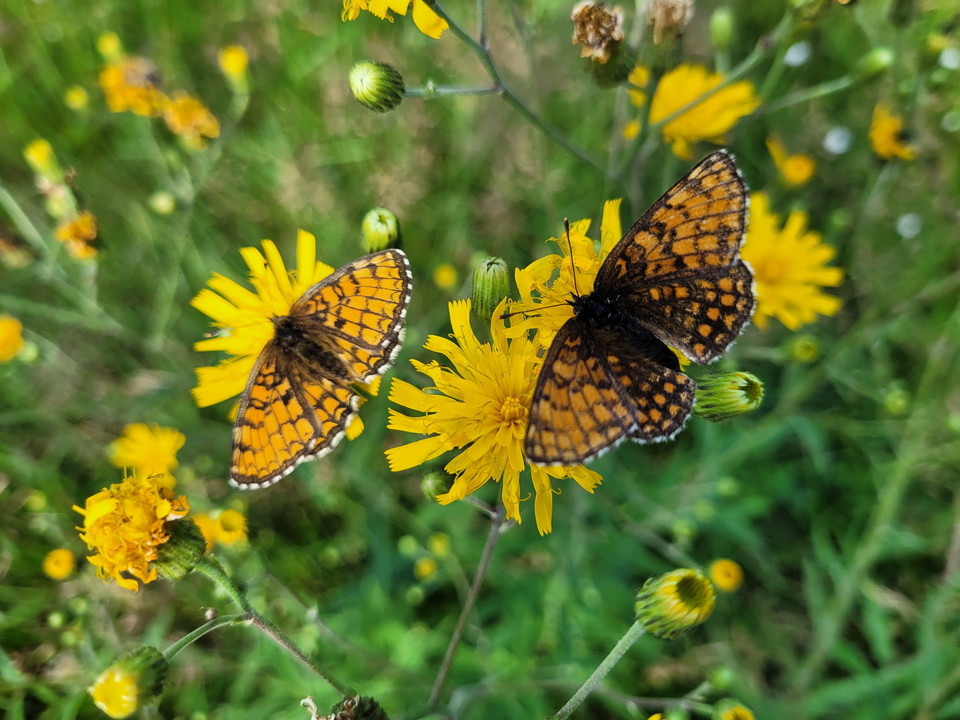
Foto: Coco Dedering
Kvill, Naturreservat
- Nature reserve
- County: Kalmar län och Öland
Actions
Description
In Kvill Nature Reserve you can experience a small-scale agricultural landscape, which was a common sight in these parts in the past. In the middle of the open fields stands the Kvill oak, Sweden's largest oak with a circumference of 14 meters. This is undoubtedly the country's most famous giant tree!
Famous tree
The Quince Oak, or Rumskulla Oak as it is also known, is not only Sweden's largest oak but probably also the oldest. It was declared a natural monument as early as 1928. When the age of the tree was calculated in 2014, it was found to be 850 ± 100 years. The tree may therefore have celebrated its 1000th birthday. In the past, the Kvillek was considered sacred and sacrifices were made under its crown. But the tree has also served as a tool shed over the centuries, so the view of the tree has changed!
More valuable trees
The quince may be the oldest tree in the nature reserve, but there are several other old deciduous trees here. Most are oaks, but ash, elm and maple also occur. The rough bark of the trees is a habitat for several unusual lichens such as yellow-spotted lichen, sooty lichen and elm lichen. The hollows that form in the trees over time are home to woodpeckers and starlings, among others.
Farmed land
In the wooded pastures there are several traces that testify to past human use. For example, you will see many piles of stones. The stones were painstakingly dug out of the ground and piled up in cairns. A lot of work has also gone into digging ditches. The cairns and ditches tell us that the pasture was previously used as a field.
Flower plumage
In summer, the open, bushy pastures are full of flowers. A feast for the eyes and a scent experience for us, and vital for all the insects that feed on the nectar of flowering herbs and shrubs. The most species-rich areas are the cairns and the south-eastern part of the open pasture. Haymaker's broom, red campion and maidenhair are just a few examples of flowers you may see. On still, sunny summer days, many different butterflies flutter around among the flowers, including the less common species of silver swift and lesser martin.
The Rumskullaeken - the largest and oldest
The Rumskulla Oak, or Kville Oak as it is also known, is Sweden's oldest and largest tree and one of the largest oaks in Europe. Its girth at breast height is 14 meters. At the end of the 1930s, a careful study was carried out to determine the age of the Kvillek oak, which came to 950 years. This means that it is now over 1000 years old and is probably the country's only millennial oak.
A thousand years ago, Sweden was populated by Vikings, and it was over five hundred years before Gustav Vasa would become king. A thousand years ago, the Kvillek was also a small plant. Now it is a stately monument to the old agricultural landscape, and to our history. It is now completely hollow and is today supported by a wire construction so as not to be torn apart but to survive and be experienced by visitors in the future.
The oak was previously a natural monument but is now part of the Kvill nature reserve and is located about two miles NW of Vimmerby. Drive towards Rumskulla from Vimmerby or Mariannelund and turn towards Norra Kvill National Park. From here the road is signposted to the oak. Parking with toilet is available next to the reserve and the footpath to the oak is accessible. There are picnic tables next to the oak.
The oak's faltering health
Since 2012, the well-known Kville Oak has shown increasingly faltering health. Analyses have pointed to several reasons for the tree's deteriorating condition:
- The iron band that used to be around the Quince tree made it difficult to transport nutrients between the crown and the roots.
- In 2012 and 2013, the Kvillek suffered from severe infestations of the oak leaf miner butterfly whose larvae consumed oak leaves. With fewer oak leaves, the tree produced less carbohydrates for the roots.
- Due to reduced transport of carbohydrates from the Kvilleken's foliage, the roots have partially died. With a reduced root system, less nutrients have been able to be taken up from the ground to be carried up to the crown. This in turn has led to a further reduction in the tree's foliage.
- In addition, the Kvillek suffers from the fungal disease powdery mildew. This disease has probably weakened the tree even more.
Several measures to save the Quince have been implemented by tree care experts.
In 2013, the previous iron band was replaced with a new type of wire construction that is more gentle on bark nutrient transport. A layer of finely divided hardwood chips, known as mulch, has been added to the soil. This layer is intended to supply the roots with nutrients at an appropriate rate while protecting the surface roots from trampling damage. The foliage has been sprayed with a special organic algae extract to create more green leaves, which in turn can generate more carbohydrates down to the oak's roots. The County Administrative Board continuously monitors the status of the tree and assesses on an ongoing basis whether there is a need for further action.
Since many visitors climbed the tree, which led to damage, it is no longer allowed to get closer to the oak than the chain-link fence that surrounds the oak. Due to the now rather poor condition of the oak, several of the rough branches are dead or dying and there is a risk of these falling down. To prevent damage to visitors, a wooden fence has now been built at a safe distance from these branches. Please respect this boundary for your own safety and that of the oak.
The oak in history
The Rumskulla oak was described as early as 1772 by the bailiff Magnus Gabriel Craelius in his book "Försök till ett landskap beskrivning". As early as 230 years ago, people could stand inside the tree and use it as a tool shed. Craelius wrote: "At the time of the famous dying of the dykes, and within 150 years after the same, the largest oaks growing here in the town seem to have first run up out of the ground, and there are still some that are older, among which one that is still fresh and stands on the Lieutenant's residence Norra Qvill's property, is remarkable, because the same is 22 cubits around the trunk; she is now hollow; and I myself have stood inside her for eight years; the farmers on the estate use her otherwise, as a tool shed, to store oars, harrows and hedges."
The oak - home for many
The oak (Quercus robur) is considered to be the organism that provides living space for most other species in our country. This is not really surprising. Its size creates many different microenvironments and it grows very old. Habitats found in old oaks include cavities, different stages of dead wood, the living wood, the roots, the canopy with leaves and saplings, the sunlit trunk with crevices and cracks, and the shaded side of the trunk with a much cooler climate. All of these environments are home to different species. In cavities in the tree, so-called mulm is formed. This is the sawdust-like remains of gnawing, droppings, bird nests and more. Oak mulch is home to many rare insects. It is mainly lichens, fungi and insects that use the oak as a habitat. At least 1500 different species are more or less dependent on oak trees. Most of these live in and on open giant oaks.
Activities And Facilities
- Nature reserve
Facts
Decision year: 2007
Area: 29.4 hectares
Municipality: Vimmerby
Landowner: Swedish Environmental Protection Agency
Administrator: Kalmar County Administrative Board
Directions
Kvill is located quite close to the National Park Norra Kvill, about two miles NW of Vimmerby. Drive towards Rumskulla from Vimmerby or Mariannelund. At the village of Venzelholm there is a sign for Rumskullaeken/Kvilleken. The reserve has a parking lot and from the parking lot to the oak there is a 125 meter long accessible trail. Part of the Sevedeleden trail runs through parts of the pastures.There are nice picnic furniture in the parking lot and by the oak. Don't miss another big tree while you're here! In the south-eastern part of the reserve there is a small footpath to a real pine giant that is now down but which is probably several hundred years old!
Regulations
In the nature reserve you are not allowed:
- Enter the fenced area where the Kvilleken stands.
- Drive a motorized vehicle outside designated roads or paths.
- Park a vehicle, caravan or trailer in a place other than designated parking spaces.
- Camping.
- Riding horses, driving horses and carriages or similar outside designated roads or paths.
- Deliberately disturbing wildlife.
- Bringing dogs or other animals that are not on a leash.
- Make a fire.
- Picking or damaging mosses, lichens or wood fungi.
- Digging or pulling up vascular plants.
- Damage or remove trees, stumps, bark, branches, shrubs or brush that are growing or dead.
Full regulations
C. Regulations for the public according to Chapter 7, Section 30 of the Environmental Code on the right to travel and stay in the reserve and on order in general within the reserve.
It is forbidden to enter the reserve:
- enter the fenced area where the Kvilleken stands.
- drive motor vehicles other than on existing roads.
- park a motor vehicle, caravan or trailer other than on specially designated roads and places
- camping
- riding or driving horse-drawn vehicles other than on existing roads
- disturbing wildlife
- Bringing an unleashed dog or other loose pet.
- Build a fire.
- Picking or damaging wood fungi, mosses or lichens.
- Digging or pulling up vascular plants.
- Damage or remove growing or dead trees, stumps, bark, branches, bushes or brush.
The regulations under C do not apply to owners or holders of special rights to property.
Contact
Email address
Per Markus Jönsson
Organization logotype
Please be aware that some of these texts have been automatically translated.
I’ve been here 9

I want to go here 5
Questions & Answers
Ask a question to other Naturkartan users.
Reviews
0 reviews
- 5 :
- 4 :
- 3 :
- 2 :
- 1 :
Users images
No user images yet. Be the first to share!