
Ullahau, Naturreservat
- Nature reserve
- County: Gotlands län
Actions
Description
Mighty sand dunes and small pits with predatory ant lions await those who venture into Ullahau Nature Reserve.
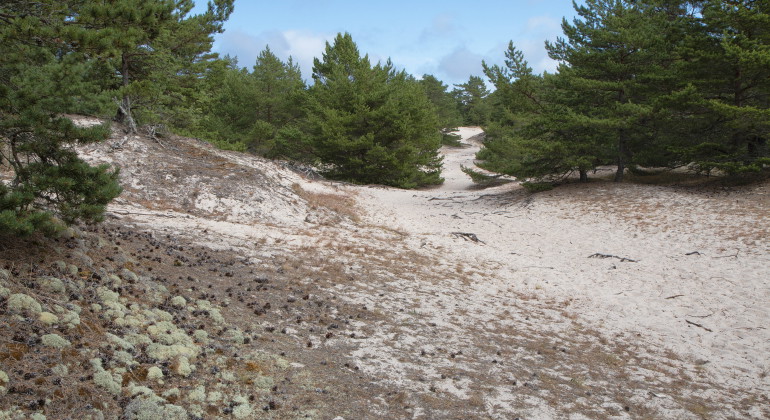
Ullahau is a large, horseshoe-shaped sand dune that is part of the large flying sand area that covers almost all of Avanäset. At its highest point, the dune rises more than 15 meters above the surroundings. The Ullahau dune probably began to form in the first half of the 18th century, probably as a result of excessive logging and grazing. On its way south, the sand smothered large areas of forest, and some arable land was also sanded over. In the early 1900s, intensive planting efforts were launched to stem the flow of sand, and just a few decades later the dune's migration was largely halted. Nowadays, Ullahau is largely covered with forest - mainly pine forest - and the open sandy areas total only about 40 hectares.
The flora in Ullahau is generally species-poor. The open sandy areas are dominated by lichens, mosses, grasses and sedges. Here and there, between the tufts of grass, there are occasional specimens of knapweed or monkshood. Inside the forest, the ground is often covered with heather or bilberry.
The open sandy soils of Ullahau are a very special habitat with a microclimate that is extreme in many respects. This has an impact on the area's insect fauna, which is unusually rich in heat-demanding dryland species. These include a number of species of wasps, some of which, including the large grasshopper wasp, are extremely rare in our country. In Ullahau you can also meet all three of our Swedish species of ant lion and especially their larvae, the ant lion. The ant lion is buried in the sand at the bottom of a funnel-shaped pit. When an ant or other bug accidentally falls into the pit, the ant lion splashes sand on its victim so that it slides further and further down towards the bottom of the pit. Eventually, the ant lion grabs its prey with its long, spiny jaws and drags it into the sand.
Activities And Facilities
- Nature reserve
Facts
Year of protection: 1966
Parish: Fårö
Characteristics: Sand dunes
Area: 143 hectares
Landowners: Private
Administrator: County Administrative Board of Gotland
Type of protection: Nature reserve and Natura 2000
Regulations
For everyone's well-being and to maintain the reserve's natural and cultural values, it is important that all visitors show consideration. In addition to the right of public access, it is not allowed to:
- drive a motorized vehicle,
- camp or set up a caravan,
- make a fire,
- put up a board, sign or poster,
- collecting insects.
Contact
Email address
Länsstyrelsen i Gotlands läns naturvårdsförvaltning
Organization logotype
Please be aware that some of these texts have been automatically translated.
I’ve been here 11





I want to go here 1
Questions & Answers
Ask a question to other Naturkartan users.
Reviews
0 reviews
- 5 :
- 4 :
- 3 :
- 2 :
- 1 :
Users images
No user images yet. Be the first to share!