
Ryssnäs, Naturreservat
- Nature reserve
- County: Gotlands län
Actions
Description
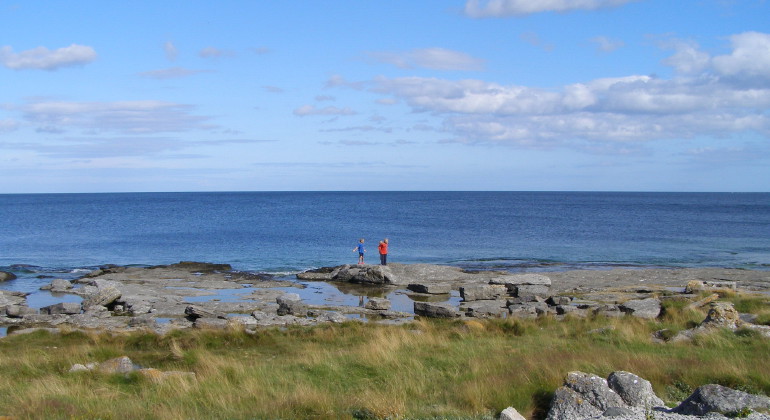
There is pine forest, alvar land, bare shingle fields, agmyrar, beach meadow and a peat bog. But also cloudberries, spider flowers, figs and an English cemetery! Ryssnäs has a lot to offer.
Ryssnäs is a 200-hectare nature reserve located on the southern tip of Fårö. Even the name suggests that there is something special about this nature reserve. It is likely that this was a place where Russian merchant ships sailed long ago. The cape in the far south has been named Ryssudden.
The vegetation at Ryssnäs is dominated by pine forest alternating with alvar fields and bare shingle fields. Common plants in the drier parts of the reserve are tulkört, backstimjan, bridebread, yellow, white and angular fat bud, earth, nodding and thistle, buttercup, little fingerwort, stand, sunflower, yellow and white moon, small bluebell, axveronika, royal candle and cat's foot. The shrub layer is completely dominated by junipers. Within the area there are a few agmires, of which Hyluvät is the largest. Inside Häjdeviken there is a small meadow area. An extremely odd plant feature at Ryssnäs is the fig tree (!) that stands in a cairn at Ryssudden.
Graunkullamyr is one of Gotland's few peat bogs, and the bog is Gotland's only habitat for cloudberries. In this relatively calcareous environment, you can also find species such as linnéa, eye pyrola, spiderwort and knotweed.
The southernmost part of Ryssnäs has a rich bird life. Large numbers of gulls, sandwich terns and little terns nest here, as well as waders such as curlew, redshank, lapwing, greater sandpiper and redshank. Other bird species that nest in the reserve are eider, graylag goose, crane and woodlark.
Especially in the northern part of the reserve, there are plenty of old pine trees, which has created conditions for a rich fauna of wood-living insects. Among other things, you can meet one of our country's largest beetles, the blacksmith's beetle. Grazing lambs have characterized the landscape for centuries and a few small houses with roofs to protect the lambs, so-called lambgift, have therefore been built.
Besides Russia, another country has left its mark on the isthmus. During the Crimean War of 1853-1856, between the Russian Empire and an alliance including Britain and France, British and French naval units used Fårösund as a base in the Baltic Sea. During the war, several hundred ships, both warships and others, called at this port. At the end of August 1854, a cholera epidemic broke out in Fårösund, an epidemic that mainly affected the crews of the ships in the harbor. In connection with this, two sick barracks were erected on the outside of Ryssnäs, and near the barracks the English bought a piece of land to use as a burial ground. Some 20 English sailors were laid to rest here.
Activities And Facilities
- Nature reserve
Facts
Year of protection: 2009
Parish: Fårö
Character: Mosaic
Area: 212 hectares
Landowner: Swedish Environmental Protection Agency
Manager: County Administrative Board in Gotland County
Form of protection: Nature reserve and Natura 2000
Regulations
For everyone's well-being and to maintain the reserve's natural and cultural values, it is important that all visitors show consideration. In addition to the right of public access, it is not allowed to:
- drive a motorized vehicle other than on the roads and parking spaces designated
- set up a caravan
- break branches or otherwise damage living or dead trees or bushes
- deliberately injure, kill or collect animals
- during the period March 15-July 15, stay in the parts of the nature reserve that constitute an animal protection area. See marking on the map
Contact
Email address
Länsstyrelsen i Gotlands läns naturvårdsförvaltning
Organization logotype
Please be aware that some of these texts have been automatically translated.
I’ve been here 7

I want to go here 1
Questions & Answers
Ask a question to other Naturkartan users.
Reviews
0 reviews
- 5 :
- 4 :
- 3 :
- 2 :
- 1 :
Users images
No user images yet. Be the first to share!