
-
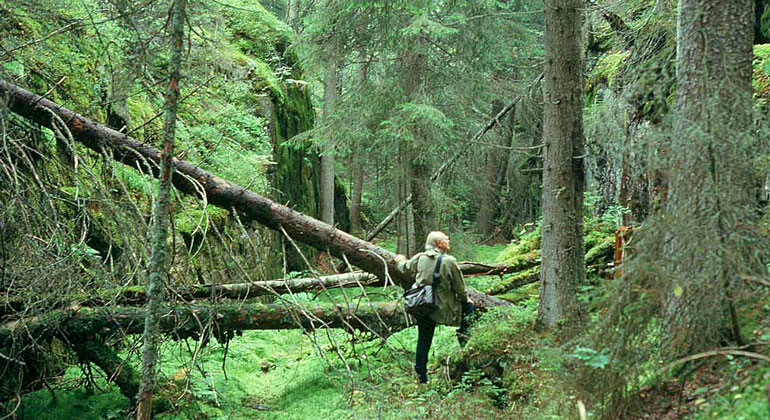
Photo: Uno Skog, Länsstyrelsen i Dalarnas län
Gravbergsdalen, Naturreservat
- Nature reserve
- County: Dalarnas län
Actions
Description
The valley consists of a 600-meter-long fault line. At the bottom lies a small, untouched spruce forest. Above the fault line grows a mixed forest.
A Fault Created by Movements in the Earth’s Crust
The Gravberget fault was formed long ago during an eventful period in the Earth’s geological history. Violent movements in the Earth’s crust caused large faults to form in the bedrock. Over the millions of years since the fault in Gravberget formed, it has widened due to weathering and erosion. Today, the fault valley is at most 10 meters deep and 5–10 meters wide.
Old spruce trees nourished by gabbro
The nature reserve is home to an old coniferous forest of spruce and pine. The pines are around 200 years old. The trees are large and majestic, and the vegetation is somewhat richer than in the surrounding area because the bedrock consists of gabbro. This is a basic rock type that provides nutrients to the soil. The forest contains plenty of decayed, fallen tree trunks—logs—and standing dead trees—deadwood.
Teeming Life After Death
The decayed wood is valuable for the forest’s diversity of plants and animals. Between 6,000 and 7,000 of Sweden’s forest-dwelling species depend on dead wood at some point in their lives. Many of these wood-dwelling species are fungi. In the nature reserve, you can easily find common polypores such as the tufted polypore, the violet polypore, and the sticky polypore. A trained eye can also spot rarities like the woolly polypore and the cream polypore.
Activities And Facilities
- Nature reserve
Facts
Bildades: 1996Storlek: 9 haKommun: SmedjebackenFörvaltare: LänsstyrelsenNatura 2000: Ingår i EU-s nätverk av skyddad natur. Om Natura 2000
Directions
The area is located about 5 km east of Björsjön.
Regulations
Within the reserve, it is not permitted to...
- damage the ground or geological features,
- damage living or dead trees and shrubs—whether standing or fallen—or pick or dig up herbs, mosses, lichens, and wood-decay fungi,
- light fires,
- catch or collect invertebrates,
- introduce plant or animal species that are native to the area,
- drive motorized vehicles off-road.
- disturb wildlife, for example by climbing nesting trees or intentionally staying closer than 100 meters to a bird of prey’s nest, den, or lair,
- bring an unleashed dog.
Click on the nature reserve’s name and select the “Documentation” tab to view the documents.
Contact
Address
Email address
Organization logotype

Please be aware that some of these texts have been automatically translated.
I’ve been here
I want to go here 2

Questions & Answers
Ask a question to other Naturkartan users.
Reviews
0 reviews
- 5 :
- 4 :
- 3 :
- 2 :
- 1 :
Users images
No user images yet. Be the first to share!