Lillagärde, Naturreservat
- Nature reserve
- County: Blekinge län
Actions
Description
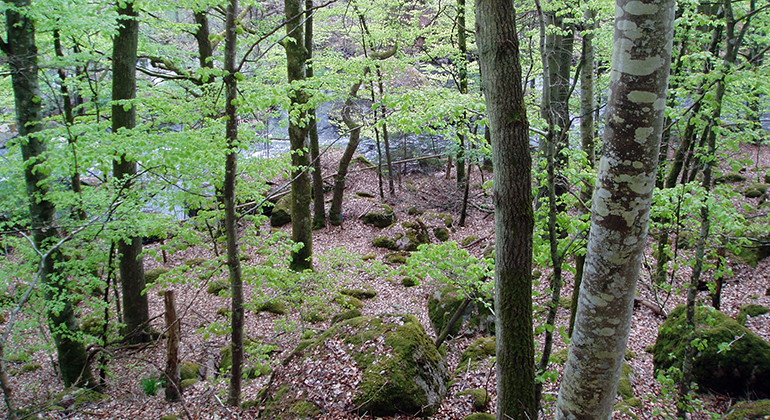
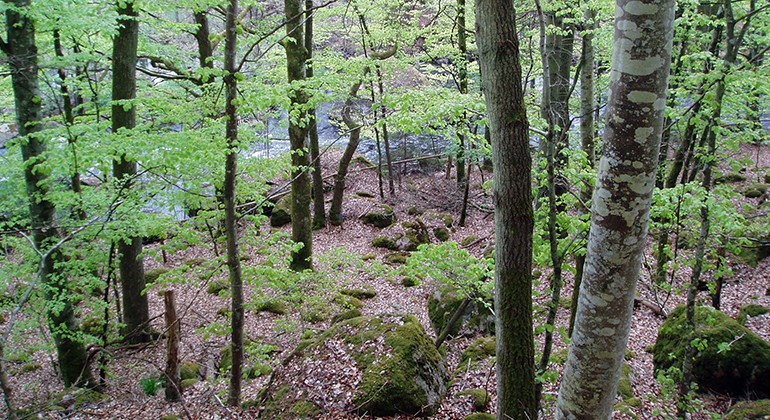
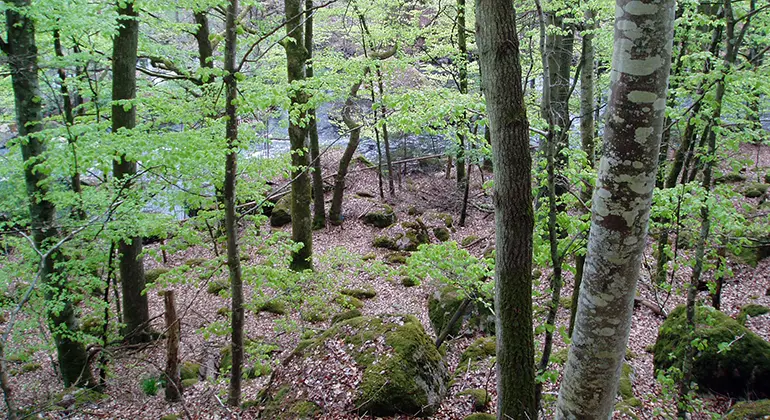
You can experience the varied nature of broadleaf forests and wooded pastures when you visit Lillagärde nature reserve. The area has restored pastures and an old riverside meadow. The river pearl mussel is a protected species that lives in Bräkneån.
A steep ravine extends down towards Bräkneån in places, and the eastern boundary of the reserve runs through the middle of the river. During an inventory of Bräkneån in 2005, it was discovered that both the thick-shelled mussel and the river pearl mussel are rejuvenating in the river.
Varied nature
Beech, oak and hazel are the dominant tree species in the forest areas. The flora is rich, especially in the lower parts closest to Bräkneån and in the ravine down to the river. Here you will find, among other things, thistle, cowslip, musk madder, lungwort and lesser witch hazel.
The large fern safflower thrives along the riverbank, as well as hemp flake, torch flower, meadowsweet and marsh willow.
Rich bird life
The varied nature is the reason why many bird species thrive in the nature reserve. Warblers such as thrushes, tits and chaffinches dominate. Great spotted woodpeckers help to create nesting sites for other birds that nest in hollows in trees. Black-tailed godwit and stonechat are two species peculiar to deciduous forests and they are found here. Chiffchaffs occasionally appear by the river.
Red-listed mussel species
Two species of mussels that are red-listed live in the river, the thick-shelled mussel and the river pearl mussel. The pearl mussel is also a specially designated Natura 2000 species. There is an action program for the conservation of the river pearl mussel that lives in the river.
To survive, mussels depend on good water quality, unclogged bottoms and the presence of host fish. The host fish of the pearl mussel are trout and salmon. The mussels depend on host fish because their larvae live as parasites on the gills of fish while they develop into small mussels. When the mussels let go of their gills, they are carried by the current and land on the bottom where they burrow between gravel and rocks and develop further.
Activities And Facilities
- Nature reserve
Facts
Year of protection: 1987
Municipality: Ronneby
Character: Valley, ravine, river, deciduous forest and pastures
Area: 14 hectares, of which 13 hectares are land and 1 hectare water
Landowner: Lund diocese
Trustee: Blekinge County Administrative Board
Type of protection: Nature reserve and Natura 2000
Directions
From the E22, take the exit towards Bräkne-Hoby. Drive through the community and turn left after one kilometer towards Björkeryd. After two kilometers, turn right at the sign "Naturreservat". After one kilometer, turn left at the sign "Lillagärde naturreservat". After another kilometer there is a small parking lot.
Regulations
You are welcome to visit Lillagärde, but please note that it is not allowed to
- destroy or damage any fixed natural object or surface formation
- unduly disturb wildlife
- let dogs loose in the area
- start a fire
- digging up plants
- picking flowers between April 1 and July 1
- use a radio, tape recorder or similar device in a disruptive manner
- camping or setting up a caravan.
Contact
Email address
Länsstyrelsen Blekinge
Organization logotype
Please be aware that some of these texts have been automatically translated.
I’ve been here
I want to go here
Questions & Answers
Ask a question to other Naturkartan users.
Reviews
0 reviews
- 5 :
- 4 :
- 3 :
- 2 :
- 1 :
Users images
No user images yet. Be the first to share!