-
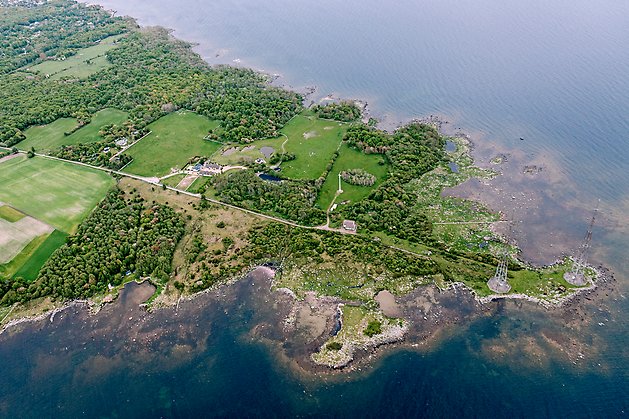
Photo: Flygfoto Bergslagsbild maj 2015
Björkenabben, Naturreservat
- Nature reserve
- County: Blekinge län
Actions
Description
At Björkenabben, marine underwater environments meet grazed coastal meadows and a deciduous forest rich in biodiversity. Here you can walk freely in lush forest or in open pastures.
Björkenabben is a flat headland bordering the sea in Hanöbukten. The area forms the "tail" of a drumlin formation at the remnant mountain Stiby backe, which is north of Björkenabben. The area contains a number of different natural environments, such as grove-like broadleaf forests with elements of swamp forest, small waters and tree-covered pastures, shrub-rich land and extensive seashore meadows.
Marine reefs
Occasional harbor seals can be seen foraging in the bays and environmental monitoring shows that the critically endangered Baltic Sea porpoise moves along the Blekinge coast in winter, even off Björkenabben. The marine reefs off the cape have been studied in recent years by Linnaeus University. The bottom is mostly free of vegetation, but areas with eelgrass or sawgrass and bladderwrack occur. The deep hard bottoms were dominated by the red algae crayfish.
The lush beech forest
The forest on Björkenabben consists mainly of nutrient-rich beech forest. The tree layer consists mainly of beech, hornbeam, alder, oak, ash, occasional elm and birch. Spring-affected wetland areas and small, hydrologically unaffected swamp forests with a forest-framed water table and elements of hazel, sometimes old and coarse, contribute to the area's diversity. The varied nature of Björkenabben attracts a large number of birds and several species of bats occur.
Remains from the Iron Age
Björkenabben's history stretches far back in time. There are remains from the Iron Age alongside stone walls and fortifications from the post-war period.
Beach meadows and grazed scrubland
Extensive salt meadows stretch around most of the headland, with narrower strips of blocky beach between the forest and the sea in the northeast. The seashore meadows provide valuable habitat for breeding birds. The area also has sedge meadows with a high proportion of sloe and characteristic dry meadow flora such as almond blossom, thrift and clove. Both coastal meadows, grassland and much of the broadleaf forest are grazed by cows.
Activities And Facilities
- Nature reserve
Facts
Protection year: 2022
Municipality: Sölvesborg
Characteristics: Coastal beech forest, wooded pasture, alder-ash swamp forests, shrubby pastures, postglacial sea walls, marine reef environments, shallow bays, open beach meadows, outdoor recreation, cultural environment.
Area: 143.8 hectares, of which 72.5 hectares are land and 71.3 hectares water
Landowner: private
Manager: Blekinge County Administrative Board
Form of protection: Nature reserve and partly Natura 2000 (in the south)
Directions
The reserve is located south of the village of Hällevik, in the direction of Grönslätt. You can travel here by bus from Sölvesborg, but you have to walk the last bit. The nearest bus stop is "Stiby backe" on the way to Hällevik, two kilometers north of the nature reserve.Take off from the E22 at the Listerlandet traffic junction (47) and follow Hälleviksvägen (road 123) for about 6 kilometers. Turn right on Stibyvägen and continue straight ahead towards grönslätt for 4 kilometers.
Regulations
You are welcome to visit Björkenabben, but please note that it is not allowed to:
- damage the ground or seabed, destroy or damage any fixed natural object or surface formation,
- drill, hack, blast, carve, dig, paint or in any way damage rock, soil or stone, or to relocate or remove stone,
- damage stone walls and other cultural heritage sites
- deliberately harming or disturbing wildlife
- capture or collect plants, fungi or animals in such a way as to damage or destroy their habitats
- damaging living or dead, standing or lying trees and shrubs, removing or burning dead wood
- damage bottom vegetation
- picking mosses, lichens or woody fungi, other than what is reasonably necessary for species identification. However, edible mushrooms may be picked for personal use,
- digging up or pulling up vascular plants
- plant, sow or propagate plants, animals, fungi or other organisms
- bring an unleashed dog, other than when herding livestock and hunting and when searching for injured animals
- drive motor vehicles, ride or cycle other than on existing roads within the reserve,
- park other than in a parking lot allocated for the purpose. Motor vehicles, motorhomes, caravans or similar may be parked here for a maximum of one day,
- camp or otherwise camp for more than two days, make fires or use barbecues, other than in a specially prepared barbecue area.
Without permission from the county administrative board, you may not either:
- conduct scientific research involving sampling, marking, trapping, installation of equipment or any form of impact on plant or animal life. Collecting by destructive methods, such as destroying substrate, is prohibited,
- using the area for competitions, exercises, events or other organized activities that may disturb nature or the public's outdoor life
- put up a board, poster, poster, sign, signpost, trail marking, inscription or similar device, other than temporarily (for a maximum of one week) in connection with hunting or organized outdoor activities.
Contact
Email address
Länsstyrelsen Blekinge
Organization logotype
Please be aware that some of these texts have been automatically translated.
I’ve been here
I want to go here
Questions & Answers
Ask a question to other Naturkartan users.
Reviews
0 reviews
- 5 :
- 4 :
- 3 :
- 2 :
- 1 :
Users images
No user images yet. Be the first to share!