-
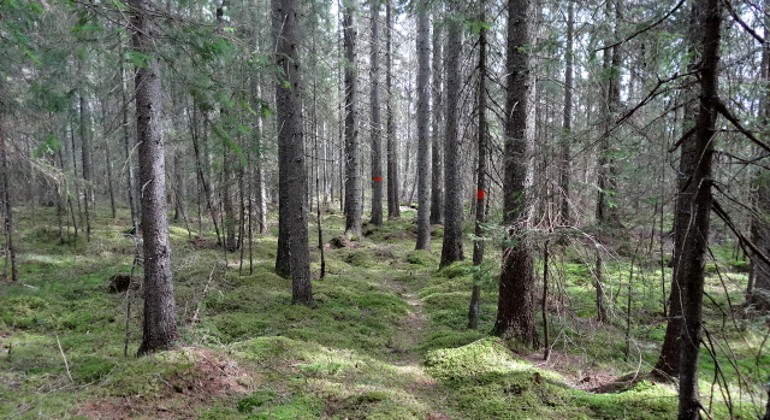
Stig genom granskog. Foto Björn Nilsson.
Flatsmossen, Naturreservat
- Nature reserve
- County: Värmlands län
Actions
Description
The area includes everything from lime-affected marshes with rich flora to vast nutrient-poor bogs.
The reserve consists of a wetland complex that mainly includes Flatmossarna, Sätermossarna, Dyvelmossen and Sågemossen. There is also some forest and a lake. The area is hilly in the northeast, while it is otherwise more flat with depressions and long slopes.
The fact that the bogs are mostly raised bogs can be seen when you walk the path across the reserve, where the land along the path is significantly lower than the surrounding bogs. The area has a strong wilderness character and high natural values. These are mainly linked to the untouched moorland, but there is natural forest on some of the mainland islets.
The Dyvel bog, with its deep, dark pools on the bog floor, shows that it belongs to the type of pools, which otherwise has a more eastern distribution in the country.
The eastern part of Flatsmossarna itself lies in a narrow depression along Långemyråsarna. Here the bog has formed what is known as a string fen - a type of bog that is common on large Norrland bogs, but is rare in the south.
The reserve was established to preserve a diverse bog complex intact. The area is part of the EU's network of valuable nature, Natura 2000, and has been protected with the support of the EU's LIFE nature conservation fund.
Animals and plants
The vegetation on the bog is characterized by species that can cope with very nutrient-poor conditions, such as dwarf birch, heather and porc. It is also home to all three of our species of reed canary grass, which catch insects as a nutrient supplement. In the mudflats, the two aquatic plants, pondweed and watermilfoil, do the same thing. The vegetation of the fen is richer. Here you can find orchids such as marsh marigold, coralroot and rich populations of meadowsweet. In some places, precipitates of the mineral iron ochre are visible above the vegetation. With a little luck, you may find the beautiful yellow parasol moss growing on moose droppings.
Cranes, greenshanks, wood sandpipers, golden plovers, black grouse and snipe are among the bird species encountered during visits. The forest areas are also home to capercaillie, great and lesser spotted woodpecker and three-toed woodpecker. Among the birds of prey, buzzards, sparrowhawks, goshawks and kestrels have been noted.
The fish community in Lake Stora Flat is made up of perch, roach and rudd.
Culture
Within the reserve area there are four Stone Age settlements along the eastern shoreline where both tools and rejects from the manufacture of flint or quartz tools have been found.
Activities And Facilities
- Nature reserve
Facts
Established: 1997
Size: 228 hectares
Landowners: Companies
Manager: County Administrative Board of Värmland
Directions
The reserve is located in Värmlands län, Årjäng municipality, about 5 kilometers southeast of Östervallskog church. Take the E18 from Årjäng towards Töcksfors. Three kilometers after Holmedal, turn north on road 177 towards Vännacka. After about 3 kilometers, turn left at the intersection and drive 12 kilometers towards Norra Ivarsbyn. Parking is about 1.5 kilometers after Lilla Kroktjärn.
Regulations
It is prohibited to:
- damage or remove natural objects or surface formations
- start a fire,
- damage or remove trees or shrubs
- picking or digging up plants. This also applies to mosses, lichens and wood fungi
- trapping animals or otherwise disturbing wildlife
- bring dogs that are not on a leash
- camping
- set up a hide or similar,
- driving a motorized vehicle
- organize an orienteering competition or similar that may cause wear and tear on the ground or vegetation.
Contact
Email address
Maila Länsstyrelsen Värmland
Organization logotype
Please be aware that some of these texts have been automatically translated.
I’ve been here
I want to go here
Questions & Answers
Ask a question to other Naturkartan users.
Reviews
0 reviews
- 5 :
- 4 :
- 3 :
- 2 :
- 1 :
Users images
No user images yet. Be the first to share!