
-
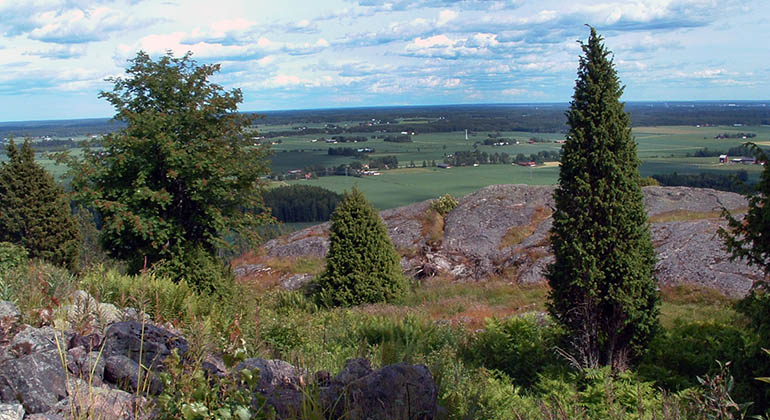
Utsikt från Ullavi klint.
Photo: Margareta Hildebrandt
Ullavi Klint, Naturreservat
- Nature reserve
- County: Örebro län
Actions
Description
The Ullavi Klint nature reserve takes its name from a steep mountain peak on the east-facing slopes of Kilsbergen. There on the crest are also the remains of an ancient castle. The reserve offers breathtaking views, imaginative ancient history and exciting plant and animal life.
Lime-affected vegetation
Spruce and pine forests grow on the slopes of the nature reserve. There are also plenty of different types of deciduous trees and shrubs such as hazel, try, olive and tibast. The soil is rich in limestone, which is reflected in the vegetation. Bloodwort, tulkört and monkshood thrive on sunlit hillsides, as do wood anemone and lesser celandine. Here and there are small, meadow-like grassy areas with unusual plants such as green hillock, woundwort and woodland violet.
Rare orchids
As many as eight different species of orchids have been found in the reserve. One of them is the rare red orchid. Also known as the red wood lily, it is a real beauty. Other orchids found in the reserve include the woodland knotweed, the helleborine and the coralroot.
Mushrooms, mosses and lichens
Limestone coniferous forest is a rare habitat type and one of the country's most species-rich natural environments worthy of protection. A characteristic of limestone coniferous forest is a great diversity of unusual soil fungi. For example, the reserve is home to the giant mushroom and the emperor mushroom. The limestone forest is also home to a number of rare lichens, mosses and wood fungi.
Heat-loving animals
The sun-warmed slopes are home to unusual species such as the dormouse and the hazel snake. Other heat-loving animals that have found a home in the steep slopes of the reserve include the spider beetle, the musk beetle and the willow beetle.
One of the county's 35 ancient castles
The hike up to the crest of the cliff is hard on the legs, but those who make it up to Ullavi klint get their money's worth. The place offers an outstanding view of Närkeslätten. Here you can also see the remains of an ancient defense wall. There are 35 such ancient fortresses, as the walls are also called, in the county. Most of them were built during the Iron Age, and were used as protection in troubled times. Some may also have been used for religious rites.
Facts about ancient castles
Ancient castles fascinate people and there is something exciting and mysterious about them. What did they look like? What were they used for? Who used them? What era are they from?
Many ancient castles in Mälardalen
There are almost 2,000 ancient castles in the Nordic countries, and just over half of these are in Sweden. There are different types of ancient castles in different areas of Sweden, and the densest concentrations are in the Mälar region, along the west coast, in Östergötland and northern Småland. On Öland and Gotland there are also so-called lowland castles, which are quite different from those on the mainland.
The first researchers
Ancient castles have fascinated people over the centuries. The very first records of the country's ancient castles were made back in the 17th century. At that time, the main focus was on inventorying the location and appearance of castles. In the 1930s and onwards, the step was taken to start investigating the castles. The first archaeological investigations were carried out by archaeologists such as Ivar Schnell, Sten Anjou, Arthur Nordén and Mårten Stenberger.
What are the different types of castles?
Throughout history, ancient castles have been classified in different ways. The earliest is a pure description of what the ramparts look like. Are there one, two or three ramparts, and did they use rocky outcrops to build the castle? Then people started to take a little more interest in where the castles are located in nature. Are they built high up on a mountain? Or are they down in the lowlands? After that, people became more interested in their function. Is it possible that people sought shelter in the castle? Are there many ancient monuments nearby? Is the site close to waterways where people could keep a close eye on who was traveling across the water? Have they been used as burial sites or are they more of religious importance? Was the castle perhaps used for living in?
What were the castles used for?
It was long believed that all ancient castles were places of refuge during troubled times, especially during the Migration Period (400-550 AD). At that time, there was no thought that the castles could have been built for reasons other than external threats, and this was long believed. Today there are several researchers who have new theories about these ancient castles. Calling all places ancient castles is not quite right, but they are often registered as ancient castles in the Swedish National Heritage Board's ancient monuments register. Other names used are ramparts or enclosures. Many castles have been used as protection in times of unrest. Other castles have been used more for religious and cultic purposes. The sites are often located on high ground and have had a good view of the surroundings. It has been a natural vantage point used to look for signals in the landscape and from other ancient castles nearby. Whatever the reason for building the castles, they have been a significant feature of the landscape and have brought many people together.
Örebro County's ancient castles
There are 34 registered ancient castles in Örebro. Most of them are located at high altitude and overlook the surrounding areas. Some castles overlook several castles while others only look over to another castle. Many of the ancient castles are located in Kilsbergen along the edge and they all look out over Närkeslätten, for example Borgaresjö skansar, Tistaborg, Ullavi klint. They have not had the main contact with each other but have instead looked out over the plain and the ancient castles located on a band in the southern part of the plain area, for example Tarstaborg. These ancient castles in turn look back towards the ancient castles of Kilsbergen.
Activities And Facilities
- Nature reserve
Facts
Municipality: Örebro
Year established: 2015
Area: 81.4 ha
Landowners: Swedish Environmental Protection Agency and individuals
Manager: County Administrative Board
Reserve creator: County Administrative Board
Directions
The nature reserve Ullavi klint is located 17 kilometers northwest of Örebro. From Örebro, take road 744 to Kil, then turn onto road 748 and drive to Klockhammar. Parking is available on the left side of the road at the end of the village. Walk the last bit to the reserve along the road and a bit into Orienterarvägen.
Regulations
In the nature reserve it is forbidden to:
- remove or damage dead trees or parts of trees
- make a fire
Contact
Email address
Organization logotype
Please be aware that some of these texts have been automatically translated.
I’ve been here 1
I want to go here
Questions & Answers
Ask a question to other Naturkartan users.
Reviews
0 reviews
- 5 :
- 4 :
- 3 :
- 2 :
- 1 :
Users images
No user images yet. Be the first to share!