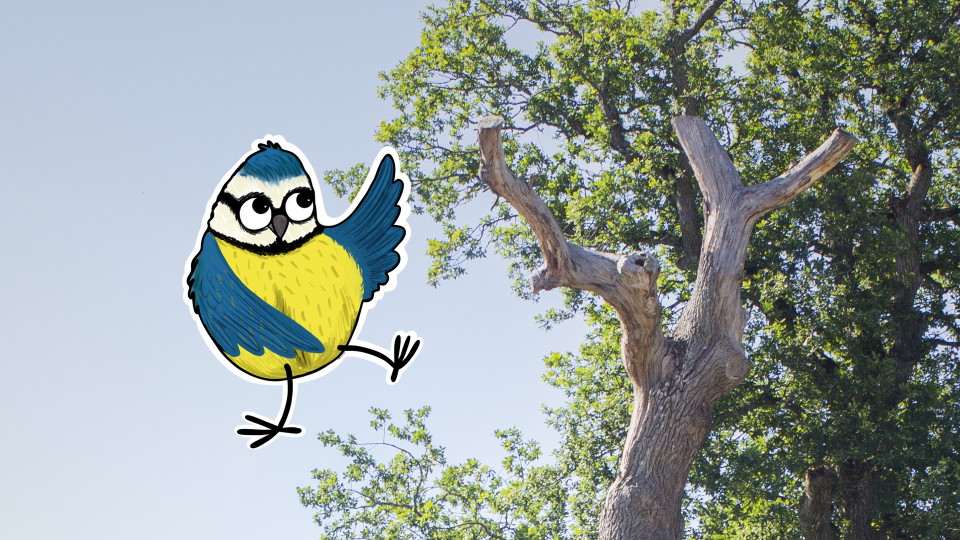
Oaks can live to be hundreds of years old, even over a thousand years. This oak tree may not be a thousand years old, but it is at least several hundred years old, and that's not bad. I don't think anyone has investigated exactly how old this tree is. Old trees, regardless of species, are almost always associated with high nature values. Over the huge period of time that an oak has been growing, it has developed and changed. It has grown rough bark with large cracks, creating a variety of conditions, known as microclimates. If you look closely at the bark, you can see that it is covered in a variety of lichens. Some of these lichens are very common and can be found on almost any tree, such as blister lichen, bitter lichen and shrill lichen, while others are real specialists, such as yellow drop lichen and oak lichen. The latter species are almost exclusively found on old and large oaks that have reached a point where the conditions of the oak bark are suitable for these species.
But it's not just the oak bark that changes. When the tree suffers damage, such as branch death, various fungi can colonize the dead wood. The fungi can grow into the tree and start decomposing even the dead wood inside the tree. The tree is only alive in the outermost parts around the trunk of the tree while the wood inside is dead, although much of the tree's water transport takes place there. When a fungus starts to break down the wood inside the tree, it is usually not a problem for the tree, but instead releases nutrients that the tree can again absorb and continue to grow from. A kind of recycling, quite simply. The decomposing wood also attracts other guests. The wood is too hard for most animals to eat on their own, but with the help of a fungus that softens it, other inhabitants arrive. As the wood is broken down by fungi and small animals, something called mulm is formed. The mulch consists of wood fragments, small animal droppings and other debris. Larger cavities may also contain the remains of bird nests or the droppings of bats that like to roost in hollow trees. Many of these species that are attracted to decaying wood are common, but there are also unusual species. One of these unusual species is the hedgehog mushroom, whose only occurrence in Östergötland is in Åtvidaberg, on an oak tree, about half a kilometer from here. In the hollow oaks at Klockarängen and in several other places around Åtvidaberg, there are findings of the large beetle leatherback, which is completely dependent on hollow trees, especially oak.
When the decomposition of the wood has gone really far, as with this tree, only a thin ring of the tree remains. The wood, which gives the tree stability and can be likened to a skeleton, has been consumed and the tree is now becoming brittle. In order to preserve the great diversity associated with old and coarse trees, they need extra care. Over the last century in particular, a large number of old and large trees have disappeared with the industrialization of our landscape. This means that the remaining old trees are particularly important to preserve in order to maintain the special species associated with them.
In densely populated areas, it is often necessary to prune old trees to prevent them from collapsing. Excavation of pipelines and paving of roads have a negative impact on trees as their root systems are often damaged. However, with the right care and consideration, trees can survive and enrich our society. This tree has been pruned to reduce the stress on its branches. By carefully and properly reducing the crown, the weight the tree needs to carry is also reduced. This reduces the risk of branches becoming so heavy that they break off, which can cause a tree this old and fragile to collapse completely.
Text for younger readers
Oak trees can be more than a thousand years old. Imagine how much they have been through. How old do you think this oak is? No one really knows. This oak tree was already growing here when the canal was built and probably at least a hundred years before that. If you look closely at the tree's bark, you'll notice that there are different colors on it. These are different lichens you see growing on the bark of the tree. On old trees like this one, there can be some really unusual lichens. They have exciting names like yellow-powdered spike lichen, yellow drop lichen or oak lichen. This tree is also hollow and there is a brown powder inside. This powder is called mulm and is mostly made up of small pieces of wood and small animal poop. Remains, such as beetle bones, are also found in the mulch. Lots of different animals live in the mulch. It is formed by fungi that feed on the wood of the tree. You might even see a fungus on the trunk of the tree or on a branch. Fungi that grow on trees are called ticks.