
Images
Art Walk in Kristinehamn
8.
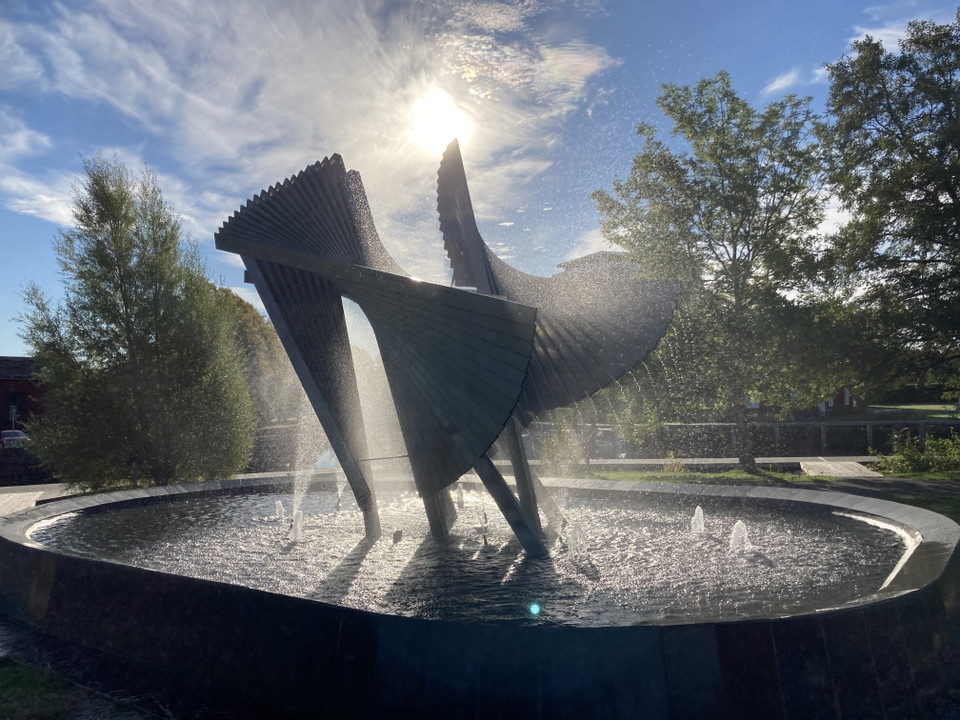
Bit för Bit (Piece by Piece)
Artist: Palle PerneviInstalled: 1968Location: Southern part of Järnvägsparken, near the library entrance, Tullportsgatan 13.
About the artwork
The sculpture is made of stainless steel, shaped and welded together. Its abstract form consists of fragments that bring to mind plants and organic shapes.
The water in the fountain complements the sculpture and connects its different parts. It flows into a large basin made of red Bohus granite.
In 1966, the Municipality of Kristinehamn announced a competition to create an outdoor sculpture. Palle Pernevi's design won, and he was given the opportunity to choose where the artwork would be placed.
According to the story, he used to walk around the town at night to find the right location. In the end, he chose Järnvägsparken.
Bit för Bit is beautifully placed in Järnvägsparken, surrounded by a park setting that has been carefully designed to complement the artwork.
Palle Pernevi (1917–1997)
Palle Pernevi, whose full name was Allan Axel Paul Pernevi, was a sculptor and draughtsman. He was born in Helsingborg and studied at several art schools, including the Akademie für Angewandte Kunst in Munich, Konstfack and the Royal Academy of Fine Arts in Stockholm.
Between 1950 and 1953, he was the first sculpture teacher at Valand Art School in its new premises in Guldheden, Gothenburg. He later also taught at Chalmers University of Technology and Konstfack.
His artistic style developed from more figurative subjects towards a freer and more abstract form of expression. He worked with a variety of materials, including iron, steel, copper, bronze and stone.
Pernevi created several public artworks in Sweden, including the fountain sculpture Fina fisken in Gothenburg and Ikaros in Kristianstad. In 1982, he was awarded the Prince Eugen Medal for his artistic achievements.
9.
Figurer i trappräcke (Figures in the Staircase Railing)
Artist: Eric ElfwénInstalled: 1955Location: Kristinehamn Library, main entrance, Tullportsgatan 13.
About the artwork
Six abstract figures are part of the railing along the library staircase. The figures are probably made of cast zinc.
The artistic decoration was part of architect Nils Grafström's vision for the library and was planned from the very beginning as a natural part of the building's design.
The town planning committee at the time invited several artists to submit proposals for the artwork, both inside and outside the building. The architect himself recommended Eric Elfwén.
Eric Elfwén (1921–2008)
Eric Elfwén was a sculptor, visual artist, graphic artist and designer. He was born in Stockholm and studied at Konstfack, as well as at the art schools of Edvin Ollers, Isaac Grünewald and Otte Sköld. He also studied architecture and stained glass abroad.
His artistic work covered a wide range of areas, from sculptures and mosaics to book covers and industrial design. He worked with many different materials and techniques, including enamel, glass and metal.
Elfwén created several public artworks throughout Sweden. These include Stridstuppar (Fighting Cockerels) at Sverigehuset in Kungsträdgården, Stockholm, and Lekande björnungar (Playing Bear Cubs) in Finspång. His works are also represented in museums in Sweden and at the Victoria and Albert Museum in London.
11.
Kvinna (Woman)
Artist: Lorraine RantalaInstalled: 1997Location: Central Brogårdsparken, along Gamla Kyrkogatan, between Krukmakeri Hemgjord and Brogymnasiet.
About the artwork
The sculpture depicts a seated woman in a slightly abstract form, cast in bronze. It stands in the middle of Brogårdsparken, next to the Varnan river, which flows through central Kristinehamn.
The woman's figure has a strong and powerful presence. Her head is slightly turned to one side, and one hand is raised and shaped like a bowl – an open form that can hold whatever the viewer wishes to imagine.
The woman sits on a base made of red Bohus granite. Around the base is a circular area paved with slate. The sculpture is surrounded by herbs, flowering shrubs and perennial plants in the park.
Lorraine began by creating the figure directly in plaster. The model was then transported to Herman Bergmans Art Foundry in Stockholm, where it was cast in bronze. The same foundry also cast the sculpture Daphne by Erik Rafael-Rådberg, which came to Kristinehamn around 50 years earlier.
Lorraine Rantala (1951–)
Lorraine Rantala is a sculptor, born and raised in Fort Wayne, Indiana, USA. She moved to Kristinehamn at the age of 18 and has lived and worked there ever since. Her studio is located in the Vågen quarter.
She studied art at Kyrkerud Folk High School in Arvika from 1972 to 1974. Since then, she has worked with sculpture and public art.
Rantala has created several public artworks in Värmland and other parts of Sweden. In Kristinehamn, her works include August Palm, Gustav Nilsson and Systrar (Sisters, also a part in this art walk). Her art is also represented in the collections of Kristinehamn Art Museum and Värmland Museum.
In 2014, she received the Fröding Scholarship together with fellow artist Kjell Sundberg.
12.
Vega
Artist: Ingalena KlenellInstalled: 1994Location: Brogymnasiet, in the older part of the school building at the end of Gamla Kyrkogatan.
About the artwork
In an extension of Brogymnasiet, formerly called Brogårdsgymnasiet, there is a beautiful glass window telling a story about the lake, the boats and the jetties.
The glass window is especially beautiful in the evening. When it is lit from inside and the surroundings are dark, the colours and details of the glass stand out in a very special way.
Ingalena Klenell (1949–)
Ingalena Klenell is a glass artist, born and raised in Kristinehamn. She attended Brogårdsgymnasiet herself, which makes her artwork at the school a special connection to her own school days.
Her artistic career began with weaving and an early interest in ceramics. She studied at several art schools, including KV Art School in Gothenburg, the Folk High School of Crafts in Leksand and Rönnowska School in Helsingborg. After one term at the Glass School in Orrefors, glass became her main material.
Klenell has developed a personal artistic style that focuses on the possibilities of glass. She creates both small objects and larger public artworks. Nature, landscapes and the relationship between people and their surroundings are recurring themes in her work.
She lives in Sunne, where she has her own glass studio together with her husband, glass artist Ragnar Klenell. In 2011, they received the Gustaf Fröding Scholarship together for their contributions to glass art.
13.
Fjädern, Hoppet och Svävaren (The Spring, the Jump and the Aerialist)
Artist: Maria (Mia) AnderssonInstalled: 2023Location: Hoppet Gymnastics Hall, Gamla Kyrkogatan 5
About the artwork
The facade artwork Fjädern, Hoppet och Svävaren is inspired by the movements of gymnastics and the three disciplines of team gymnastics: floor exercise, tumbling and trampoline.
The figures are made up of several bodies that together form a whole. Just as in team gymnastics, they create movement, power, strength, energy and precision. They also show how something that seems impossible can become possible, such as lifting yourself off the ground.
The artwork was created especially for the facade of the gymnastics hall. It is the result of Kristinehamn Municipality's one-percent rule, introduced in 2021. This rule means that one percent of the costs of new construction, renovation and extensions of municipal buildings must be set aside for art.
The figures are cut from aluminium sheets. Some parts have a brushed surface that reflects the light and colours around them, while others are painted in shades that match the bronze colour of the building. LED lighting enhances the sense of movement across the facade and illuminates the artwork after dark.
Take a look at the artwork in the evening when the lights are on. The movement and interaction between the figures then appear in a different way.
Maria (Mia) Andersson (1978–)
Maria (Mia) Andersson is an artist born in Motala. She works with many different forms of art and materials, including video, text, textiles, performance, installations and public art. She studied at Central Saint Martins College in London and Konstfack in Stockholm.
Her artistic work explores how places and spaces are shaped and changed, as well as the human body and its movements in different environments. She often works through research and long-term projects that bring different art forms together.
Together with Turkish artist Nancy Atakan, she has spent several years exploring the history of Swedish Ling gymnastics and how it spread to Turkey in the early 20th century. This work has resulted in several artworks and exhibitions. Her interest in the movements of gymnastics and the ways the body can express itself can also be seen in her public artworks.
Her public artworks include Spinn (2023), created for the sports hall at Sannaskolan in Gothenburg, and En parkfantasi (2021), a site-specific sound artwork at Alsters herrgård outside Karlstad.
14.
Advent
Artist: Ethel HalvarssonInstalled: 1953Location: Kristinehamn Church, Östra Staketgatan
About the artwork
The choir carpet Advent was designed by Ethel Halvarsson in 1951 and woven in 1953 by Värmlands hemslöjd. It is made using the traditional Swedish rölakan weaving technique and measures 540 × 466 centimetres.
The carpet is rich in symbolism. In the central circular shape, which resembles a compass rose, there is a cross. It can be interpreted as an image of Jesus – a compass rose and needle showing the way.
Around the circle are palm branches and tall arches that can also be seen as gateways. Along the bottom edge of the carpet are shapes that bring to mind the city walls of Jerusalem.
Ethel Halvarsson also designed other textiles for Kristinehamn Church: two altar frontals, two chasubles and a chalice cloth. These textiles can also be viewed on request before your visit.
Kristinehamn Church is open on weekdays from 1 pm to 4 pm, and on Sundays at 11 am and 6 pm in connection with services. At other times, the church is open in connection with ceremonies.
Ethel Halvarsson (1917–2011)
Ethel Halvarsson, also known as Ethel Halvar-Andersson, was a textile artist born in Kristinehamn. She learned embroidery and weaving at Kristinehamn Practical School and continued her studies at the Higher School of Arts and Crafts in Stockholm, now part of Konstfack.
She worked for Jönköpings hemslöjd and Värmlands hemslöjd before opening her own studio in Karlstad in 1955. During her career, she designed more than a thousand patterns for carpets, furniture fabrics and interior textiles. Around 1,000 of her carpet design sketches have been preserved.
Her main field of work was textiles for churches. Using a simple but expressive visual style, she worked with colours and symbols to tell biblical stories. She had a special understanding of the character of church interiors and adapted her work to the spaces they were made for. Her textiles can be found in around 60 churches in the Diocese of Karlstad.
One of her best-known commissions was the interior design of Säffle Town Hall in 1954, where she worked with architect Nils Einar Eriksson. She designed two large rölakan carpets for the stair hall. In the council chamber, she created chair fabrics, curtains and a large damask textile. When the building opened, the newspaper Svenska Dagbladet described it as both an art museum and an exhibition of interior design.
At the age of 86, in 2003, she made her final sketch for a choir carpet, for Mikaeli Church in Arvika. The same year, a retrospective exhibition of her work was shown at Kristinehamn Town Hall, that at the time was a museum.
15.
Systrar (Sisters)
Artist: Lorraine RantalaInstalled: 2004Location: Familjecentralen, Assemblégatan 1
About the artwork
Swinging your legs when your feet cannot reach the ground is a familiar movement for many children. This movement was the starting point for Lorraine Rantala's sculpture Systrar.
The sculpture shows two sisters sitting together on a bench. Their gently swinging legs and the close bond between the children are central to the artwork.
There is also an empty space on the bench for another child or an adult to sit beside the sisters. In this way, the viewer becomes part of the sculpture and its sense of togetherness.
Lorraine Rantala (1951–)
See information about the artist under artwork Kvinna (Woman).
10.
Daphne
Artist: Eric Rafael-RådbergInstalled: 1949Location: Rådhusparken, Kungsgatan 25
About the artwork
The girl who modelled for sculptor Eric Rafael-Rådberg in 1945 was named Daphne Nicou, later Engström. She was only eight years old when the work began.
Rafael-Rådberg had got to know the Nicou family through Lilli Larsson from Björneborg, who persuaded Daphne to pose for him. It took many hours of sitting before the sculpture was finished and could be cast in bronze at Herman Bergmans Foundry in Stockholm.
A small plaque on the sculpture's base reads: “Thank you, Daphne Nicou, for your help.”
The first order for the sculpture came from the Nicou family in 1946. At the same time, the town of Kristinehamn wanted to buy a work by the local artist. The town therefore asked the family for permission to make a copy, which they agreed to. In 1949, the sculpture was placed as a fountain feature in the middle of Rådhusparken.
Eric Rafael-Rådberg (1881–1961)
This strict, eccentric but also playful artist was born in Kristinehamn in 1881. He was a sculptor, photographer and interior architect. He trained under sculptor Christian Eriksson and later studied at art schools in Stockholm and Paris. In 1916, he made his debut at Liljevalchs art gallery in Stockholm.
He was a much sought-after portrait sculptor. Among his works are a bronze statue of Jenny Lind on Djurgården in Stockholm and portraits of Gustaf Fröding, Admiral Fredrik Henrik af Chapman and Dan Broström in Gothenburg. A less common commission was sculpting Selma Lagerlöf's hands after her death.
Around 1922, he bought Österviks Chapel and the old dairy next to it. He moved there with his family and set up his studio in the dairy building. Today, the former dairy is a museum displaying works by Rafael-Rådberg. He died in 1961 at his home in Österviks Chapel.
Österviks Chapel is run by a foundation and is open during the summer season. At other times of the year, visits can be arranged on request.
16.
Kakelmålning utan namn (Untitled Tile Mural)
Artist: Bengt OlsonInstalled: 1972Location: Reception, Kristinehamn Municipal Building, Kungsgatan 29B
About the artwork
This large tile mural, measuring 260 × 350 centimetres, was originally created for Swedbank's premises in Kristinehamn. Bengt Olson developed his own technique for painting on small ceramic tiles while working on some of his large-scale art projects in France.
In 1971, he experimented with the technique at the historic porcelain manufacturer Faïencerie de Gien in France. Parts of the work could later be removed and become independent artworks, mounted on panels. One year later, Swedbank in Kristinehamn commissioned this artwork.
When Swedbank moved to smaller premises in 2021, the artwork remained in the former bank building. A few years later, it was given a new public location when it was moved to the reception of Kristinehamn's new municipal building, which opened in April 2026. Bengt Olson and the Bengt Olson Foundation were pleased that the artwork was once again accessible to the public in his hometown.
The artwork can be viewed on weekdays when the municipal building is open: Monday–Thursday 8 am–12 pm and 1 pm–4.30 pm, Friday 8 am–12 pm and 1 pm–4 pm.
Bengt Olson (1930–)
Bengt Olson is a painter, sculptor and graphic artist, born and raised in Kristinehamn. His parents, Allan Olson and Elin Maria Johnsson, were both interested in art. As a child, he often went with them to art exhibitions, and the family home had art books that awakened his interest, especially in French art.
In the summer of 1940, when Bengt was ten years old, he went with his father to Värmlands Museum in Karlstad. There, he saw Rembrandt's self-portrait and the painting Saskia and Athena for the first time. The experience made a strong impression on him. He began earning a living from his art at the age of 15, and in 1948, when he was just 18, he held his first exhibition in Kristinehamn.
He studied at Valand School of Fine Arts in Gothenburg from 1948 to 1952, where he was taught by Endre Nemes. He then travelled to Paris to continue his studies with the French artist Fernand Léger from 1952 to 1953. Paris had long been his dream, and in 1960 he moved there. The city became his home and workplace for almost six decades.
While studying in Gothenburg, Bengt Olson helped form the artists' group Grupp 54 together with other students from Valand. The group wanted to create space for new artistic expressions, including abstract and surrealist art. Later, he also helped establish Galleri 54. In Paris, he became part of the international art scene and made contact with many artists and gallery owners. Together with gallery owner Daniel Gervis, he initiated the international art fair FIAC, which began in Paris in 1975.
Olson has worked with many materials and techniques, from oil paint, pastels and watercolours to sandblasted concrete and glazed tiles. His art often has an abstract, organic style, with colour, movement and forms from nature playing an important role. He has created several large public artworks in France, including in Créteil and Courbevoie, and his works can be found in many places around the world. In 2002, his artistic career was celebrated with a major retrospective exhibition at the Musée Maillol in Paris.
Despite his international career, Bengt Olson has never sought to become a public figure. Instead, he has let his art take centre stage. The Swedish newspaper Göteborgs-Posten has described him as “Sweden's most well-known unknown artist”. He is one of the artists who has created the largest number of monumental public artworks in Paris. Many of his works are located in places where people pass by every day, sometimes without knowing who created them. But in Kristinehamn, there is every reason to know his name.
Read more about Bengt Olson and his art through his own stories at bengtolson.se.
The man behind the Picasso sculpture
In Kristinehamn, Bengt Olson is perhaps best known for his important role in bringing the Picasso sculpture to the town. The story began in the autumn of 1963, when he happened to meet the Norwegian artist Carl Nesjar on a country road outside Paris. Nesjar worked with Pablo Picasso and told Olson that Picasso wanted to give a town the opportunity to realise one of his sculpture models on a monumental scale.
Olson saw an opportunity for his hometown and was allowed to take the model to Sweden to see if Kristinehamn would accept the offer. He contacted the town's politicians and presented the idea. After a quick decision, the town agreed. Photographs of Kristinehamn were sent to Picasso, who eventually gave his approval. On a photograph showing the planned location, he wrote: “Oui Picasso, 7.7 64”.
The result was the world's largest Picasso sculpture: the 15-metre-high sculpture Jaqueline (Tête de femme) on the shore of Lake Vänern, inaugurated on Midsummer's Eve in 1965. It was one of Picasso's first monumental sculptures and is today Kristinehamn's most visited attraction. Without Bengt Olson's initiative, it might have ended up somewhere completely different.
Read more about the Picasso sculpture in Kristinehamn:https://www.visitvarmland.com/kristinehamn/kultur-historia/picassoskulpturen/
1.
Solstrålar (Sunbeams)
Artist: Malin SparrvardtInstalled: 2025Location: Tegelslagargatan 42, by Raggartorget
About the artwork
The mural Solstrålar depicts small burdock, an unusual plant that in Värmland only grows on the island of Saxholmen in the Kristinehamn archipelago. Through this mural, the artist wants to spark curiosity about both the plant and the island's history.
Small burdock is a perennial herb with small yellow flowers and can grow up to one metre tall. On the building's facade, Malin Sparrvardt has created a composition in which the tall plants bend to fit into the space and seem to seek shelter together. The yellow tones complement the colour of the building.
Nature and history meet on Saxholmen. Small burdock grows here, including near the ruins of a medieval castle dating back to the 13th century. The island has an unusually rich variety of plant life and has also been the site of archaeological excavations.
Malin Sparrvardt (1991–)
Malin Sparrvardt was born in Stockholm in 1991 and works as an artist under the name Korallpionen. She trained as an art teacher and cabinetmaker and has developed her mural painting practice independently.
Plants and nature are recurring themes in her art. She wants to bring more greenery into public spaces and often chooses plant motifs that have a connection to the place where the mural will be located.
Malin works with brushes, especially wide decorating brushes. She often sketches freehand directly onto the wall and mixes the colours on site. Her murals can be found in several places in Sweden and abroad.
5.
Galeasen Mathilda
Artist: Carl-Emil BerglinInstalled: 1965Location: North side of the quay in the Inner Harbour, near Norra Hamngatan 10
About the artwork
The sculpture Galeasen Mathilda is a memorial to Axel Broström and his first vessel – a small sailing cargo ship that marked the beginning of one of Sweden's major shipping companies.
In 1865, Axel Broström bought the schooner Mathilda at an auction for 2,000 borrowed riksdaler. He had previously worked for a wholesale merchant in Kristinehamn, where he became familiar with the ship through his work loading and unloading cargo. Buying the vessel was his first step towards the shipping business that would eventually grow into the Broström Group.
To mark the 100th anniversary of the purchase, Kristinehamn Municipality decided to create a memorial. Artist Carl-Emil Berglin, together with blacksmith Erik Moberg, made a copper replica of the schooner. The ship stands on a tall, sloping pedestal by the quay in the Inner Harbour.
The sculpture is a reminder of a time when shipping on Lake Vänern was an important part of Kristinehamn's business life, and of how a single vessel could mark the beginning of a major business story.
Carl-Emil Berglin (1915–2009)
Carl-Emil Berglin was a sculptor and painter, born in Högbo, in what is now Sandviken Municipality. He studied at the Royal Institute of Art in Stockholm from 1944 to 1949 and went on to work in both sculpture and painting.
He created freestanding sculptures, portrait busts and public artworks in several parts of Sweden. His public works include Blommande träd (Flowering Tree), a large, colourful sculpture at Danderyd Hospital, and several works in Luleå. His art is characterised by a wide range of materials and styles, from freestanding sculptures to large-scale works in public spaces.
4.
Väktarna (The Guards)
Artist: Harry MobergInstalled: 2024Location: Between Varnan and Smedjan, Norra Hamngatan 10
About the artwork
Väktarna consists of three iron sculptures made at Bergmans Foundry in Karlskoga. A bronze version of the artwork can be seen at Värmlands Museum.
There is little documented information about how the sculptures were created or what they represent. They may be connected to Hannibal, a theme that Harry Moberg explored extensively when creating the artwork.
Hannibal Barca was a famous military commander in ancient era. He is best known for his campaign from Spain to Italy, when, according to historical accounts, he led his army across the Alps with war elephants among his troops. This is considered one of the most remarkable military achievements of the ancient world. Perhaps Väktarna can be interpreted as a depiction connected to this campaign, but there is no confirmed explanation of what the sculptures represent.
Harry Moberg (1927–2018)
Harry Moberg was a painter, sculptor and printmaker, born in Öregrund. He studied at the Académie Libre art school in Stockholm and travelled to southern France in 1947 with his artist friend Evert Lindfors. He stayed there for two years and made his debut at an exhibition in Cagnes-sur-Mer in 1949. The French landscape and light became important sources of inspiration throughout his artistic career.
After studying with artist Erling Ärlingsson in Karlstad, Moberg moved to Kristinehamn in 1953. He became part of a lively local art scene and spent time with artists including Stig Olson, Ingemar Lööf and Sven Holm. Together with Gertrud Bensow-Lööf, Stig Olson and Ingemar Lööf, he exhibited in Kristinehamn in 1959 and 1960. The same group also took part in the Stockholm Salon at Liljevalchs Art Gallery in 1959.
Moberg worked with painting, sculpture and printmaking. Landscapes were a recurring subject, often featuring small, solitary figures that give his images a dreamlike and mysterious atmosphere. He also drew inspiration from literature and Greek mythology. His subjects included the stories of Odysseus and Penelope. As a printmaker, he was particularly skilled in woodcut and experimented with multi-colour printing and different printing materials.
He also created public artworks. His works are held in several museums and municipal art collections. During his long career, he received several grants and awards, including the Swedish Arts Grants Committee's major working grant and the Fröding Scholarship.
In the 1960s, he began returning every summer to the village of Goult in Provence, a place that continued to inspire his art. He worked as an artist for more than 70 years and lived in Kristinehamn until his death.
3.
Jag är alltid på plats (I Am Always Here)
Artist: Ulrika SparreInstalled: 2021Location: Kristinehamn City Park, near the bridge towards Fisktorget, Brandkårsvägen 11
About the artwork
Jag är alltid på plats consists of a natural stone found in the forest, bearing the short but thought-provoking words: Jag är alltid på plats - I am always here.
The artwork was first shown during Ulrika Sparre's summer exhibition at Kristinehamn Art Museum in 2021. The exhibition included five outdoor artworks. As it was uncertain whether the museum would be able to open during the pandemic, several works were placed outdoors. The municipality later bought the stone instead of having it transported back, and it became a permanent feature of the city park. Its natural material fits well into the park setting.
The words on the stone raise questions about presence, belonging and our relationship with a place. What does it really mean to always be here?
There is another artwork by the artist in Kristinehamn Municipality. Jag väntar under stjärnorna (I Wait Under the Stars) stands just inside the entrance to Folkets Park in Björneborg.
Ulrika Sparre (1974–2025)
Ulrika Sparre was an artist born in Stockholm. She studied fine art at Konstfack University of Arts, Crafts and Design in Stockholm and also studied sculpture in the Netherlands. Her artistic practice included sculpture, performance, sound, light, photography and installations.
Her work explored faith, identity and people's outlook on life. She was also interested in the need to ask existential questions in a secular society. By combining different artistic forms, she wanted to encourage people to reflect on things that are often difficult to put into words.
2.
Helårsfontän (All-Year Fountain)
Artist: Carl NesjarInstalled: 2006Location: Kristinehamn City Park (Stadsparken), Brandkårsvägen 11
About the artwork
Carl Nesjar is perhaps best known in Kristinehamn for his close connection with Pablo Picasso and his involvement in the creation of the Picasso sculpture in 1965. For many years, the municipality had wanted to acquire a work of art by Nesjar of its own.
In May 2003, an unexpected opportunity arose to make this happen. Another of the municipality's artworks had been blown up by vandals, and the insurance compensation could help fund Helårsfontänen. Hopefully, this is the first and only time that the destruction of one artwork has helped bring another into being!
Nesjar created several all-year fountains in steel and aluminium, and the work in Kristinehamn is designed to change with the seasons. The fountain is about four metres high and combines water and light. In winter, the water can freeze into a shimmering curtain of ice, giving the sculpture a completely new appearance. In summer, the jets of water form cascades that catch the light and create movement. In the evening, the fountain takes on a different character as lighting highlights the water and sculpture.
Carl Nesjar (1920–2015)
Carl Nesjar was a Norwegian painter, photographer and sculptor, born in Larvik. He grew up in Norway and the United States and studied at, among other places, Pratt Institute and Columbia University in New York, the National Academy of Fine Arts in Oslo and in Paris.
Nesjar enjoyed exploring new materials and techniques. He worked with painting, printmaking, photography and sculpture, but became best known for his monumental concrete works. Nature was a recurring source of inspiration, especially rocks, water and ice. He was also interested in how light, movement and the forces of nature could become part of an artwork. His all-year fountains, where water and ice change the appearance of the sculptures with the seasons, are one example of this.
Nesjar became internationally known through his close collaboration with Pablo Picasso. It began in the late 1950s and lasted for almost 20 years. The collaboration was based on a technique Nesjar had developed with architect Erling Viksjø, in which images could be transferred onto concrete using sandblasting. Picasso was interested in the possibilities and began contributing drawings and sculpture models that Nesjar could turn into large public artworks.
The work required both artistic understanding and technical skill. Picasso's designs were enlarged and transferred onto concrete surfaces. By sandblasting away parts of the concrete's outer layer, Nesjar exposed the stone aggregate beneath, creating the lines and contrasts of the design. Together, they created around thirty public artworks in countries including Norway, Sweden, France, Spain and the United States.
One of the best-known results of their collaboration is the sculpture Jacqueline in Kristinehamn. The 15-metre-high sculpture is based on a model by Picasso, while Nesjar was responsible for bringing it to life on a monumental scale.
6.
Regnlyra (Rain Lyre)
Location: Norra TorgetThe artwork will be installed at Norra Torget in 2027. More information will be available once the artwork is complete.
7.
Ett skepp kommer lastat (A Ship Comes Loaded)
Artist: Simon Alfredo Diaz CompagnetInstalled: 2025Location: Kristinehamn Conference Centre, Västerlångg. 21
About the artwork
Ett skepp kommer lastat connects Kristinehamn's past and present, with references to the archipelago and the city's maritime heritage, among other things. The artwork also includes symbols strongly associated with Kristinehamn, such as the Bojorten and the Picasso sculpture.
The design complements the character of the building and the history of the town, while also looking to the future. The title refers to a well-known Swedish game in which players take turns adding their own words or objects to what the ship is carrying. In the same way, the artwork leaves room for visitors to interpret for themselves what the ship carries and where it is heading.
The artwork was created specifically for this location, to connect the building, Kristinehamn and the stories that shape the place.
Simon Alfredo Diaz Compagnet (1978–)
Simon Alfredo Diaz Compagnet is a visual artist, street artist and art director, born and raised in Oslo. He is self-taught and has around 30 years of experience in graffiti and contemporary urban art.
As a young artist, he was inspired by political street art and poster art from Chile. This influence continues to shape his visual style. He works in several forms, including painting, murals, street art and video art. He has also created visual designs for concerts and other events.
In his murals, he likes to tell stories, spark curiosity and create an emotional connection with the viewer. Alongside his artistic work, he has worked as a motion designer, including at NRK, and taught visual communication. He has also led graffiti and street art workshops for children and young people.
Categories
- Art