
-
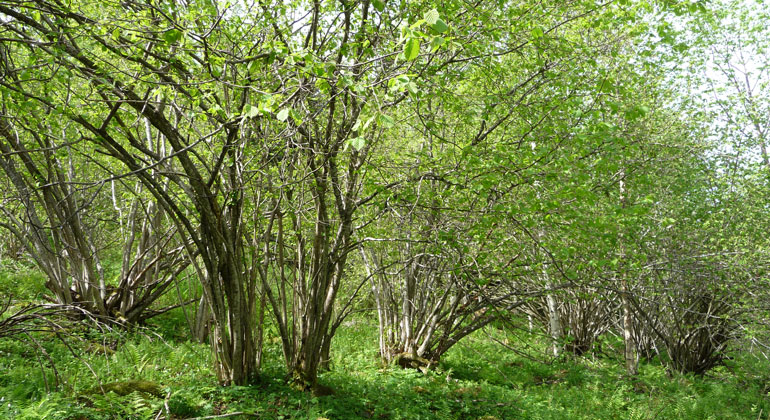
På Bromsbergets sluttningar finns det ovanligt mycket hasselbuskar.
Photo: Länsstyrelsen i Dalarnas län. -
-
-
Bromsberget, Naturreservat
- Nature reserve
- County: Dalarnas län
Actions
Description
Bromsberget is at its best in the spring and early summer! That’s when the bluebells and the fragrant sweet woodruff bloom among the beautiful hazel groves. You might even be lucky enough to spot a nutcracker or a rock bunting as well!
Photo: Dalarna County Administrative Board
Hazel and Other Hardwoods, as well as Spruce
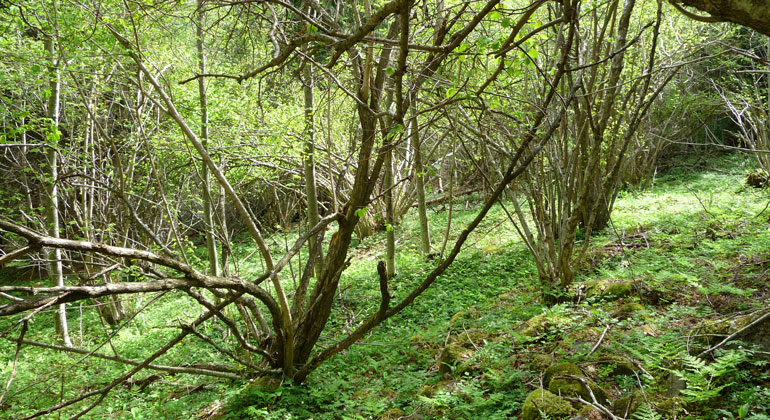
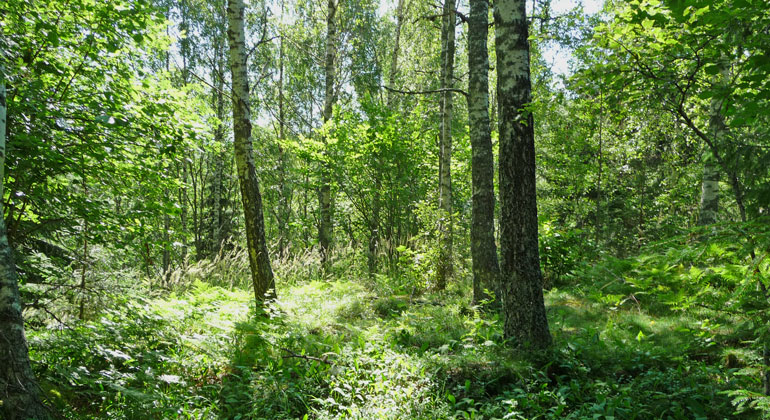
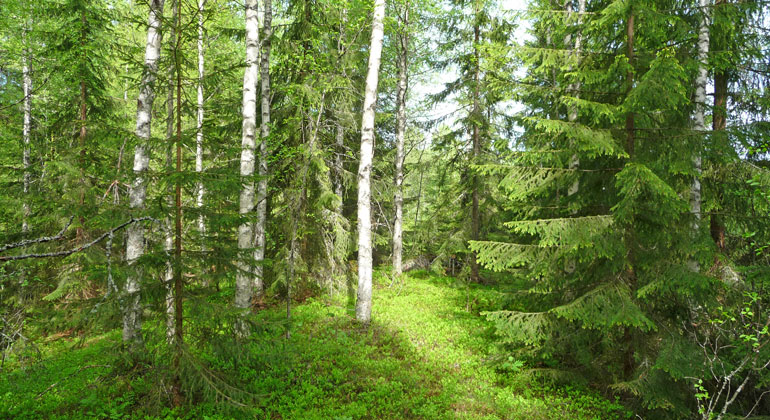
In addition to the abundant hazel stands, there are also some hardwood trees here, including a small number of linden and maple trees, as well as a few more elms. But there are also what are known as common hardwoods—that is, aspen, birch, willow, rowan, and alder. In many parts, hazel is the dominant species, along with middle-aged spruce.
How did the forest come to be like this?
Until the 1970s, the area was one of Dalarna’s finest hardwood forests. Most of the old deciduous trees in the area—both common and hardwood species—were ring-barked at that time. The idea was to promote the growth of more spruce trees. This was largely successful, although a large number of the older deciduous trees survived the ring-barking. Hazel also thrived, developing in patches into pure groves.
Fantastic birds and beautiful flora
Birdlife is abundant, featuring the nutcracker, the rock bunting, and several pairs of hazel grouse. Daphne and hepatica are found throughout the area. The musk orchid has been observed at one location. Many species benefit from the limestone-influenced bedrock and the deciduous woodlands, including hazel.
The nutcracker
The nutcracker is entirely dependent on the presence of hazel. The northern limit of the bird’s range follows almost exactly the boundary of hazel’s distribution in Sweden. From late August through October, nutcrackers are most frequently seen. During this time, they gather nuts for the winter. Behind its tongue, the nutcracker has a large pouch. Up to 20 nuts can be squeezed into this pouch, which it then carries away. The nuts are subsequently hidden on the ground beneath the moss. The nutcracker locates its nuts with great precision, even when the ground is covered by a thick blanket of snow.
Daphne
Daphne blooms on bare twigs, that is, even before the leaves have had time to emerge. This sometimes happens as early as March, while the snow is still on the ground. The flowers are fragrant. The fruits are bright red, almost round, berry-like drupes. But be careful! The entire plant is highly toxic. The bark and berries, in particular, contain daphnetoxin and mezerein, which are highly irritating.
Activities And Facilities
- Nature reserve
Facts
Bildades: 2011Storlek: 28 haKommun: SmedjebackenFörvaltare: LänsstyrelsenNatura 2000: Ingår i EU-s nätverk av skyddad natur. Om Natura 2000
Directions
The area is located about 13 km south of Söderbärke and 11 km west of Fagersta.
Regulations
Within the reserve, it is not permitted to...
- damage growing or dead trees—whether standing or fallen—as well as stumps and shrubs, with the following exception: collecting loose, small, dry branches and twigs for the purpose of making a fire.
Without permission from the County Administrative Board, it is prohibited to:
- dig up plants, pick mosses, lichens, and wood-dwelling fungi, or collect animals (such as insects)
- organize or conduct competitions, camp activities, and other large-scale or recurring organized events.
Click on the nature reserve’s name and select the “Documentation” tab to view the documents.
Contact
Address
Email address
Organization logotype

Please be aware that some of these texts have been automatically translated.
I’ve been here
I want to go here
Questions & Answers
Ask a question to other Naturkartan users.
Reviews
0 reviews
- 5 :
- 4 :
- 3 :
- 2 :
- 1 :
Users images
No user images yet. Be the first to share!