
-
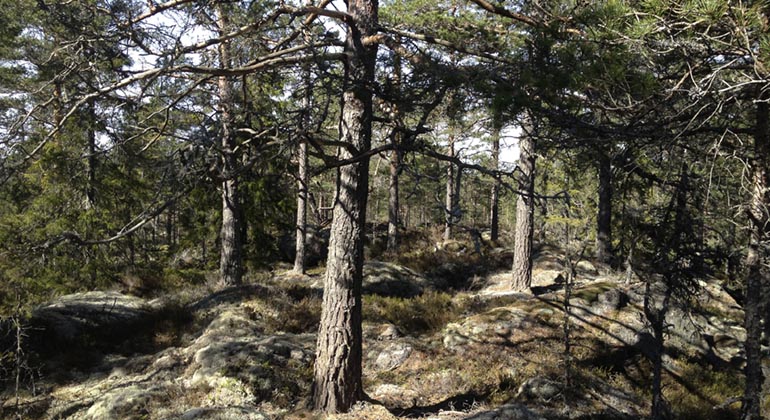
Tjuråsen.
Photo: Daniel Gustafson
Tjuråsen, Naturreservat
- Nature reserve
- County: Örebro län
Actions
Description
Tjuråsen Nature Reserve is a large forest area with dramatic terrain. The sparse pine forest on the heights contrasts sharply with the lush and tall spruce forests down in the valleys. The forest has been left untouched for a long time, making it a haven for many unusual species.
Rocky outcrops and rift valleys
The reserve's forests consist mostly of sparse rocky pine forests, but down in the crevice valleys the vegetation is more lush. Here there are impressive spruce forests with elements of aspen, birch and willow. Under boulders and thick moss traps, underground streams bubble up. In the valleys, a network of tracks can also be seen. They date back to the days of the forest horse, but since then the forest has remained untouched. The wild terrain of the area, with differences in altitude of almost a hundred meters, has made forestry difficult and contributed to the high natural values of the reserve.
Old and dead trees
The age of the forest, around 100-150 years, is not remarkably high, but there are elements of significantly older trees, both individually and in smaller stands. A pine tree high up on a rocky outcrop above the Svinpotten pond has been determined to be 470 years old. The reserve also has plenty of dead trees - a valuable habitat for many wood-living fungi, mosses and insects. Especially down in the valleys, there are in some places real mass occurrences of dead trunks. The woolly adelgid is an example of an unusual wood-living fungus that occurs in the reserve.
Humid local climate
The proximity to the Svartälven river means that the local climate is humid, which is exactly what many lichens want. For example, the area is home to the Norwegian beaked lichen, an unusual species that requires extremely high humidity. Birds in the area include typical forest species such as capercaillie and three-toed woodpecker.
Forest fire
The forest has been affected by forest fires for centuries. Traces of forest fires, known as fire sounds, can be found on both living pine trees and old pine stumps. Some stumps bear traces of up to six different fires. On living trees, the fire sounds are usually visible as half-healed wounds or rather cracks along the trunk, with exposed wood and carbon residues. At the edges of the wound, the bark has formed a callus.
Accessibility
There is a marked path in the reserve. Along the path in the center of the reserve there is a shelter with a fireplace.
Is there firewood?
Firewood is available at the fireplace. Remember to burn in moderation, so that there is enough wood for future guests. The firewood is replenished regularly, but we cannot guarantee availability at all times. If you want to be sure to be able to make a fire - bring your own firewood. It is not allowed to burn sticks and branches from the forest in the reserve.
Activities And Facilities
- Nature reserve
Facts
Municipality: Hällefors and Nora
Year established: 2007
Area: 466 hectares
Landowner: Swedish Environmental Protection Agency
Manager: County Administrative Board
Reserve creator: County Administrative Board
Directions
The Tjuråsen nature reserve is located about 20 km north-northeast of Karlskoga and about 15 km west of Gyttorp. Rockesholm is located about 4 km northwest of the reserve.
Regulations
In the nature reserve it is forbidden to:
- Remove or damage dead trees or parts of trees
Contact
Email address
Organization logotype
Please be aware that some of these texts have been automatically translated.
I’ve been here 5


I want to go here 10


Questions & Answers
Ask a question to other Naturkartan users.
Reviews
0 reviews
- 5 :
- 4 :
- 3 :
- 2 :
- 1 :
Users images
No user images yet. Be the first to share!