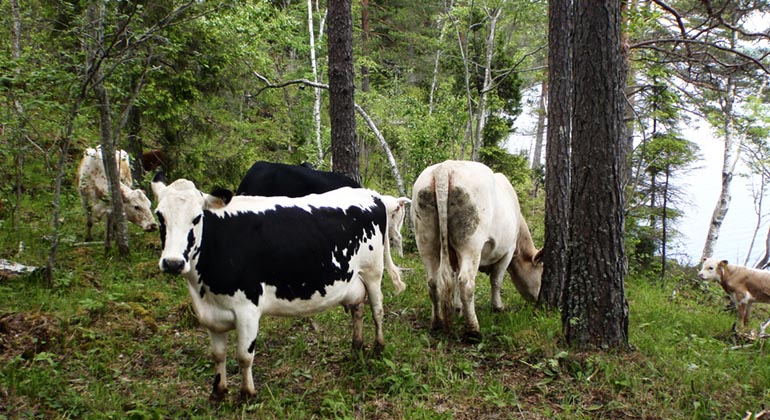
In the Näsmarkerna nature reserve, cows are once again grazing in the forest. The grazing animals create a varied, semi-open and species-rich environment. The forest in the reserve is varied, from sparse limestone pine forests, boulder-rich meadow spruce forests and areas with deciduous trees such as elm, lime and ash. The soil is rich in limestone and many rare plants and fungi thrive here.
Species-rich limestone pine forest
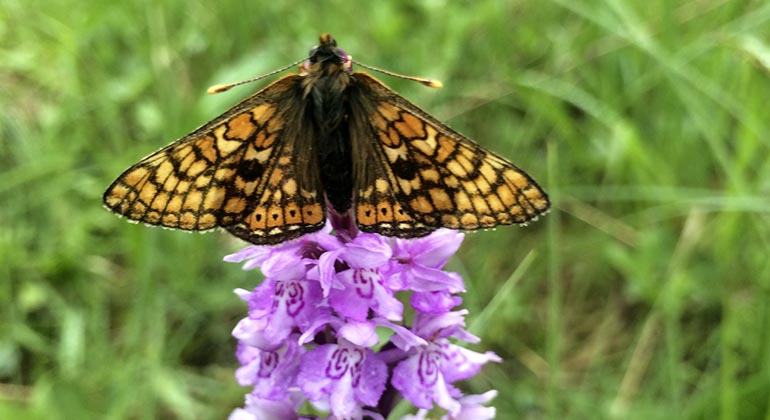
The bedrock consists of limestone, which also makes the soil calcareous. The mountain forms long, narrow ridges, and bare rocks are visible on the shore. Perhaps the most interesting thing about Näsmarkerna is the limestone pine forest that stretches along the lake between Näset and Bergnäsudden. Between the sparse pine trunks, there is a great diversity of species of discerning plants and fungi that like warmth and lime-rich soil. A number of orchids grow here, such as purple knotweed and spurge. Limestone pine forests are a rare forest type in almost all of Sweden, and those that exist are threatened by overgrowth and clear-cutting.
Cows grazing in the forest
Even into the 20th century, a large proportion of cattle grazed freely in the forest. Grazing shaped the forest into a semi-open and very species-rich environment, a type of forest that has now almost completely disappeared in our country. The forest has probably been grazed here since the 14th century, when an ironworks was built in Älvhyttan at the northern end of the lake. As soon as the snow melted away, the animals were let out to graze. During the 20th century, forest grazing ceased and the forests grew back. But since 2010, the cows have been grazing in the Näsmarkerna forest again.
Grazing creates a varied environment
What is special about the grazed forest is that it is so varied. Open glades are interspersed with denser bushes and groves of trees. Conifers coexist with deciduous trees, young small trees with older, larger trees. Here, the light-loving species of the meadow are interspersed with the more shade-resistant ones of the forest. The grazing animals spread seeds and spores wherever they wander. The trampling of hooves creates holes in the ground's grass and moss where species that need bare soil to germinate can take root. Many unusual fungi thrive in the grazed forest, such as the violet, yellow thorn, smooth thorn and four-spotted earth star. Animal dung is fast becoming a popular restaurant and nursery for many specialized and now increasingly rare insects.
Röjängen ─ an extreme rice marsh
Between two mountain ridges lies the long, narrow Röjängen marsh. As the name suggests, the marsh's grass and sedges used to be cut for hay. The bog is a so-called extreme rice bog with many specialized species. It is extremely rich in minerals such as lime, but less nutritious. Only plants that can stand with their roots in water thrive here. Everything from various semi-grasses such as sedges and beaked sedges to orchids such as meadow lilies, knotweed, marsh lilies and marsh marigold. All of these species depend on keeping the marsh open. The marsh is therefore regularly managed by mowing or grazing.
A village with many nature reserves
In the village of Älvhyttan you will find several nature reserves. In the middle of the village is Venakärret - a so-called extreme rice bog. Just east of the marsh you will find species-rich pastures in Vena hage and a little further south, on the way up towards Övra gården, is an old hayfield, Älvhytteängen. A little to the north is another small marsh, namely Bromängen.
Sign-interpreted information