• Lindhult.
    Lindhult.
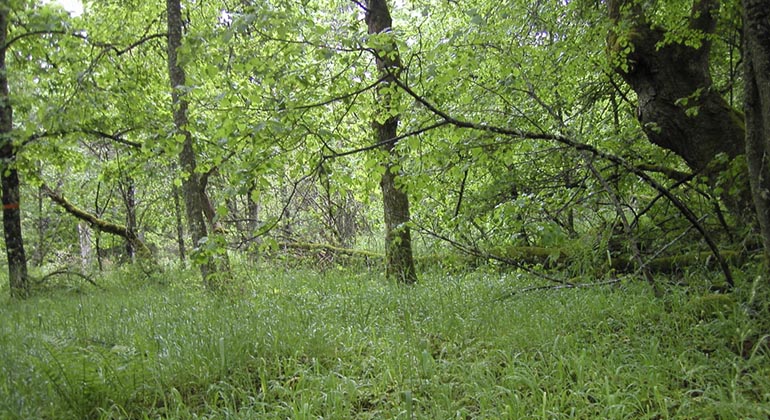
    Photo: Sandra Thunander

Lindhult, Naturreservat

  • Nature reserve
of 5 stars

Actions

  • Directions

Description

Lindhult Nature Reserve is a peaceful little oasis in the middle of the forest. A forgotten hay meadow that has been left to grow again. Here, the black-and-white flycatcher and the green warbler are left alone, along with several other bird species that form a lovely choir in the spring.
Apart from some natural overgrowth, time has stood still in Lindhult since the reserve was established in 1951, as one of the first in the county. Step by step, nature is taking back what man once used. In Lindhult you can be on your own. A nice path runs through the peaceful area. There are no other amenities.

Old cultivated landscape

As early as 1951, a small deciduous forest area was protected here in Lindhult. Further back in time, the area was much more open and was used for both mowing and grazing before it was left to slowly grow again.
Leaves were also an important resource in the past as winter feed for livestock. Several old lime trees bear traces of leaf cutting, known as pollarding. Linden is the area's most common tree species and was probably so in the past, given the name Lindhult. There are also plenty of oak and maple trees, and the shrub layer is dominated by hazel with hints of try and rosehip. The sparse forest in the north transitions southwards into a more closed grove forest. The moist ground next to Tripphultsmossen is mainly birch and alder. Green warblers, black and white flycatchers and great spotted woodpeckers are some of the birds that thrive in the reserve.

Rich spring flowering

Old forests with lime, oak and other so-called noble deciduous trees are today a rare habitat type in Örebro County, and indeed throughout Europe. Lindhult provides a small glimpse of the vast broadleaf forests of the past and offers a sanctuary for some of the threatened species of broadleaf forests. Both oak and lime need plenty of space to grow old. Therefore, we sometimes clear spruce and some younger deciduous trees in the area. The vegetation is rich in the reserve. On the ground, you can find various grasses such as horsetail and meadow grass. In the spring, many herbs bloom, such as cornflower, spring pea and toothwort. In the eastern part of the reserve there is also a small stand of the inconspicuous orchid, helleborine. There is also a lot to explore among the fungi here in Lindhult. On the ground you'll find rarities such as the almond and curly-leaved chanterelle, while the brown-skinned and oxeye mushrooms grow on dead branches and trunks.

Weather forecast (at 12:00)

Loading…

Get here by public transport

Activities And Facilities

  • Nature reserve

Facts

Municipality: Hallsberg

Year established: 1951, expanded in 1980

Area: 2 hectares

Landowner: Grimstens häradsallmänning

Administrator: County Administrative Board

Reserve creator: County Administrative Board

Natura 2000: the area is part of the EU's network of protected nature, SE0240126 Lindhult

Directions

In central Östansjö, turn onto Bredslättsgatan. Turn right after 500 meters and right again after another 500 meters. Turn left after 800 meters.

Regulations

In the reserve it is forbidden to:

  • make fires
  • drive motorized vehicles
  • ride horses
  • camping
  • picking flowers, digging up or otherwise damaging herbs, grasses, mosses or lichens
  • breaking twigs, felling or otherwise damaging living or dead trees and shrubs, taking seeds and otherwise damaging vegetation
  • organizing orientation checks or marked trails
  • putting up a board, placard, poster, sign, inscription or similar

Contact

Email address

Please be aware that some of these texts have been automatically translated.

I’ve been here 1
I want to go here 1

Questions & Answers

Ask a question to other Naturkartan users.

Reviews

—

0 reviews

of 5 stars

5 :
0.0%
4 :
0.0%
3 :
0.0%
2 :
0.0%
1 :
0.0%

Users images

No user images yet. Be the first to share!

Naturkartan

Open this in the app