
-
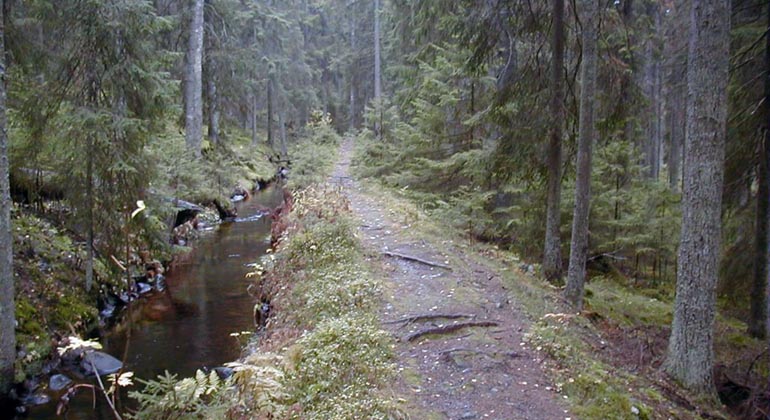
Kanalen till Pershyttan.
Photo: Peter Ström
Kvarnbäcken-Lerkesån, Naturreservat
- Nature reserve
- County: Örebro län
Actions
Description
The Kvarnbäcken-Lerkesån nature reserve has one of the county's finest populations of river pearl mussels. The stream is also home to trout and stone loach, and rare mosses grow on the stones. The area's hydropower has been used by man for many centuries for various purposes. Because of the rare pearl mussel, the reserve is part of Natura 2000, the EU's network of valuable nature sites.
Pearl mussels and rare mosses
In Kvarnbäcken-Lerkesån, there are plenty of pearl mussels of different ages, which shows that new mussels are being produced. This indicates that the habitat is also good for trout. The larvae of the river pearl mussel live as parasites on the gills of the trout for about nine months. Rare mosses, such as thread moss, grow on rocks in the stream. Adjacent to the stream there are remnants of former open environments with an interesting meadow flora. Among other things, several species of dewberry grow here. Beavers also occur along the stream valley and affect the environment by felling deciduous trees and building dams.
The water was once used as a source of power
Just west of Kvarnbäcken-Lerkesån is Pershyttan, a miners' village where miners have mined iron ore and produced iron since the 14th century. In the landscape around the village there are many traces and remains that tell the story of mining for 700 years; everything from coal beds and slag heaps to peat remains and overgrown fields. The water in Kvarnbäcken-Lerkesån has provided power for a number of activities. Along the southern part of Lerkesån, there are remains of a hammer forge (Övre Stampen) and a chamois leather stamp (Nedre Stampen). Slag from older iron production in a blast furnace has also been found here, a form of smelting furnace that was often used before smelters became common. Along Kvarnbäcken there are traces of two mills, but also slag residues that indicate that there were probably also one or more smelters here. A canal was built in the latter part of the 19th century to bring more water to the Pershyttan smelter. With the help of this, the smelter could be operated all year round.
Activities And Facilities
- Nature reserve
Facts
Municipality: Nora, Örebro
Year established: 2005
Area: 66 ha
Landowner: Swedish Environmental Protection Agency
Manager: County Administrative Board
Natura 2000: the area is part of the EU's network for protected nature, SE0240028 Kvarnbäcken-Lärkesån
Directions
Kvarnbäcken-Lerkesån flows from south to north in the valley east of Pershyttan. Drive from Nora towards Pershyttan and turn off towards the slalom slope at Digerberget. The river flows past immediately west of the parking lot to the ski slope.
Regulations
In the reserve it is not allowed to:
- disturb the water flow in the stream
- move stones in the stream
- walk in the stream
Contact
Email address
Organization logotype
Please be aware that some of these texts have been automatically translated.
I’ve been here
I want to go here
Questions & Answers
Ask a question to other Naturkartan users.
Reviews
0 reviews
- 5 :
- 4 :
- 3 :
- 2 :
- 1 :
Users images
No user images yet. Be the first to share!