
-
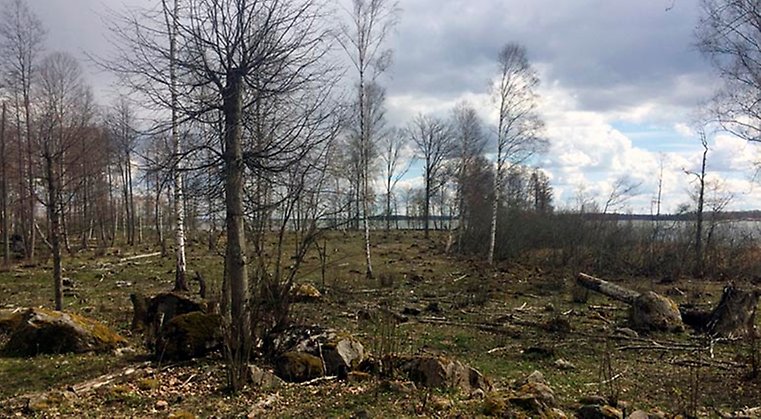
Göksholm.
Photo: Åsa Forsberg
Göksholm, Naturreservat
- Nature reserve
- County: Örebro län
Actions
Description
The Göksholm nature reserve consists of pastures and deciduous forest areas with many old, large oaks and other deciduous trees. And it is precisely the deciduous trees that are the reason why the area was protected. The fact that oaks, lime trees and other deciduous trees have existed here for a very long time makes the Göksholm peninsula a popular habitat for a wide range of rare and endangered species.
Farmed land with a long history
Göksholm has a long and exciting history. The farm's manor house is Sweden's oldest stone building that is still inhabited. Måns Bengtsson Natt och Dag, who was accused of murdering Engelbrekt in 1436, lived here. The farm's location in the middle of the Hjälmaren plains is well suited to cattle farming. Maps from the second half of the 19th century show that most of the reserve area consisted of hay meadows, where hay was harvested for winter feed for the animals. When agriculture was modernized in the 20th century, much of the hayfields were converted to pasture. The lowering of Lake Hjälmaren in the 1880s converted many previously wet areas into arable land. In the pasture west of Tomta there used to be a summer barn for dairy cows and at Björknäs there was a windmill and a brickworks in the 19th century.
Pastures with old deciduous trees
The area's high natural values are primarily linked to old deciduous trees in open and grazed land. Deciduous trees have grown here for a very long time, both broadleaf trees such as oak and lime, as well as other deciduous trees. As a result, it is home to many rare plants, fungi and animals. Among lichens and mosses we find species such as brown needle lichen, blunt feather moss, tree porella and trap moss. Göksholm is also a popular place for bats, with no less than six different species. Among the plants, we find, for example, soapwort, fern, toothwort and the slightly special yellow-flowering spring barley.
Deciduous swamp forest
In the swamp forest next to the shore, nature is allowed to take care of itself, which provides a varied environment that favors bird life, among other things. This forest began to grow after the Hjälmaren lake was lowered. There are deciduous trees such as silver birch and silver birch in various ages. Many different insects move into the dead and dying trees, which in turn become food for woodpeckers, for example. The reserve is also home to birds such as ospreys, tits and tits. Various larks and egrets like to rest in the open fields.
Activities And Facilities
- Nature reserve
Facts
Municipality: Örebro
Year established: 2017
Area: 116.4 hectares
Landowner: Private
Reserve creator: County Administrative Board
Reserve manager: County Administrative Board
Directions
The Göksholm nature reserve is located just under three miles east of Örebro town. Drive Hjälmarevägen from Örebro to Stora Mellösa, then turn left onto Göksholmsvägen. The nature reserve is located south of Göksholm farm, between the farm's central farmland and Hjälmaren.
Regulations
In the nature reserve it is forbidden to:
- drill, hack, blast, dig, carve, paint or otherwise damage rock, the earth's surface, stone or to move or remove stone,
- drive a motorized vehicle
- felling, removing or otherwise damaging living or dead standing or fallen trees and bushes
- make a fire other than in a place designated by the manager with firewood brought in or provided by the landowner or manager,
- damage vegetation in general, e.g. by digging up plants such as rice, grass, herbs, mosses or lichens,
- riding a bicycle or horse other than on a road and on designated trails
- deliberately disturbing wildlife, e.g. by climbing trees or staying near inhabited dens
- bring dogs that are not leashed during the period May 1-September 30, other than herding dogs when working with grazing animals in the reserve,
- collect animals, lichens or mosses without the permission of the County Administrative Board,
- without the permission of the County Administrative Board, set up a permanent board, sign, poster or similar device or to cut tracks,
- without the permission of the County Administrative Board, use the area for organized competitions or exercises, camp activities or similar.
But it is allowed to:
- pick berries, edible mushrooms and flowers for your own use, but not protected species.
Contact
Email address
Organization logotype
Please be aware that some of these texts have been automatically translated.
I’ve been here 1

I want to go here
Questions & Answers
Ask a question to other Naturkartan users.
Reviews
0 reviews
- 5 :
- 4 :
- 3 :
- 2 :
- 1 :
Users images
No user images yet. Be the first to share!