
Dyestad is a mushroom site of distinction. Mycologists have found several unusual fungi in the lush soil. There are also many examples of unusual lichens in the reserve. They grow mainly on the trunks of deciduous trees.
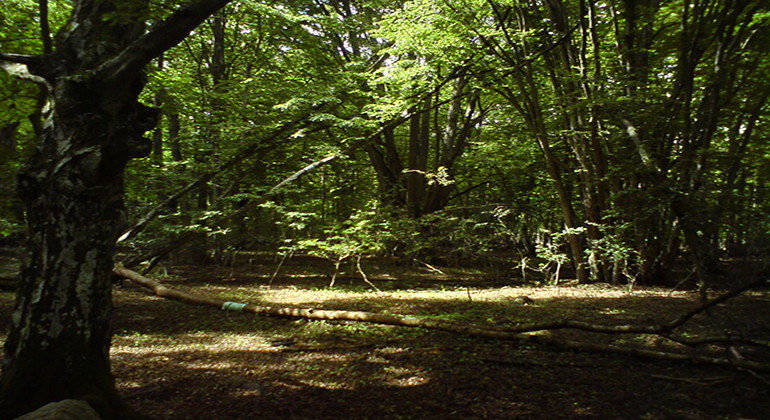
You are now on the edge of the Mittlandsskogen, Northern Europe's largest contiguous deciduous forest area below the mountain range. Here in Dyestad, as in many other parts of Mittlandsskogen, broadleaf trees dominate. The broadleaf forest is about a hundred years old and the most common tree species are hornbeam and oak. In the south, the forest turns into a pasture. The entire reserve area is grazed by cattle.
As many as 50 different species of fungi are registered for the area in the Öland Botanical Association's flora register. A real rarity is the small fox spider, which has only been found in a few places in the whole country. Other examples of Dyestad's rich fungal flora are saffron spider mite, saddle marble and red-flamed thread.
Many of Mittlandet's broadleaf forests today grow on land that until the beginning of the 20th century was broadleaf meadows and pastures. In Dyestad there are traces of the time before the deciduous trees took over. In several places you can see simple rows of stones, partly sunk into the ground and overgrown with moss and grass. These so-called stone strings are the remains of enclosure walls. The function of the walls was to exclude grazing animals from the harvest fields or simply to mark a boundary. The stone walls probably date from the Iron Age.
Year of decision: 1998
Area: 6.2 hectares
Municipality: Borgholm
Landowners: Swedish Nature Conservation Agency and individuals
Manager: Kalmar County Administrative Board
The reserve is located in the immediate vicinity of Dyestad village, 14 km northeast of Färjestaden. The area can be reached via a small private road from the public road to Dyestad-Björkerum.Parking lot is located in the southern part of the reserve.
In the nature reserve you are not allowed:
After consultation with the County Administrative Board, you may:
C. Regulations according to Chapter 7, Section 30 of the Environmental Code on the right to travel and stay in the reserve and on order in general.
In addition to prohibitions and regulations in other legislation, it is prohibited to,
Surveys or research must be carried out in consultation with the County Administrative Board.
Per Markus Jönsson

Please be aware that some of these texts have been automatically translated.
Ask a question to other Naturkartan users.
0 reviews
No user images yet. Be the first to share!