
Uggarde Rojr
- Archaeological
- County: Gotlands län
- 6981.89 km away from you
Actions
Description
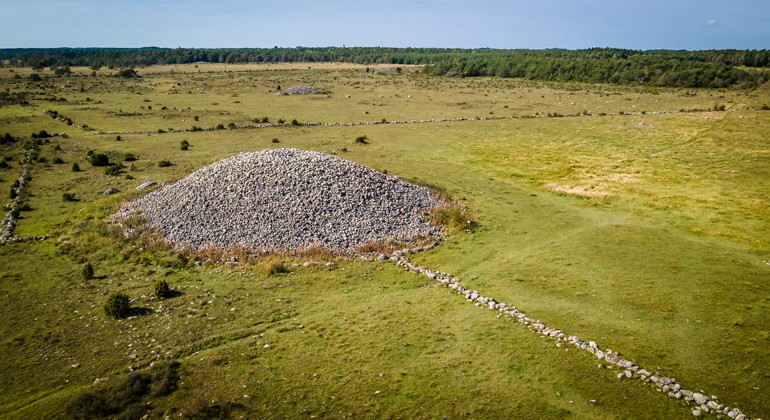
A marked trail takes you around this historic landscape. Among other things, you will see Gotland's largest Bronze Age cairn, Uggarde rojr.
The area has a concentration of large Bronze Age cairns in a low-lying and open landscape along the former coastline. The environment and the remains show how the landscape was used during the Bronze Age and the Early Iron Age.
In addition to the large cairns, there are also scattered smaller burial grounds and occasional graves in the form of shipwrecks and stone circles.
The cairns are burial sites. They have often been used for a long time and are burial places for several people. The cairns functioned as a form of territory marking, to mark out their area. The weather lines have been important, with the south having a special significance. It is common for there to be a south-facing structure at burial sites from this time, as here at Uggårde.
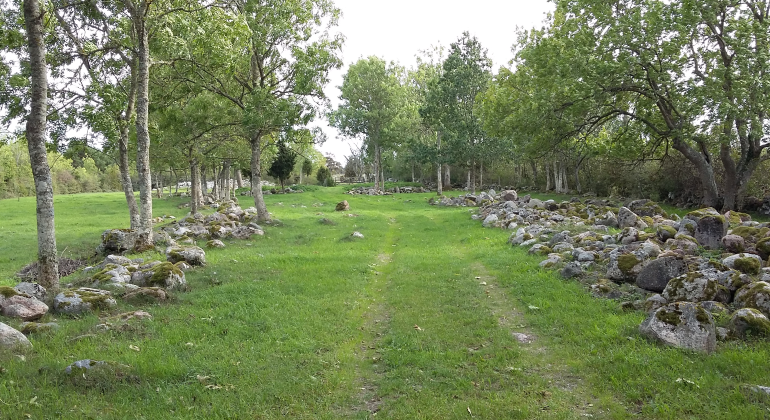
A little inland there are remains that indicate settlement and cultivation. House foundations and stone walls have been found here, and there is also one of Gotland's largest fossil field systems.
Good to know for you as a visitor
- At the parking lot there is an information sign about the area and leaflets for the cultural trailPdf, 2.5 MB..
- To enter the visitor site area, you need to pass through the paddock.
- There are cows grazing in the pasture.
- It can be wet and muddy, especially in spring and fall.
- The facilities and parking lot are on private land. Please be considerate, leave no litter and respect the animals.
Activities And Facilities
- Archaeological
Facts
Socks: Rone
Characteristics: Bronze Age cairn, cultural trail
Landowner: Private
Type of protection: Ancient monument
Directions
From Visby - take road 142 to Hemse, turn off towards Rone and continue towards Ronehamn. Turn right towards Havdhem and then directly left towards Sigdes / bygdegård. At the T-junction turn right and then the visitor center is on the left.
Regulations
The cairns and the stone strings are protected as ancient monuments according to the Cultural Environment Act (1988:950), Chapter 2.
According to the Cultural Environment Act, permission from the County Administrative Board is required to disturb, remove, excavate, cover, alter or damage an ancient monument.
Remember that a land area around each ancient monument is also protected. Even a newly discovered ancient monument has immediate protection.
If you are unsure how large the protected area is, you can contact the County Administrative Board.
Contact
Email address
Länsstyrelsen i Gotlands läns naturvårdsförvaltning
Organization logotype
Please be aware that some of these texts have been automatically translated.
I’ve been here
I want to go here
Questions & Answers
Ask a question to other Naturkartan users.
Reviews
0 reviews
- 5 :
- 4 :
- 3 :
- 2 :
- 1 :
Users images
No user images yet. Be the first to share!