
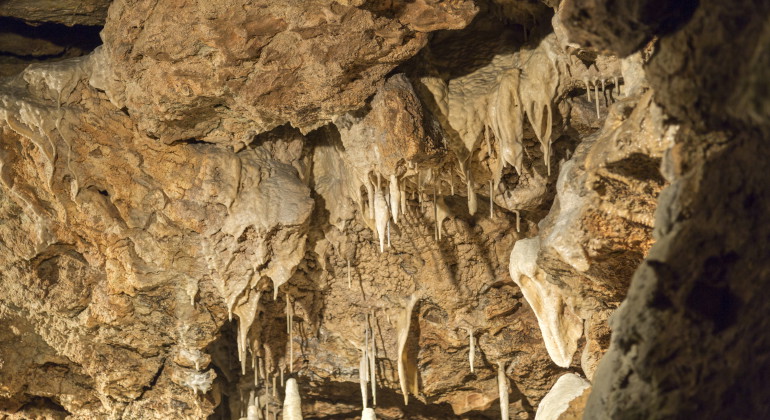
Lummelundagrottan, Naturreservat
- Nature reserve
- County: Gotlands län
Actions
Description
Lummelunda Cave is one of the longest caves in our country - the total length of the parts explored so far is almost 4.5 kilometers. However, there is still a lot to discover. In summer, you can see the outer part of the cave system with a guide.
The cave is a so-called karst cave that has been formed by water penetrating the limestone bedrock through narrow cracks. Where the surface water met the groundwater, the water began to dissolve the limestone, creating longer and longer underground passages.
The cave can be said to consist of two parts: a water-bearing, active part and a now dry part, the fossil system. The water that flows through the active part of the cave comes from a canal dug through the now drained Martebo bog. At the bottom of the canal there are several sinkholes, where the water disappears into the ground and then finds its way to the cave by hitherto unknown routes. The cave contains many beautiful stalactites of various kinds. The inner parts of the cave have a relatively constant climate with an air temperature of 8-12o C and a relative humidity of 95-100%.
Most of the cave was probably formed before the last ice age. The mouth of the cave, Linnaeus' cave, has been known for a long time and is mentioned by Linnaeus from his trip to Gotland in the summer of 1741. However, the inner part of the cave was only discovered in 1950 by three young people.
Activities And Facilities
- Nature reserve
Facts
Year of protection: 1989
Parish: Lummelunda
Characteristics: Caves
Area: 17 hectares
Landowner: Private/Naturvårdsverket
Manager: County Administrative Board of Gotland
Type of protection: Nature reserve
Regulations
For everyone's well-being and to maintain the reserve's natural and cultural values, it is important that all visitors show consideration. In addition to the right of public access, it is not allowed to:
- without the permission of the County Administrative Board, enter the part of Lummelunda Cave that lies inside Hall 6 (see map),
- chop, chisel or drill in solid rock,
- pick or remove any form of mineral such as stone, fossil or newly formed limestone, e.g. dripstones,
- building a fire
- collecting animals.
Contact
Email address
Länsstyrelsen i Gotlands läns naturvårdsförvaltning
Organization logotype
Please be aware that some of these texts have been automatically translated.
I’ve been here 16





I want to go here 2
Questions & Answers
Ask a question to other Naturkartan users.
Reviews
0 reviews
- 5 :
- 4 :
- 3 :
- 2 :
- 1 :
Users images
No user images yet. Be the first to share!