
Kastalbacken
- Archaeological
- County: Gotlands län
- 6984.40 km away from you
Actions
Description
North of Lau church is a ruin of a castle built in the 12th century. During the 13th and 14th centuries, the castle was rebuilt and used as a vicarage.
Castles of Gotland
During the 12th and 13th centuries, the Baltic Sea was ravaged by foreign powers and on Gotland, farmers and burghers fought over trading rights. In 1288, a civil war broke out. Kastals, castles, were built as defense facilities. Gotland has 12 known castles or defense towers, 4 round and 8 square. Most are located some distance from the coast, near churches or at former harbors or trading posts.
A castle is built on the same principle as a core tower in a medieval castle. A core tower was the strongest part of the castle. Castles were built of stone, with thick walls and often inaccessible entrances, narrow staircases and dark passages - all so that an invading enemy could be easily surprised. Castles have several floors, the top and bottom of which are usually vaulted.
Lau castle
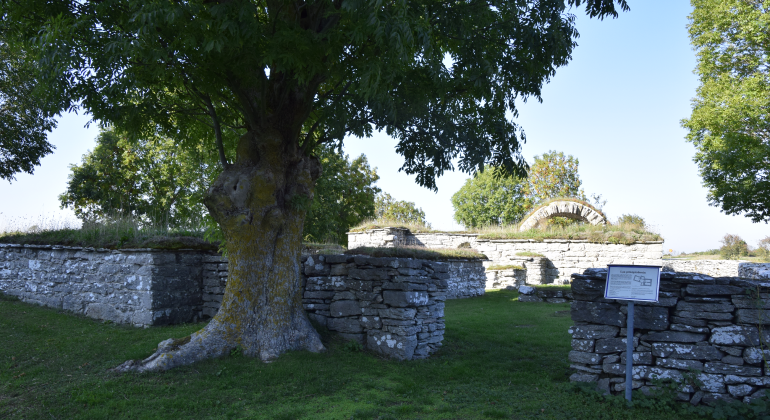
The ruin you see in the picture above is a composite ruin consisting of an older and a younger part. The far part in the picture is the oldest part. It is built square with thick walls. In the picture above you can see the vault that belonged to the castle. The thick walls of the older part indicate that it was a castle, a defense facility.
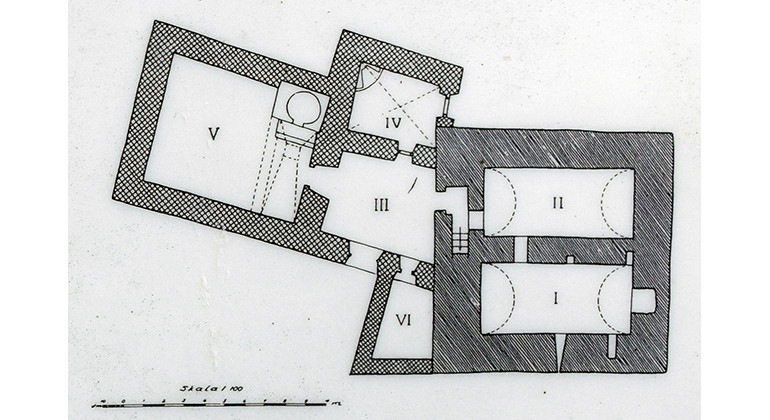
On the ground floor of the castle there are two rooms of the same size (Room I and Room II in the photo). They both previously had barrel vaults. The remains of the staircase that led to the upper floor of the castle are visible in the wall outside Room II.
The younger part was added in the 13th-13th centuries and is the remains of the medieval presbytery. Room III served as a hall and room V as a kitchen. Room IV had plastered walls on the inside. During the restoration in 1935, traces of a curtain painted in black, yellow, red and blue were seen on the plaster remains.
Good to know for you as a visitor
- The ruin is visible from the road. Parking is available adjacent to the cemetery.
Activities And Facilities
- Archaeological
Facts
Socks: Lau
Character: Medieval ruin
Landowner: Föreningen Gotlands fornvänner
Type of protection: Ancient monument
Directions
From Visby: Drive road 143 towards Ljugarn for about 45 km. Just before the village, turn right towards Alskog and Lau. After about 1 km, turn towards Lau. Park the car at the church.
Regulations
The ruin is protected as an ancient monument according to the Cultural Environment Act (1988:950), Chapter 2.
It is forbidden to climb on the ruin.
According to the Cultural Environment Act, permission from the County Administrative Board is required to disturb, remove, excavate, cover, alter or damage an ancient monument.
Remember that a land area around each ancient monument is also protected. Even a newly discovered ancient monument has immediate protection.
If you are unsure how large the protected area is, you can contact the County Administrative Board.
Contact
Email address
Länsstyrelsen i Gotlands läns naturvårdsförvaltning
Organization logotype

Please be aware that some of these texts have been automatically translated.
I’ve been here
I want to go here
Questions & Answers
Ask a question to other Naturkartan users.
Reviews
0 reviews
- 5 :
- 4 :
- 3 :
- 2 :
- 1 :
Users images
No user images yet. Be the first to share!