
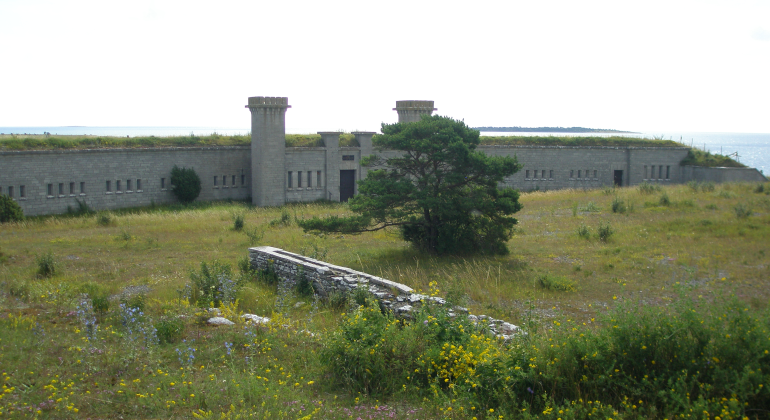
Enholmen
- Archaeological
- County: Gotlands län
- 6969.97 km away from you
Actions
Description
On this barren island, just outside Slite, you can learn about a piece of defense history and how it developed from the 17th century until 2010.
Few places in Sweden have a military history to tell from the 1600s to the 2010s. Most buildings have been erected and demolished and adapted to prevailing defense strategies. Today, well-preserved remains and buildings remain and tell the story of Gotland's defense history.
Enholmen as a defense facility
After the Peace of Brömsebo in 1645, planning began for the five-cornered bastion rampart, the construction of which began in 1657 and was then interrupted. Work resumed in 1711 and was not completed until 1771. The name Carlsswerd derives from the swords of Carl XII: Doppskon, Knappen, Fästet, Klingan and Baljan.
However, the defense facility quickly became obsolete and was demolished in 1788, following an increased threat from the east and Sweden's changed defense strategy.
When cholera reached the shores of the Baltic Sea in 1831, a quarantine station and a cholera hospital were established on Enholmen. The site reverted to a port of war during the Crimean War in 1853. As a result, two casemated defences were built and completed in 1858. By 1904, the facilities were replaced by the Mojner battery, south of Slite, and the Enholmen batteries were closed.
However, Enholmen has been manned by military guards during the two world wars and has subsequently had various functions, including as a training ground for the coastal artillery in Fårösund. It was not until 2010 that Enholmen was demilitarized.
Good to know for you as a visitor
- You need to take a boat to get to Enholmen.
- Remember to show consideration, do not leave any rubbish and respect the wildlife on the island.
Activities And Facilities
- Archaeological
Facts
Parish: Othem
Character: Defense facility
Property owner and manager: Statens fastighetsverk
Type of protection: State building monument and ancient monument
Directions
From Visby: Take road 147 to Slite and follow the signs to Slite strandby, where the boats depart.
Regulations
The donjons from 1858 are protected as a state building monument under the Cultural Environment Act (1988:950).
Karlswärdsfästningsruin is protected as an ancient monument according to the Cultural Environment Act (1988:950), Chapter 2.
According to the Cultural Environment Act, permission from the County Administrative Board is required to disturb, remove, excavate, cover, alter or damage an ancient monument.
Remember that a land area around each ancient monument is also protected. Even a newly discovered ancient monument has immediate protection.
If you are unsure how large the protected area is, you can contact the County Administrative Board.
Contact
Email address
Länsstyrelsen i Gotlands läns naturvårdsförvaltning
Organization logotype

Please be aware that some of these texts have been automatically translated.
I’ve been here
I want to go here
Questions & Answers
Ask a question to other Naturkartan users.
Reviews
0 reviews
- 5 :
- 4 :
- 3 :
- 2 :
- 1 :
Users images
No user images yet. Be the first to share!