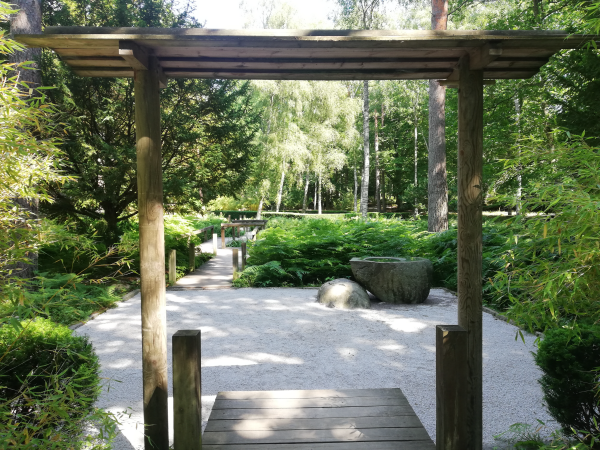
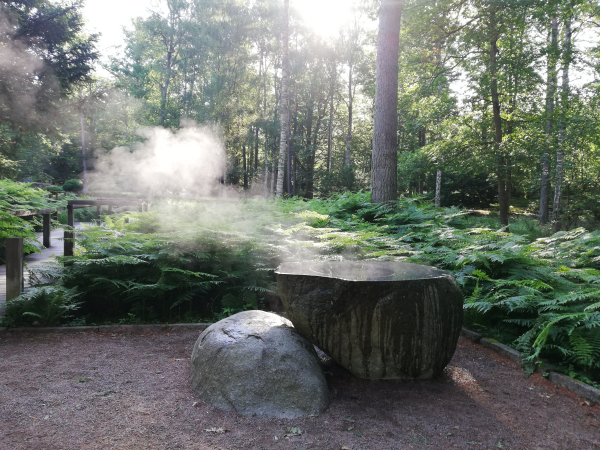
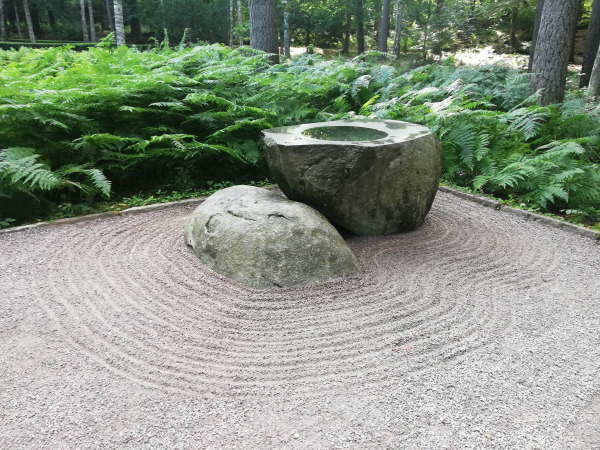
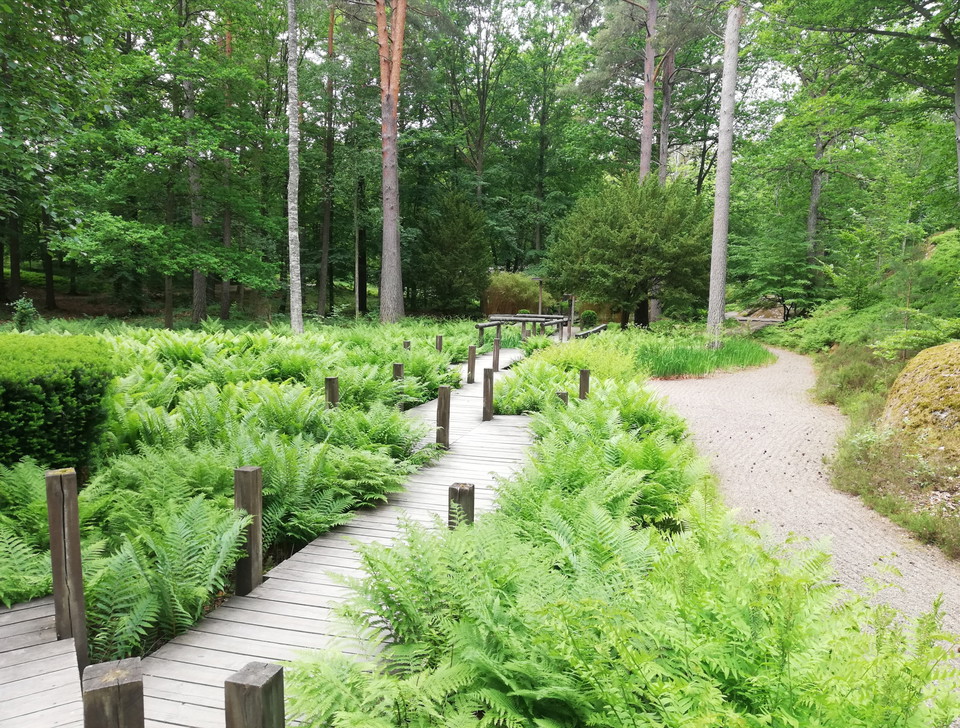
The Japanese garden in Ronneby has influences from both Zen Buddhist gardens and the tea garden, roji, as well as the promenade park. The Zen Buddhist temple gardens are usually so-called dry gardens - karesansui - strictly reduced in expression and material. They are viewed, not entered, from the temple porch.
In a Japanese garden, non-living objects such as stones and water are thought to have a living soul and a personality of their own. A stone has a tail, a head, a back and a stomach. Each stone has its own language, it hears, feels and sees. Many of the stones are selected with great care to fit into the Japanese garden environment. Everything is treated as if it were alive, tasks such as weeding are carried out with careful precision using correct, calm and efficient movements.
In a Japanese garden, it is all about metaphors, a stone in a small lake becomes the paradisiacal islands where everyone is happy and has eternal life. Small stones become endless mountain ranges, small plants become large forests. The raked gravel symbolizes the roaring waves of the endless seas. The original nature forms the basis of the garden, often the garden contains few components to give the visitor the opportunity to complete the picture with their own imagination.
Maintenance is important, a craft that requires patience and care. The plantings should be beautiful all year round. Trees and shrubs make up the largest part of the garden's vegetation, flowers are of secondary importance. Moss-covered stones are common features. Shrubs and trees are pruned so that they stand out in the best possible way, a reasonable amount of leaves may be left on the ground, and branches can be tied up to catch the snow in a beautiful way, all to give a pleasant impression.
After passing through the simple bamboo gate, a winding path leads to the meditation pavilion (tea house). The path is surrounded by Japanese maple, rustling mountain bamboo, Japanese iris in changing colors, fragrant wet moss and many other plants. The sensory experiences make the short walk to the pavilion a long journey. In the meditation pavilion, there is a strange feeling of being both inside and outside at the same time. You can stand here for a long time and enjoy the grandeur of nature.
The tea garden
The tea garden developed in connection with the ritualized way of drinking tea. Roji, which translates as dew, differs from other Japanese gardens in that it is more of a passageway to the tea house, a movement, than a garden. With the physical movement, one's mood also changes. Along the dew path, the visitor leaves behind the worries of everyday life and enters the peaceful world of tea.
The whole layout of the tea garden strives for a kind of refined poverty, where the scarce, almost unfinished materials leave the visitor to add their own thoughts. Most of the tea ceremony is about learning to sharpen all your senses, because only then can you develop and be enriched. That's why there are no bright colors, no floral displays. The greenery gives a dim light.
People come here to create spiritual peace and tranquillity through meditation; worries from everyday life disappear, thoughts are purified and the garden has the ability to capture the elements that make the mind see clearly again.
The Japanese Garden in Ronneby was created in 1987 with the help of landscape architect and professor Sven-Ingvar Andersson and his assistant, Japanese landscape architect Akira Mochizuki.