
-
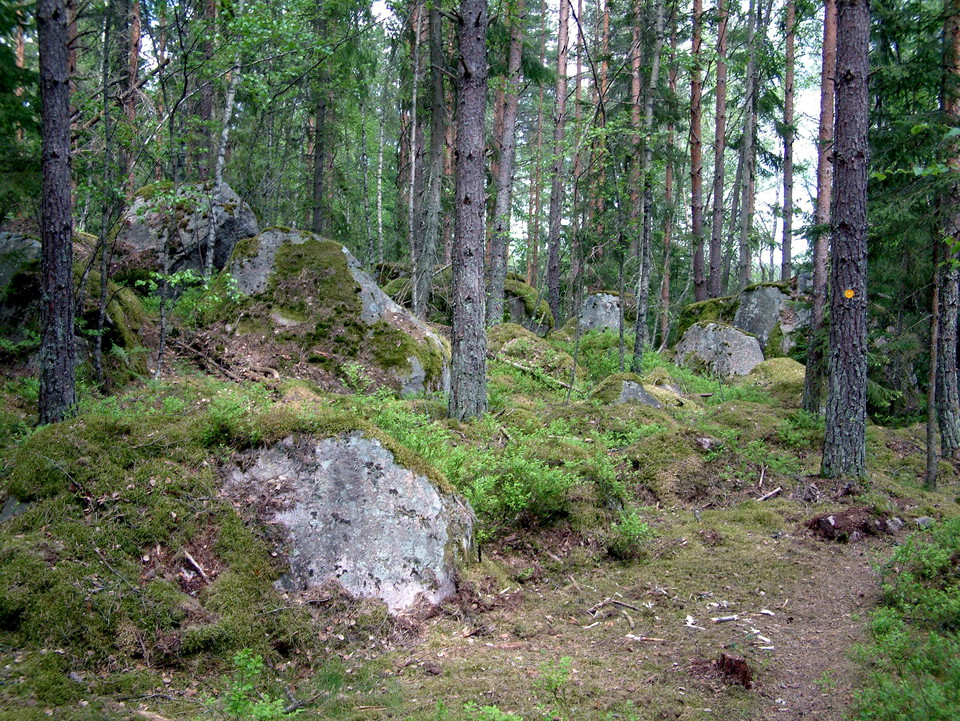
Storblockig morän med småkulliga ytformer är typiskt för ”Grimmansmåla mo” (G. Knutsson 2008).
Kuva: Gert Knutsson -
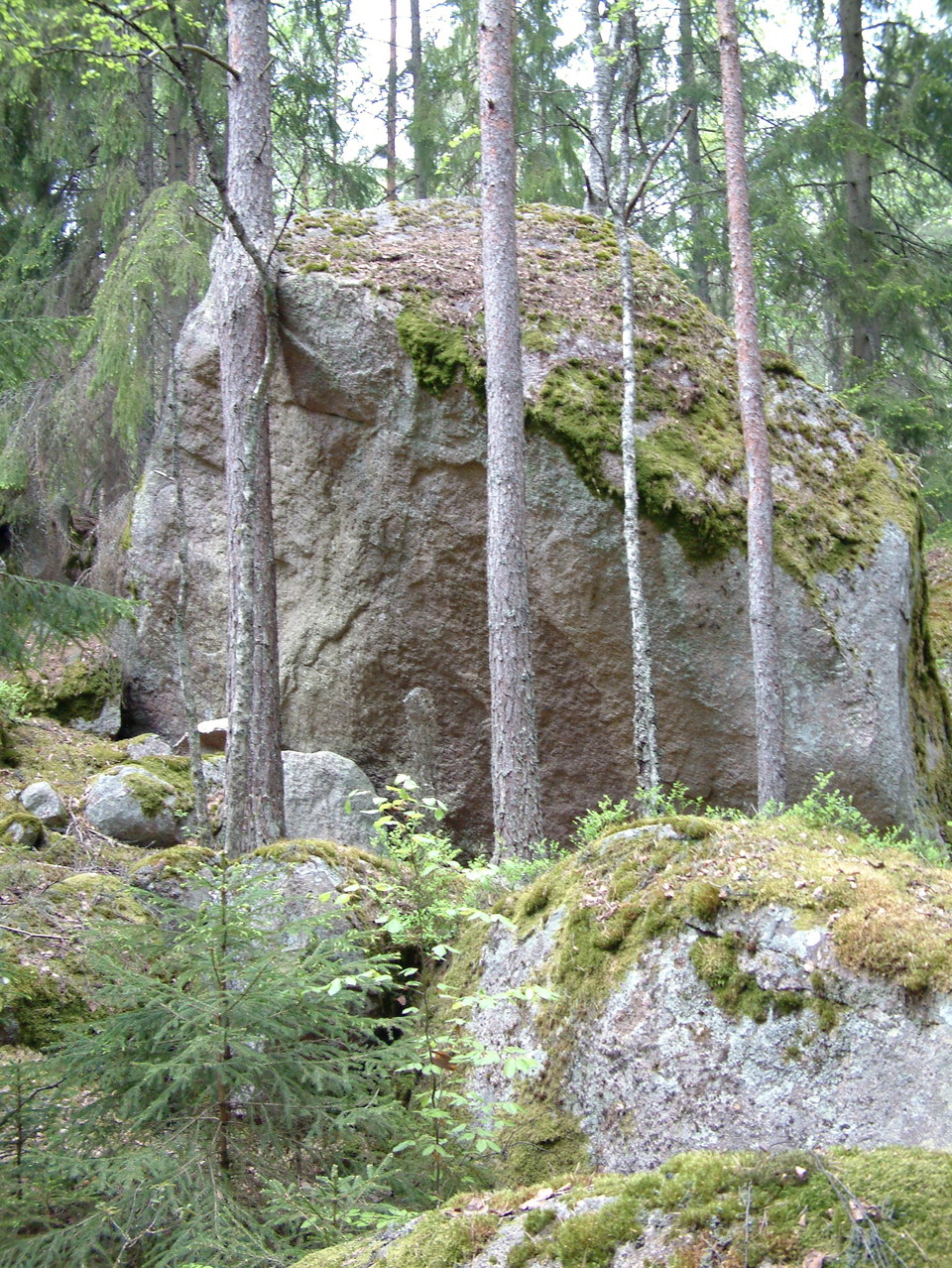
Jätteblock av röd Växjögranit i ”Grimmansmåla mo”. Sådan granit utvanns tidigare i trakten, först i s.k. blocksten (som detta block), senare i fast berg (G. Knutsson 2008).
Kuva: Gert Knutsson
Moränmarkerna
- Kiinnostuksen kohde
- Kunta: Kalmar län och Öland
- 6864.54 km päässä sinusta
Toiminnot
Kuvaus
The trail now runs almost entirely through very typical moraine soils ("Grimmansmåla mo"). Such soils have also been passed throughout the northern part of Rostockaholme and will also dominate towards the end of the trail south of Grimmansmålasjön.
Moraine (or pinnmo and in Småland "jätter") is the name given to the type of soil that was formed when the once mighty inland ice slid across the landscape, picked up loose soil material (weathering products and the like), broke off both large blocks and stones from the rock and packed it all together into our country's most common type of soil, moraine. It covers the bedrock almost everywhere and forms different surface forms depending on the depositional environment. Here at the trail, it is a little chalky, which indicates formation in a so-called dead ice environment in the Lyckebyån valley. The high villages in these areas, on the other hand, are often shaped as long narrow ridges, so-called drumlins, which were deposited by an active land ice, for example at Algutsboda church (Knutsson 1962).
The moraine usually has a sandy-muddy or gravelly groundmass and often high block and stone content. The grain size composition depends to a large extent on the type of rock in the area and on how far the particles were transported. The most common type of rock here, the red Växjögranite, has clear but sparse fractures, allowing large blocks to be broken off by the ice. The diorite gave rise to much smaller blocks, as did the hard and small-cracked porphyry, which is found in the northern part of Algutsboda. As a rule, the blocks are sparsely scattered on the surface and inside the moraine, so-called normal blocky moraine, which is the most common cultivation soil in the area. The many and sometimes wide stone walls testify to an impressive cultivation effort - it has been calculated that the total volume of the stone walls in Algutsboda parish is as large as the volume of the Pyramid of Cheops in Egypt (Edmark 1981). However, the moraine along this part of the trail is mostly rich or large boulders and has been too difficult to cultivate except in a few "lucky spots".
Look around you along the trail! There are large areas of large granite boulders and some very large boulders, boulders or so-called giant boulders. Stacks of large boulders and overhangs of giant boulders even form small caves, e.g. at the hill southeast of Grimmansmålasjön, where the giant boulder measures about 5 x 5 x 5 meters!
Toimintaa ja tilat
- Kiinnostuksen kohde
Ota yhteyttä
Sähköpostiosoite
Olen ollut täällä
Haluan mennä tänne
Kysymykset & vastaukset (Q&A)
Esitä kysymys muille Naturkartan-käyttäjille.
Arvostelut
0 arvostelut
- 5 :
- 4 :
- 3 :
- 2 :
- 1 :
Käyttäjien kuvat
Käyttäjien kuvia ei ole vielä. Ole ensimmäinen, joka jakaa kuvan!