
-
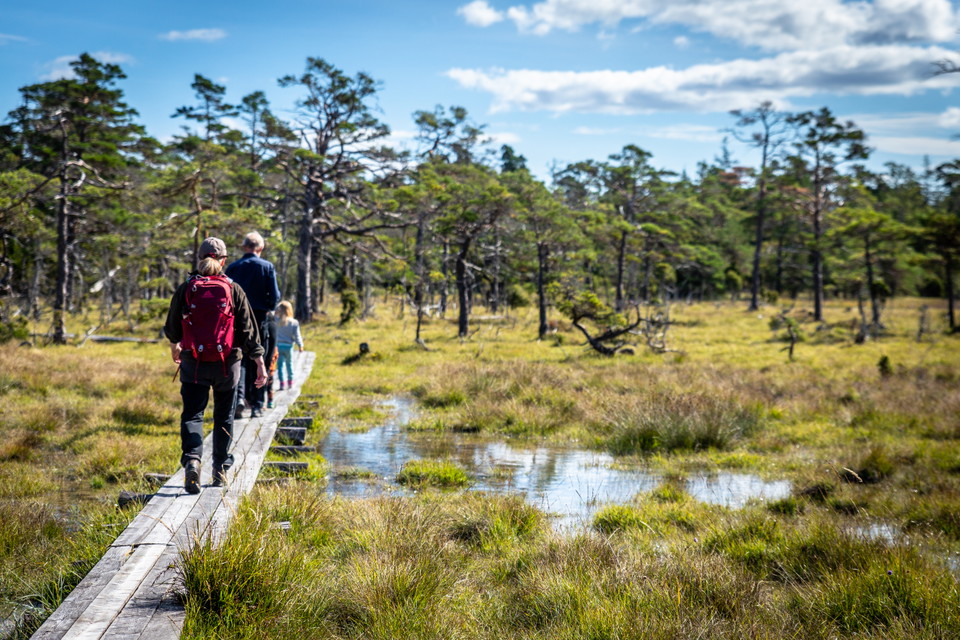
Över våtmarksområdena är stigen spångad.
Photo: David Skoog / Länsstyrelsen i Gotlands län
Naturstig, Kallgatburg
- Hiking
- Near parking
- Circular trail
- County: Gotlands län
- 6962.45 km away from you
Trail details
- Length 2.5 km
Actions
Description
Welcome to Kallgatburg Nature Reserve. A 120-hectare reserve that is home to Sweden's largest population of yew and a spring-fed wetland area with interesting flora, Rövätar.
The hiking trail
The 2.5 kilometer long hiking trail takes you well into the reserve over paths and trails. On the map you will see several points of interest, which should also be marked with numbers on the path's signposts.
You will find a description of each point of interest on the respective markings in the map, but they are also listed below for those who prefer to read here.
1. The beginning of the path
The path initially follows an old road that is already marked on the surveyor's map from 1698 and is called Enewätsgatan. Along the fence to the right are a couple of small yews. Common herbs along the path up to station 2 are daisy, buttercup, bloodwort, cowslip, little bluebell and common tansy.
2. Ole's meadow
We have now passed a wide gravel embankment and come down into a depression with open ground. The area, called Ole's meadow or Ainvätar by the locals, has previously been meadowland and you can clearly see that most of the old ash trees that grow in the vicinity bear clear traces of leaf cutting (felling or pollarding). Foliage harvesting involved using a long knife to cut or chop off leafy twigs and branches from the trees in late summer in order to dry them and later use them as winter feed for the animals. The leaves were considered an excellent complement to hay. In early summer, you can see some flowering orchids out here in the open area. The most common are St. Peter's keys. During the spring snowmelt or after heavy rain, the depression is often completely filled with water.
3. Cold meadow plants
We will now soon reach the northern part of Rövätar. Here you can make the first acquaintance with typical spring marsh plants such as axag, water primrose (blue flowers), mountain primrose (white flowers), mayweed, marsh lily and greater willowherb (growing mainly along the edge of the water body obliquely to the right) as well as the orchids meadow keys, marsh keys, bride's spurge, sweet spurge and marsh clubroot.
4. Pale meadows
In this area, the soil layers are dominated by bleak, which is a highly calcareous soil that develops on moist ground. It occurs throughout the open area but is most evident in the former trackway to the left of the path. Forest growth is very slow on these pale soils, and some of the pines out here are more than 250 years old.
Among the herbs, you may notice bloodroot, cleavers, cornflowers, lily of the valley, meadowsweet (blooms only in August) as well as spurge and marsh marigold.
5. yew
Even the legendary nature conservationist Rutger Sernander believed in the 1940s that the large yew stand at Kallgatburg should be protected. The yews here are so dense that very little light penetrates to the ground. As a result, the undergrowth is extremely sparse. Among the plants that still manage to survive down in the darkness are mainly blue and white anemone, lily of the valley and squirrelberry.
Yews are dioecious, i.e. the male and female flowers are on separate trees. They flower in April and bear red fruit in September. The seeds of the yew are dispersed by birds that eat the fruit; the flesh of the fruit is the only part of the yew that is not poisonous.
(Note, however, that the seeds inside the fruits are poisonous!)
5B. Detour to the Gucko shoe
A detour of about 1km from the trail takes you to Gotland's richest site for the orchid guckosko. Guckuskon normally blooms in late May to early June and many orchid enthusiasts flock here during that period.
6. Karls gata
The path now follows a gravel embankment formed by Lake Ancylus, a predecessor of today's Baltic Sea. The embankment is about 35 m above the current sea level. In older times, the highway between Visby and Bunge ran along the embankment, and it is actually this road that has given its name to this area. Kallgate (= Karls gata, Karls väg) is an Old Swedish name for what we would now call a "public highway" ("Karl" in Old Swedish meant "free individual man, farmer".) Along the path grow - in addition to lots of yew - ash, hazel, rowan, oxel, rock oxel, hazel, bracken and forestry.
7. The oaks
Old oaks are home to many species of wood-boring insects that gnaw their way through the wood. This old oak can be around 400 years old, and for half of its life it can serve as a home for various rare insect species.
8. Bloodthistle and ag
On both sides of the footbridge grows bloodroot, a plant that in our country only occurs on eastern Gotland. The flowers of the bloodroot are gathered in a dense, rounded axil. It has no petals, and the red in the flower consists of the bracts. Bloodroot blooms in high summer.
In this part of the bog, you can also see some rye grass. Agen is a semi-grass with broad, sharply serrated leaves. On Gotland it was once very important as a roofing material for outbuildings, and some barns and sheds are still roofed with ag. The vegetation in this part of Rövätar is otherwise completely dominated by the grass bluebell.
9. Fungi and insects
The path passes an old pine log (to the right of the path) that is very slowly being broken down by fungi and insects. The released nutrients are then taken up by the plants growing around it.
10. Old pine tree
Because of the difficulty of transporting the timber, forests on moorland have usually not been felled but left untouched. It has therefore been able to grow very old.
This pine tree was a small seedling in 1707, when Charles XII was king of Sweden, and is now over 300 years old.
11. Carnivorous plants
To the left of the footbridge grows the greater willowherb, which is one of our country's few "carnivorous" plants. Small insects that land on the leaves get stuck on the red, sticky glandular hairs that sit along the edges of the greenish-yellow leaves. Once an insect is stuck, the leaf curls up and egg white-digesting enzymes dissolve the insect's soft parts. The larkspur blooms with white flowers in July.
Other typical spring marsh plants that grow here next to the footbridge are axag, grass wool, mayweed, marsh lily and marsh keys.
12. Woodruff and brown eyebright
Here along the eastern side of the path, in addition to the spring marsh plants we became acquainted with earlier during the hike, you can see a couple of new species.
One of them is the brown eyebright, a semi-grass that in Sweden only occurs in limestone bogs on Gotland and a few places in Skåne. The other plant that can be found here is brown eyebright, which only occurs on Gotland and here lives as a parasite on axag. The brown eyebright is rather inconspicuous and can be quite difficult to find, but it grows mainly in the tufts of axag. It does not flower until August.
13. Bryet
Here is a water collection, a brya, which holds water all year round and during the summer serves as a water hole for the grazing animals. Along the edge of the water collection grows, among other things, dune and ditch veronica and marsh marigold, and down in the water you can see loops of frog's tail.
14. The stream channel
Here the path follows a stream channel that is filled with water during snowmelt but is usually completely dry in summer. The water comes from a spring (a crack in the rock) located near the western boundary of the reserve.
The ground vegetation is quite sparse but typical of shady areas and is dominated by wood anemone, wild garlic, wild lettuce and musk madder. Just as you enter the woodland mist, to the right of the path, under a hazel tree, you can see a small stand of stinkweed, a coriaceous plant that really lives up to its name.
A little further on, up on the embankment of old beach gravel, the ground is well-drained, and here you will find typical dry-land plants such as creeping thyme, sundew, yarrow, bluebell, bloodwort, gray mallow, coastal rue, goat's beard, yellow pennywort, common brownwort and oxberry.
Activities And Facilities
- Hiking
- Circular trail
Accessibility
- Near parking
Surface
Path and footbridge
Hills
Almost completely flat
Vegetation
Stilts over fences, railings.
Downloads
Contact
Email address
Länsstyrelsen i Gotlands läns naturvårdsförvaltning
Organization logotype
Please be aware that some of these texts have been automatically translated.
I’ve been here 4


I want to go here 4
Questions & Answers
Ask a question to other Naturkartan users.
Reviews
0 reviews
- 5 :
- 4 :
- 3 :
- 2 :
- 1 :
Users images
No user images yet. Be the first to share!