Langhammars, Naturreservat
- Nature reserve
- County: Gotlands län
Actions
Description
The stately rauks on the beach at Klajvika are without doubt the most photographed rauks on Gotland. They are even depicted on the back of the Swedish 200 kronor banknote. But Langhammar Nature Reserve has so much more to offer than rauks. The 480-hectare nature reserve includes Langhammars itself, which stands out as a peninsula just over 2.5 kilometers long between Aursviken in the west and Tällevika in the east, but also the alvar fields immediately south of Langhammars.
In the west, the reserve borders the lakes Bondansträsk and Norrsund, which are remnants of the ancient strait that once divided Fårö into a western and an eastern part.
The bedrock in the area consists of alternating layers of limestone and reef limestone. In the southern part of the reserve, the soil cover is thin, and in many places the slope is exposed. However, especially in the northern part of Langhammars, the rock is largely covered by beach gravel and shingle, and along the shore from Bondansträsk to Grunnsänden there is a strip of shingle embankments up to 300 meters wide. On the beach slope above Klajvika there are more than 50 rauks, some of which are more than 8 meters high and shaped like picture spires. The rauko area at Langhammar is undoubtedly one of Gotland's most beautiful!
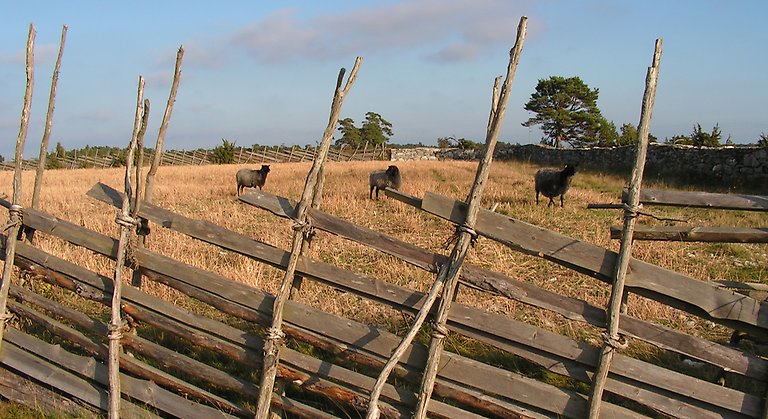
The vegetation on Langhammar and the land to the south is strongly characterized by the fact that the area has been grazed by sheep for a long time. Mainly in the southern part of the reserve, the landscape has the character of a small broken savannah landscape, where pine groves alternate with barren, heathy alvar surfaces and smaller areas with slightly more lush wet meadows. In the central part of Langhammar, the rocky ground is largely covered by low, creeping juniper bushes, which have been tamed by the sheep and the wind.
Naturally, the barren land within the reserve is not particularly rich in birdlife. However, breeding birds include herring gulls, sandwich terns, golden plovers and curlews. In connection with wetlands of various kinds, you will often see snakes meandering away. Insects you may encounter in the area include the Apollo butterfly, the blue-winged grasshopper and the giant woodpecker.
Activities And Facilities
- Nature reserve
Facts
Year of protection: 1931
Parish: Fårö
Character: Smoky area, rocky beach and rocky areas.
Area: 479 hectares
(459 land/20 water)
Landowner: Private/Naturvårdsverket
Manager: County Administrative Board of Gotland
Form of protection: Nature reserve and Natura 2000
Regulations
For everyone's well-being and to maintain the reserve's natural and cultural values, it is important that all visitors show consideration. In addition to the right of public access, it is not allowed to:
- dig, chop, chisel, drill or otherwise damage land, solid rock or boulders,
- move or remove stones, boulders or fossils,
- drive or park motorized vehicles outside designated roads and parking areas,
- set up a caravan or stay overnight in a motorhome
- make open fires other than in specially designated fireplaces.
Contact
Email address
Länsstyrelsen i Gotlands läns naturvårdsförvaltning
Organization logotype
Please be aware that some of these texts have been automatically translated.
I’ve been here 14



I want to go here 2
Questions & Answers
Ask a question to other Naturkartan users.
Reviews
0 reviews
- 5 :
- 4 :
- 3 :
- 2 :
- 1 :
Users images
No user images yet. Be the first to share!