
-
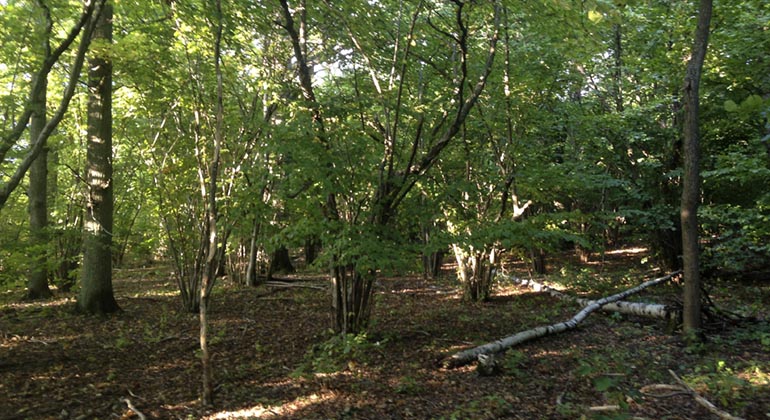
Berga äng.
Photo: Henrik Josefsson
Berga äng, Naturreservat
- Nature reserve
- County: Örebro län
Actions
Description
The Berga "meadow" nature reserve was a hay meadow with deciduous trees, which was already protected as a domain reserve in 1942. As the meadow did not continue to be mowed or grazed, it gradually grew back into a dense deciduous forest with oak as the dominant tree species.
Lövlund
The former meadow is now a completely closed hardwood grove. The crowns of 150-year-old oaks form a canopy over shrubs of hazel, cranberry, hedge, goat's-beard, gooseberry and gooseberry. The oaks in the reserve are considerably younger than oaks in other oak stands in Närke, such as the Sköllersta prästäng nature reserve, but there are old stumps of large oaks that have been felled. This shows that the oak has long been a dominant tree in Berga "meadow". The area is most accessible in spring before the leaves have fallen. Then the choir of birds is powerful under the canopy. A field road leads to the southern boundary of the reserve, but there are no marked paths or trails in the area.
Species of the dense deciduous forest
Woodpeckers, songbirds and many insects thrive in the impenetrable deciduous forest, which has now become a valuable refuge for animals living in deciduous trees in the cultivated landscape. Most of the former meadow plants have not survived the conversion to deciduous forest. One flower that has disappeared is the currant, which was here in the late 1940s. Some species that thrive in slightly sunnier places, but which are still present, are wild onion, cowslip, hogweed and teveronica. Instead, woodland plants that thrive in shady places have migrated in. These plants include fern, wood violet, wood anemone, lily of the valley, wood sorrel and sorrel. The reserve also has a couple of old cultivated plants, honeysuckle and gooseberries, which have gone wild from cultivation. Lichens and mosses are scarce and the fungal flora is poorly known. Known species include the hazel tick, which lives on the dead trunks of hazel, the oak-associated pale mushroom, the oak and hazel sulphur mushroom and the gray wart lichen, which grows on the bark of old deciduous trees.
Accessibility
Berga äng belongs to level 1 in the county administrative board's leveling of the county's nature reserves, which means that the reserve lacks outdoor recreation facilities.
Activities And Facilities
- Nature reserve
Facts
Municipality: Örebro
Established year: 1997 (domain reserve 1942)
Area: 3 hectares
Landowner: Swedish Environmental Protection Agency
Manager: County Administrative Board
Reserve creator: County Administrative Board
Directions
From Sköllersta, continue east on highway 52. Drive past the sign "Naturreservat Kvismaren" and turn right towards "Köpsta". Drive 300 meters and park at a small path that goes towards the meadow on the left.
Regulations
In the nature reserve it is forbidden to:
- damage the surface of the ground
- disturbing wildlife
- pick flowers, lichens and wood-living fungi or otherwise damage vegetation by picking or digging, make carvings on dry trees or bark or damage flames
- start a fire
- camping
- drive a motorized vehicle or ride a bicycle
- affix a picture, poster, billboard, sign, inscription or similar device
Contact
Email address
Organization logotype

Please be aware that some of these texts have been automatically translated.
I’ve been here 2

I want to go here
Questions & Answers
Ask a question to other Naturkartan users.
Reviews
0 reviews
- 5 :
- 4 :
- 3 :
- 2 :
- 1 :
Users images
No user images yet. Be the first to share!