-
Fotograf: Pierre Stjernfeldt
Ljungåsen, Naturreservat
- Naturreservat
- Landsdel: Kalmar län och Öland
Handlinger
Beskrivelse
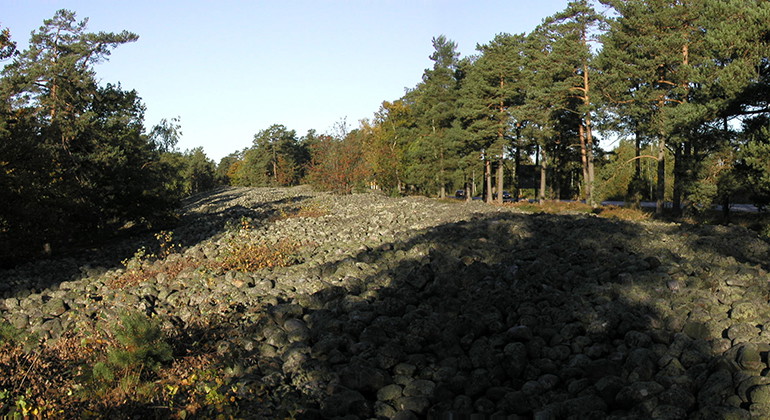
When you stand on Ljungåsen's shingle field, you have several kilometers to the sea. But around 11,000 years ago, this was a pebble beach, against which the sea waves crashed. The stones were worn against each other and ground round. When the land rose after the Ice Age, the shingle field was pushed well up on land. In 1907, geologists recognized the beauty of the field and in 1960 the geologically valuable area was protected.
Transportation of rocks
During the Ice Age, large parts of Scandinavia were covered by a mighty ice sheet. As the ice expanded southwards, it picked up material along the way, from large boulders to small stones. The heavy ice also crumbled large boulders into pebbles and gravel, which also became trapped in the ice. As the climate warmed, the ice melted. The ice front retreated and all the material that had been frozen inside the ice ended up on the land slope. Like here at Ljungåsen, where large amounts of rock were left behind by the ice.
Stone beach
When the ice melted, the sea level rose and the Ljungåsen shingle field was covered by water. Over time, the land rose. The shingle field became a beach that was worked by the sea waves. Stones were ground round as waves made them roll around and rub against each other. The waves also created groynes and crescent-shaped pits, which can still be seen today on the shingle field. The sea walls show how high the sea level was at one time.
Geological attraction
As the land continued to rise, Ljungåsen's shingle field became further and further from the sea. Today, it is several kilometers to the nearest beach, but the field is preserved in the condition that the sea left it thousands of years ago. The reason it is still open is that plants find it difficult to grow in the barren environment. Seeds are washed down the rocks by rainwater, into an environment where there is little to grow in and where light cannot reach.
Aktiviteter og faciliteter
- Naturreservat
Fakta
Year of decision: 1960
Area: 5 hectares
Municipality: Västervik
Landowner: Västervik municipality
Trustees: Västervik municipality in consultation with Kalmar County Administrative Board
Rutevejledning
The reserve is located along the entrance road to Västervik. Information about Ljungåsen is available in connection with the information point about Västervik.
Regler
In the nature reserve you are not allowed:
- Move rocks, gravel or soil.
- Dig or pull up plants.
- Destroy the humus cover.
- You must not cover the ground with anything.
- You must not build buildings or other structures.
Full regulations
Within the protected area, stones, gravel or soil must not be disturbed. Vegetation or humus cover may not be removed other than as stated in the management plan. The land must not be covered. No buildings or other structures may be erected within the area.
Kontakt
E-mailadresse
Per Markus Jönsson
Organisationens logo

Jeg har været her
Jeg vil gerne derhen
Spørgsmål og svar
Stil et spørgsmål til andre Naturkartan-brugere.
Anmeldelser
0 anmeldelser
- 5 :
- 4 :
- 3 :
- 2 :
- 1 :
Brugernes billeder
Der er endnu ingen brugerbilleder. Vær den første til at dele et!