
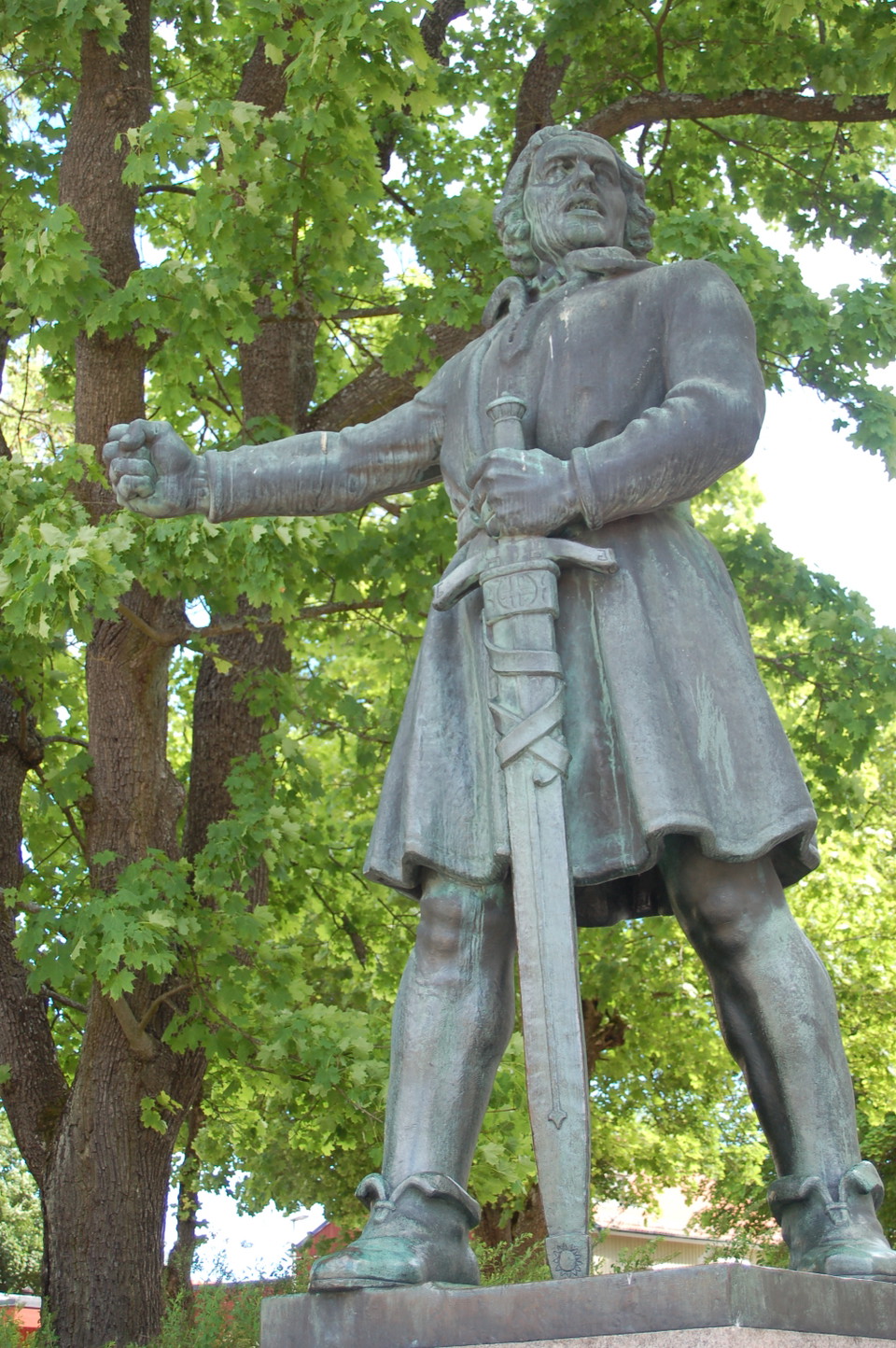
Engelbrektstatyn
- Geluid
- Regio: Västmanlands län
- 6724.57 km van u vandaan
Acties
Omschrijving
Engelbrekt Engelbrektsson was a lowly mine owner in Norberg of German origin. In the summer of 1434, he led the miners and farmers of Bergslagen in revolt against the Union King Erik of Pomerania and his cruel bailiffs.
With taxes and cruelty, the bailiffs made life unbearable not only for the peasants but also for many nobles. The worst of them all, at least if the Engelbrekt Chronicle is to be believed, was the Dane Jösse Eriksson in Västerås. Another bailiff of the same ilk as Jösse Eriksson was the Italian Giovanni Franco, who resided in Köping. The king had gotten to know him on his trip to Palestine and persuaded him to come to Sweden. Within a few weeks, all of central Sweden except Stockholm had joined Engelbrekt. Civil war raged.
Then, in January 1435, a large gathering of nobles, bishops and burghers gathered in Arboga and elected Engelbrekt as the king's chief steward, that is, commander-in-chief. Engelbrekt and his closest men were elected to the Riksraad. This meeting was known for a long time as Sweden's first parliament.
In 1935, the Riksdag celebrated its 500th anniversary with a magnificent party in Arboga, attended by royalty and Sweden's political elite. A competition was announced among Sweden's leading sculptors to portray Engelbrekt. Carl Eldh won, and since 1935 his statue of Engelbrekt has stood in front of Trinity Church as a hero of freedom against authority and oppression.
Engelbrekt is Sweden's most famous freedom hero and the first to make a name for himself in Swedish history without being a royal or a highborn. So what did Engelbrekt look like? We do not know. In Bishop Thomas' Freedom Song, he is described as a little man, a small man. Historians have interpreted this in two ways: either that he was lowly or that he was small in stature. A drawing from around 1436 in Magnus Eriksson's Laws of the Land shows a man leaning on a crutch and cane - some historians believe that this image represents Engelbrekt, who suffered a war injury in the last years of his life.
Engelbrekt had many enemies and in 1436 he was murdered on an islet in Lake Hjälmaren. Despite, or perhaps because of, his early and violent death, Engelbrekt was heroized and celebrated, and there were stories of miracles around his grave in Örebro.
Historians have long since dismissed 1435 as Sweden's first parliament because peasants were not present at the meeting. But the tradition lives on and in 2035 Arboga will surely celebrate the 600th anniversary of the Arboga meeting and Engelbrekt. Was he a man of the people, a hero of freedom? Or was he the mountain man who only complained about the taxes? Or was he a representative of Hansan, a German collaborator? The debate continues. Maybe in 2035 we'll get the answer! /Hans Almgren
Activiteiten en faciliteiten
- Geluid
Contact
Adres
Arboga turistbyrå Tel: 0589-87151 Epost: turistinfo@arboga.se
E-mailadres
Ulf Johansson
Ik ben hier geweest
Ik wil hierheen
Vragen en antwoorden
Stel een vraag aan andere Naturkartan gebruikers.
Beoordelingen
0 beoordelingen
- 5 :
- 4 :
- 3 :
- 2 :
- 1 :
Afbeeldingen van gebruikers
Er zijn nog geen afbeeldingen van gebruikers. Deel als eerste!