
-
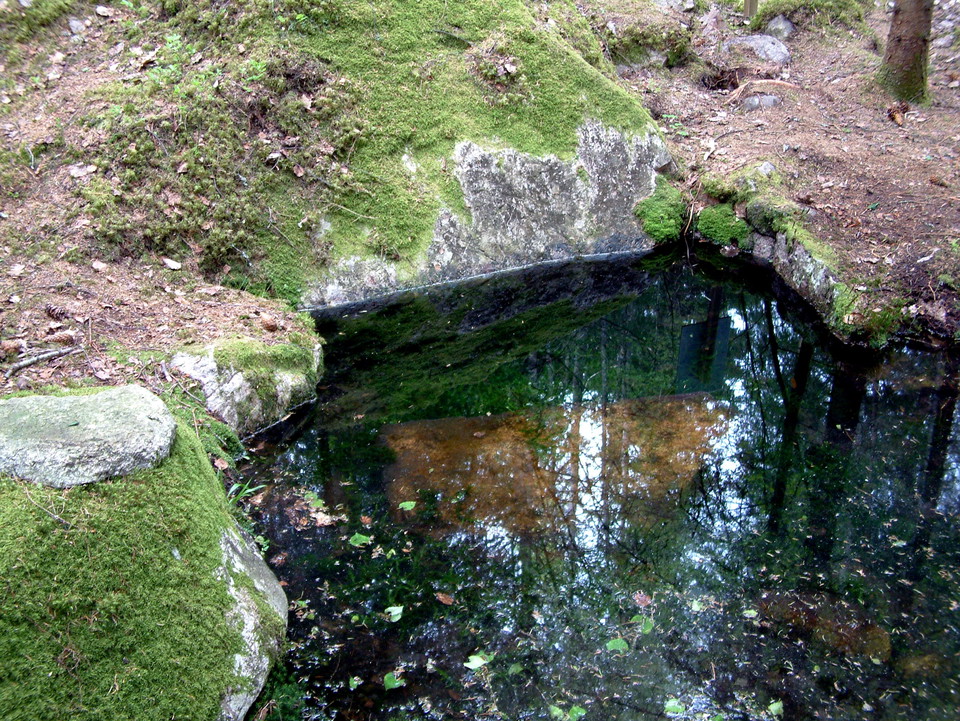
Drottning Kristinas källa ligger mycket typiskt nedanför en markerad sluttning i moränmark på underliggande granitberggrund. Den har ett relativt kraftigt flöde av klart och kallt vatten (G. Knutsson 2008).
Foto: Gert Knutsson
Drottning Kristinas källa
- Interessant sted
- Fylke: Kalmar län och Öland
- 6864.56 km fra deg
Handlinger
Beskrivelse
Our walk continues and for a few hundred meters we walk parallel to Kungsvägen south. When Charles XI built his new naval base in Karlskrona, roads were also needed to quickly bring troops down to the waiting ships. The baptism of fire came a few years later, when thousands of Carolinians passed through here on their way to the battlefields of Europe. According to a local (and fanciful) tradition, Queen Christina also passed through here on her way to Rome. She rested at the spring located along the trail. It is therefore called Queen Kristina's spring, but older people call it "Johan's spring" after the last crofter who lived in the nearby croft.
A spring (cold spring) is a distinct outflow of groundwater from soil or rock and the collection of water with runoff (e.g. a stream), which often occurs. The water temperature is usually low and even (between +6 and +8 degrees Celsius in these regions). This means that a genuine spring does not freeze in winter and provides cooling water in summer (Knutsson & Tornehed 1984). The springs have had/have a very important function for the water supply. As late as the dry summers of the 1950s and 1960s, people carried water 300-500 m from this spring to the houses up on the hill. The clear and fresh water tastes good and has been much appreciated by the local population.
The spring is very typically located at the foot of a relatively steep slope of moraine soil and the underlying granite bedrock. The water emerges at the contact between a large and several smaller boulders, forming a spring basin, which now has a wide outflow channel, making the flow appear to be dammed. Previously, the water level in the spring was lower and the water ran off into a small babbling brook. The flow varied between 25 and 100 m3/day, with the highest flow in spring and the lowest in late summer and early fall.
Some special plants, mainly mosses such as the large water lily, thrive in and around the spring itself. Larvae of caddisflies and certain microorganisms are usually found in spring water with a relatively constant flow and temperature, but have not been studied in detail. However, the water chemistry of the spring has been studied since 1968 as the spring is part of the Swedish Geological Survey's (SGU) observation area for groundwater in the Emmaboda area. The water chemistry has been relatively stable with a pH of around 6 even during the most severe years of acidification in the 1970s and 1980s (Knutsson 1981).
Aktiviteter og fasiliteter
- Interessant sted
Kontakt
E-postadresse
Jeg har vært her
Jeg ønsker å dra hit
Spørsmål og svar
Still et spørsmål til andre brukere av Naturkartan.
Omtaler
0 anmeldelser
- 5 :
- 4 :
- 3 :
- 2 :
- 1 :
Brukernes bilder
Ingen brukerbilder ennå. Bli den første til å dele!