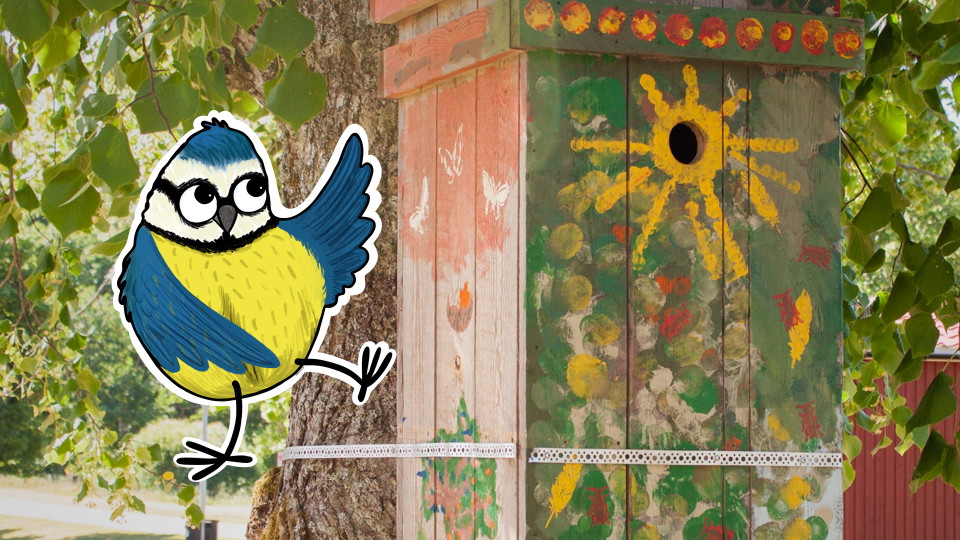
That's a strange word, "hollows"... What could it mean? Most people know what a burrow is, but they usually think of birds. Maybe even bats. This hollow, however, is not for either birds or bats, although they are welcome to live here too. Above all, this hollow is for insects, arachnids and other bugs and fungi that normally live in hollow trees. Mulm is formed in hollow trees. Mulch is a loose material and is partly composed of decomposed wood from the tree, animal droppings and dead animal remains. If birds or bats live or have lived in the tree, there may also be a lot of residues from these inhabitants as well, such as nest remains, droppings and dead young.
So why on earth do we put up moles? Especially here in Åtvidaberg, where we already have so many old and decaying trees? Yes, that is true. We have many old and beautiful trees in Åtvidaberg. They are a huge asset and something to be proud of. Many of the trees are remnants from the previous use of the landscape, before the community spread out. The fact that only remnants of the old landscape remain has contributed to a major imbalance in the biodiversity found here. This means that today there are many small and isolated patches of valuable trees. Their isolation means that the species that live in or on the trees are unable to move to new trees to settle in or on. Isolation is a form of fragmentation, i.e. it divides the landscape into smaller areas. The creation of trees with cavities is limited in a community where there are fewer trees than in a normal landscape and, as the trees are often adjacent to buildings or where people are present, there is an increased need for security. As a result, trees that are or are perceived to be dangerous are removed instead of being left to age. It also takes a very long time for cavities to develop. For oaks, it takes about 200 years for cavities to form. Cavity trees create artificial hollow trees that help a wide range of species that depend on this environment to spread across the landscape. The hollow trees become stepping stones for the species, making it easier for them to spread to other trees and connect with their conspecifics over a wider area. This, in turn, reduces the risk of species extinction as there is less risk of inbreeding. If a species were to die out from a tree for any reason, there is a greater chance of recolonization if the species is in contact with a larger network of possible nesting sites.
So what species live in these hollow trees? There is a huge variety of species that are linked to trees with some form of dead wood. In total, there are around 7,000 species in Sweden that are in some way dependent on dead wood, of which around 1,000 are different species of beetles. Other species groups consist mainly of fungi, arachnids, mosses and lichens, but some birds are also dependent on dead wood for foraging or nest building. For example, the white-backed woodpecker is heavily dependent on broadleaf forests (birch, aspen and alder forests) rich in dead wood for foraging and nesting. Around 25% of all species associated with dead wood are listed on the Swedish Red List of Threatened Species.
So do mulmholks work? Do all these species want to live here? Because the hollow is an artificial environment, it is almost impossible to mimic all the different habitats found in a natural hollow tree. Many species are generalists and don't have very high habitat requirements, while there are those that have incredibly specific requirements. A study of hollows in an old oak environment showed that they harboured about 70 % of all the species found in the hollows of the oaks in the area. So, not all species benefit from snags, but a very large proportion do. Some species or groups of species that have often been found in hollows are the brown marmorated stink bug, stump beetles, shortwings, the black beetle Prionychus ater, the small knotted beetle and several other species of knotted beetles. But there are also more unusual species such as the leatherback beetle, the blowfly Hypebaeus flavipes and the four-spotted wood fungus beetle.
This mulch pile is just over 600 liters in size. It is about 80% filled with oak sawdust and a lot of leaves, about half of each. Small holes in the roof, and gaps in the structure, allow water to flow into the burrow. This is important so that it does not become too dry. Although this is meant to be a dry environment, it must not be too dry, some moisture is also needed. There is an entrance hole that is about 6 centimeters in diameter. This is where a large proportion of the nest's inhabitants enter. Either flying in or crawling in, while many fungi hitchhike with various animals. There are also bugs that hitchhike, including various species of clawed caterpillars that use this method as they cannot fly themselves. Birds are also welcome through the hole, which is why it is so large. Insects and other bugs would otherwise be fine with a smaller hole.
This mule hole is also decorated. This was done before they were to be set up by schoolchildren as a summer holiday activity organized by the Cultural School. In total, three moles were decorated, all of which can be seen along this walking trail.
Text for younger readers
This box is called a mulmholk. Mulch is a material that forms inside hollow trees. It is made up of small pieces of wood, bug poop and the remains of dead animals. It can also contain the remains of birds' nests and their droppings or those of bats. It doesn't sound very cozy, but there are lots of species that love this environment. Thousands of them in fact. Many species are beetles with funny names. For example, the leatherback beetle, so named because it smells a bit like leather. Some people think it smells like peaches. If you smell it on an old tree, or in a hollow, it could be a male leatherback beetle trying to attract a female. Another species is the four-spotted wood fungus beetle. Long name! It's called that because it has four reddish-brown spots on its shell. Many fungi also live inside hollow trees. It is these, together with wood-eating insects and bugs, that cause a cavity to form in the tree. A hollow is set up to help all the species that thrive in hollow trees, as they are in very short supply. The hollows allow the species to spread to new trees, which also have these man-made cavities to live in.