
-
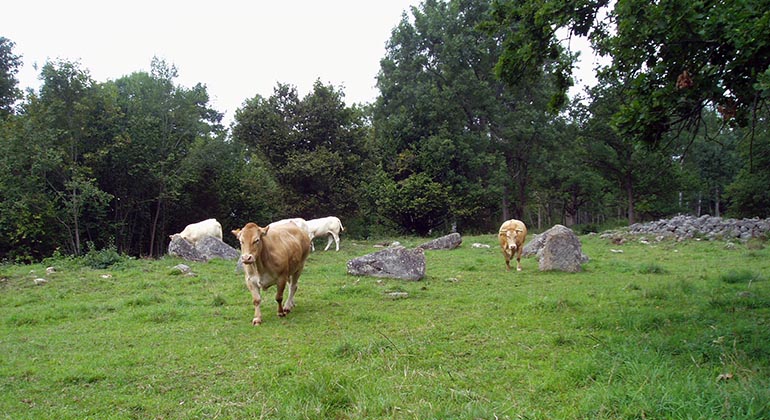
Naturreservatet hålls öppet med hjälp av betande kor.
Foto: Karin Sund
Botåsen, Naturreservat
- Naturreservat
- Fylke: Örebro län
Handlinger
Beskrivelse
Botåsen Nature Reserve is located in a beautiful drumlin landscape with distinctive, rolling hills. For thousands of years, oak trees have grown on the hills, which have been important nesting sites for many insects and bellbirds. During a visit in the spring, you can enjoy both the flowers and the beautiful birdsong. A number of rare fungi also grow in the reserve. People lived here as early as the Bronze Age.
The rolling drumlin landscape
Botåsen is located in one of the country's best developed drumlin landscapes. The drumlins are made up of earth material brought here by the ice sheet. They are stretched out in the direction of the ice movement, which was north-south in the area. Oak trees have been growing on the drumlins since the beginning of the warm period 8,000 years ago.
Cultural history of the area
Graves within the reserve show that people lived here already during the Bronze Age to Iron Age period (1800 BC - 1050 AD) and perhaps earlier than that. The dry soil on the ridge was both easy to cultivate and good to live on. Until the 1950s, two fields were cultivated on the northern part of the ridge and on either side of the highway on the southern part of the ridge. The rest of the land was probably used primarily as pasture in the 19th and 20th centuries. On the crest of the ridge and on the slope to the southeast there is a large area of clearance cairns and small areas of fossil arable land, which tell us about older times of cultivation. On Botåsen, there are also stone strings. Among the graves, a few round stone circles stand out and a large burial cairn, a domarring, which consists of a ring of upright stones. On the western side of the ridge, just south of the entrance to the Berget farm, there is an old sacrificial spring called Botkällan. Drinking water from a sacrificial spring and perhaps sacrificing something at the same time was once thought to give strength or cure diseases.
Vegetation and bird life
Under oaks and hazels, there are plenty of bluebells in bloom in the spring, with elements of lungwort, green-white night-flowering violet, under-violet, magic grape and marsh marigold. In the more open parts of the meadow, wood anemone, bush violet, nettle bell, pig's root, buttercups, cowslip and other plants that benefit from grazing bloom. Botåsen's greatest natural value is its fungal flora. A number of very rare species grow here, such as the breadfruit, scales, ollon toadstool and the mushroom. The mushroom thrives on calcareous soil in semi-open hazel groves and deciduous forests and likes to grow in areas without herbs or grasses. It feeds on dead leaves. Many bird species thrive in the varied pasture and deciduous forest environment and bird song in spring and early summer is intense. For example, you can hear nuthatches, blackcaps and warblers.
Sign language information
About prehistoric graves in Botåsen nature reserve
Aktiviteter og fasiliteter
- Naturreservat
Fakta
Municipality: Lekeberg
Year established: 2005
Area: 19 hectares
Landowners: Swedish Environmental Protection Agency and individuals
Reserve creator: County Administrative Board
Manager: County Administrative Board
Veibeskrivelse
Botåsen is located about 8 km south of Fjugesta, along the public road between Hackvad church and Viby church. Drive from Fjugesta towards Hackvad church and about 1.5 km south of the church.
Forskrifter
In the nature reserve it is forbidden to:
- damage living or dead trees
Kontakt
E-postadresse
Organisasjonens logotype

Jeg har vært her 3

Jeg ønsker å dra hit 1
Spørsmål og svar
Still et spørsmål til andre brukere av Naturkartan.
Omtaler
0 anmeldelser
- 5 :
- 4 :
- 3 :
- 2 :
- 1 :
Brukernes bilder
Ingen brukerbilder ennå. Bli den første til å dele!