Mörbylånga kommun - Öland
Välkommen till vårt fantastiska friluftsliv i v...

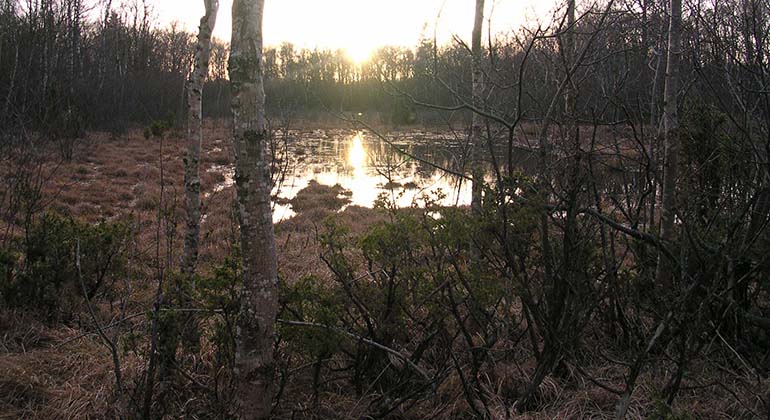
Rösselkärret is one of many valuable natural areas in Mittlandet. Here you will find dense broadleaf forest, open wet meadows and rich marshes. In early spring, the bluebell blooms among the brown leaves of last year, and in May the characteristic song of the nightingale sounds from the bushes. But the earliest of all is the long-legged frog, which sometimes spawns as early as January!
In the nature reserve and its surroundings, there are several spawning sites for the long-legged frog. It spawns in spring in small waters and spends the rest of the year on land. This is something it has in common with the great crested newt, another unusual amphibian that lives in the nature reserve.
Rösselkärret is part of Öland's valuable forest area with deciduous trees, Mittlandsskogen. Large, continuous broadleaf forests are rare in Sweden today and the animals and plants that live in these forests have therefore become increasingly rare. The rare violet finger fungus is an example of a species that thrives in broadleaf forests and with a little luck you may spot it in the nature reserve.
The nature reserve has open wetlands, wet meadows and rich marshes. On sunny summer days, many different butterflies flutter over the open wet meadows. One of these is the protected wet meadow butterfly.
Inside Rösselkärrets nature reserve is one of the torp relics from Eriksöre Österskog. Eriksöre Österskog was a piece of land that was allocated to the village of Eriksöre when the Djurgården establishment ceased at the beginning of the 19th century and the land previously held by the Crown was to be distributed to individual villages and farms. Eriksöre is far from here, seven kilometers as the crow flies, but the land here was still allocated to Eriksöre.
At this time, the population of Sweden was reaching new heights and it was necessary to cultivate land that would normally have been considered too poor for the effort. By the mid-19th century, a handful of crofts had been built here. The croft inside the reserve is very well preserved and the barn site still has walls several meters high and it is easy to see the traces of houses and gardens.
Lena König runs the podcast Archaeology and History.
In this episode "Ödebyn Eriksöre-Österskog" from 2024, she meets archaeologist Karl-Oskar Erlandsson. He has taken an interest in the history of Österskog and tells us about when the crofts were built, about the living conditions and why they were eventually all abandoned.
The episode is produced with a grant from the County Administrative Board of Kalmar County.
Year of decision: 1995
Area: 18 hectares
Municipality: Mörbylånga
Landowners: Swedish Environmental Protection Agency and individuals
Administrator: Kalmar County Administrative Board
The reserve is accessed from the road between Tävelsrum and Tveta recreation area. South of the road, about 900 meters from the turnoff towards Tävelsrum, is a burial ground. From here, an approximately 1 kilometer long farm road leads into the reserve.
In the nature reserve you are not allowed:
You need permission from the County Administrative Board to do this:
C. Regulations pursuant to Chapter 7, Section 30 of the Environmental Code.
It is prohibited within the reserve:
It is forbidden to do so without the permission of the County Administrative Board:
Regulations C7 and C9 do not apply to temporary activities (lasting for
maximum 24 hours) on a smaller scale, for example for occasional training
or in childcare or school activities.
Per Markus Jönsson


Still et spørsmål til andre brukere av Naturkartan.
0 anmeldelser
Ingen brukerbilder ennå. Bli den første til å dele!