
-
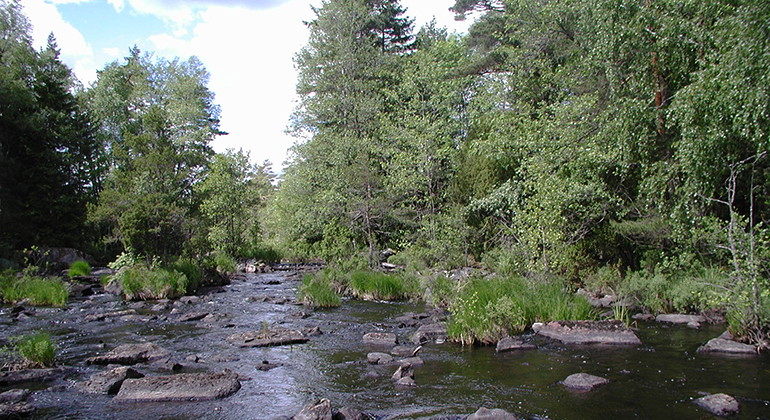
Foto: Tommy Gustafsson
Pauliströmsåns nedre dalgång, Naturreservat
- Naturreservat
- Fylke: Kalmar län och Öland
Handlinger
Beskrivelse
The Pauliströmsån river flows freely through the reserve through forest and open wetlands. Both the river and its surroundings have high natural values. The reserve is home to many different species, ranging from small aquatic caddisflies to peculiar fungi.
Valuable river
During its journey down to Emån, Pauliströmsån changes character. From Nedre Svartsjön, the water flows freely in strong currents over rocky bottoms. At Lövö, the river branches off in what are known as "quills". To the south, where the river is surrounded by flatter land, the water flows slowly. Pauliströmsån has a high naturalness with few stretches that have been cleared of stones by man. The water quality is also good - neither overfed nor acidified.
Special bedrock
At Lövö there is a narrow strip of alkaline rocks. As they weather, minerals are released into the ground, raising the pH value. The minerals also reach the river water, which counteracts acidification. The alkaline rocks characterize the reserve's plant and animal life. For example, organisms sensitive to acidification, such as river pearl mussels, trout and several species of mayflies and caddisflies, thrive in the river.
Threatened habitats and rare species
Thanks to the basic rock types, one of our rarest habitats is found in the reserve - limestone coniferous forest. The limestone coniferous forests are found on the slopes around Bjurängen but also along the river valley. Unusual fungi thrive in the limestone coniferous forests. They only grow in forests where the soil has an elevated pH value. Older conifers are also a must as the fungi cooperate with these trees. Several of the reserve's rare soil fungi have an intimate relationship with conifers called mycorrhiza. Beneath their fruiting bodies, down in the soil, the fungi have a network (mycelium) of thin threads (hyphae). These threads help the tree's roots to absorb water and nutrients. In return, the fungus receives building blocks in the form of carbohydrates from the tree roots. It is therefore important to have a continuity of conifers in the reserve. Otherwise, rare mycorrhizal fungi such as the ragweed, the spicebush, the copper spicebush and the velvet spicebush will disappear.
Many different birds thrive in the varied nature of the reserve. The common snipe, white-tailed godwit, common goldeneye and common tern are linked to the water environments. In the forest live, among other things, duck, woodcock and capercaillie.
The river pearl mussel is one of several threatened species that have a sanctuary in the nature reserve. It lives on bottoms with sand, gravel and stones and feeds by filtering organic particles from the water. To thrive, the water must be clear, oxygen-rich, nutrient-poor and have a stable pH.
Aktiviteter og fasiliteter
- Naturreservat
Fakta
Decision year: 2022 Area: 173 hectares of which 135 hectares is land Municipalities: Hultsfred Landowners: The state and private and jointly owned land Manager: Kalmar County Administrative Board
Veibeskrivelse
The reserve is located about 1.5 km northwest of Järnforsen in Hultsfred municipality.
Forskrifter
In the nature reserve you are not allowed:
- Park a motor vehicle, caravan or trailer in a place other than the designated place.
- Camp or stay overnight in a car, motorhome or caravan for more than one day in the same place.
- Damage or disturb mammals and birds, climb trees or be close to a bird of prey's nest, lair or burrow
- Bringing a dog, or other animal, that is not on a leash
- Build a fire other than in an outdoor kitchen.
- Break branches, cut down or damage living or dead trees or bushes.
If you have permission from the County Administrative Board, you may:
- pick mosses, lichens or wood-living fungi. Without permission, you may only take single specimens for species identification.
- pick up or move live mussels in the watercourse
- digging up or pulling up plants
- set traps that kill to capture insects
- Put up a sign, board, poster, artwork, orientation controls, signs, markers or similar.
Full regulations
C. Regulations according to Chapter 7, Section 30 of the Environmental Code on the right to travel and stay in the reserve and on order in general
Within the reserve it is forbidden to:
- park motor vehicles, caravans or trailers other than in designated places
- camp or stay overnight in a motorized vehicle or caravan for more than one day in the same place
- injuring or disturbing mammals and birds, climbing nest trees or staying near a bird of prey's nest, lair or burrow
- bring an unleashed dog or other pet that is not leashed
- make a fire other than in an outdoor kitchen
- break branches, fell or damage living or dead trees or bushes.
It is forbidden to do so without the permission of the County Administrative Board:
- pick mosses, lichens or wood-living fungi except for single specimens for species identification
- pick up or move live mussels in the watercourse
- digging or pulling up vascular plants
- collecting insects or other invertebrates with traps that kill
- placing a sign, board, poster, artwork, orientation controls, markers, signs or similar.
Regulations C 2, C 4, C 5 and C 11 do not apply to property owners or hunting rights holders. However, measures must not be taken to deter the public from the beach area.
Regulation C 3 does not apply to hunting rights holders when hunting.
Regulation C4 does not apply to agricultural tenants when herding cattle.
Regulations A and C do not prevent police, medical or emergency services personnel from using motorized vehicles, motorized vehicles and dogs during operations and from taking other measures if necessary.
The regulations under A and C do not prevent the Swedish Armed Forces and the authorities within the military part of the total defense from conducting activities aimed at monitoring the Swedish territory and detecting or repelling violations of the same. A permit from the County Administrative Board is required for the construction of permanent surveillance facilities.
Kontakt
E-postadresse
Per Markus Jönsson
Organisasjonens logotype

Jeg har vært her
Jeg ønsker å dra hit
Spørsmål og svar
Still et spørsmål til andre brukere av Naturkartan.
Omtaler
0 anmeldelser
- 5 :
- 4 :
- 3 :
- 2 :
- 1 :
Brukernes bilder
Ingen brukerbilder ennå. Bli den første til å dele!