
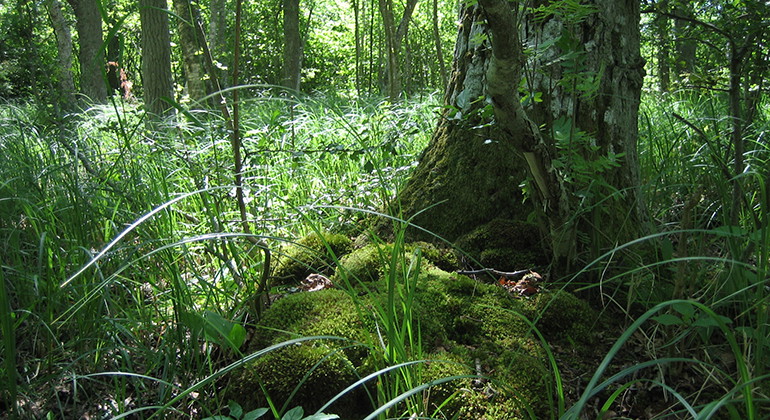
Knisa deciduous forest offers varied nature and exciting ancient remains. In the hay meadows, swamp forests and lush groves there is a great diversity of flowers, birds, lichens, mosses and bugs. Welcome to discover valuable nature!
The land in the reserve once belonged to the medieval villages of Knisa and Gel. Here, the villagers harvested their hay from vast hay meadows. Some of the meadows were open and alder-like, while others had scattered deciduous trees and bushes. But the land had been farmed long before that, as early as the Iron Age. All the ancient remains in the form of longhouses and enclosures in the reserve bear witness to this.
During the 20th century, large areas of meadowland were abandoned on Öland, just like in the rest of the country. Some of the meadows here in Knisa grew back, but there are still unusually large areas of open meadowland left. The fields, which have been mown for generations, display an outstanding array of flowers. Salsify, tansy and spurge are all examples of the rich meadow flora. The abundance of flowers attracts butterflies, bees and other insects in search of nectar.
The reserve's pristine swamp forests and deciduous meadow habitats are invaluable for a number of species that depend on old deciduous trees and decaying dead wood. For example, several cavity-nesting species thrive here, such as the skylark, lesser spotted woodpecker, starling, cuckoo and collared flycatcher.
Lush deciduous forests with old oaks and ash trees now grow over large parts of the former hay meadows. The oldest oaks are up to 250 years old. But it wasn't just the hay that was harvested in the former broadleaf meadows. They also provided leaves and twigs for the cattle's winter feed. Many of the old ash trees still bear the traces of pollarding, another word for the harvesting of leaves that was common in the old farming community.
Decision year: 2015
Area: 59.6 hectares
Municipality: Borgholm
Landowners: Swedish Environmental Protection Agency and individuals
Administrator: Kalmar County Administrative Board
Along road 136, turn towards Knisa and continue straight for about 1 km. For parking, continue the road to Knisa village and turn south. The parking lot, which is shared with the nature reserve Knisa mosse, is on the west side of the road.
In the nature reserve you are not allowed:
If you have received permission from the County Administrative Board, you may
C. Regulations according to Chapter 7, Section 30 of the Environmental Code on the right to travel and stay in the reserve and on order in general.
It is forbidden to enter the reserve:
It is forbidden to do so without the permission of the County Administrative Board:
Regulations C1 and C14 do not apply to property owners, agricultural tenants and hunting rights holders.
Per Markus Jönsson


Still et spørsmål til andre brukere av Naturkartan.
0 anmeldelser
Ingen brukerbilder ennå. Bli den første til å dele!