Mörbylånga kommun - Öland
Välkommen till vårt fantastiska friluftsliv i v...

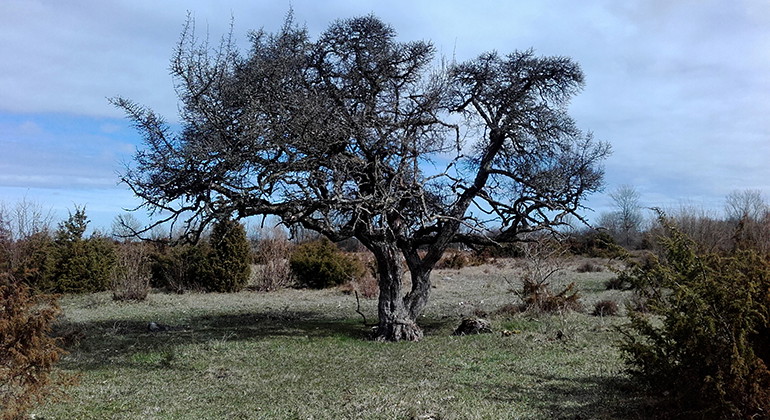
The reserve includes alpine meadows, wet meadows and broadleaf forest. Both the forest and the open fields are grazed by cattle and sheep. This benefits many of Gössluna's rare plants and animals.
Alvaret has been influenced by man and his grazing animals since ancient times. Until the Iron Age, animals were kept outside all year round. After that, they were kept in stables during the winter months. The animals were then given hay to eat, which the farmers collected from the farm's meadows. Large parts of the reserve have traditionally been used as meadows. Some parts have also been used as fields, which is still the case today.
On a walk through the reserve you can see many different plants. The spring flora of the broadleaf forest is dominated by bluebells in blue, yellow and white. In the borderland between the forest and the open fields, the lesser celandine, the orchid two-leaf and the rare large violet thrive. The chalky meadows are home to, among other things, chickweed, chickweed and toadflax. The latter is a low-growing shrub with yellow flowers. In Sweden, toadflax only grows wild on Öland and Gotland.
The reserve's most unusual flora can be found in the dry meadows and alvar meadows. Orchids such as Adam's and Eve's and gunpowder burners grow here. Some of the most exclusive species include alvar wormwood, gray grass, Hartman's starling, large sand lily, woolly ranunculus and field bindweed.
Year of decision: 1972
Area: 12.3 hectares
Municipality: Mörbylånga
Landowner: Individual
Administrator: Kalmar County Administrative Board
The reserve is located within the World Heritage Site of Southern Öland's cultivated landscape
The reserve is located just off the public highway between Bårby and Alby. From two parking lots, a smaller one along the road and a new larger one further east, there are marked paths to the reserve. The newly built parking lot has a toilet for visitors to the reserve and the trail system out on the alvar. Next to the parking lot, along the road, is Gösslunda pipe, an impressive burial mound from the Bronze and Iron Ages.The hiking trail through the reserve goes from the north through deciduous forest out through the open pasture. If you don't want to go back the same way, there is a stile in the south that leads out onto the surrounding alvar. If you walk about 300 meters west, you will meet a hiking trail that leads south to Tingstad flisor and north back to the parking lot. The part between the trails is not marked.
In the nature reserve you are not allowed:
If you have obtained a permit from the County Administrative Board, you may:
C. Regulations according to Chapter 7, Section 30 of the Environmental Code on the right to travel and stay in the reserve and on order in general.
It is forbidden to:
Per Markus Jönsson

Still et spørsmål til andre brukere av Naturkartan.
0 anmeldelser
Ingen brukerbilder ennå. Bli den første til å dele!