-
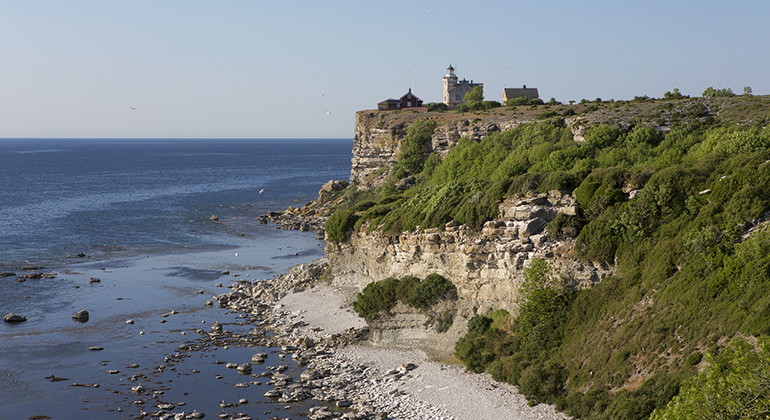
Från Stornasar har man fin utblick över Västerberget med fyren och tusentals häckande sillgrisslor.
Stora Karlsö, Naturreservat
- Naturreservat
- Fylke: Gotlands län
Handlinger
Beskrivelse
Imagine a combination of a North Atlantic bird mountain and an island in the Greek archipelago - that's Stora Karlsö. Here you can see thousands of auks and also thousands of orchids.
Stora Karlsö is located just over six kilometers off the west coast of Gotland, more than twice as far from land as the neighboring island of Lilla Karlsö. The island is almost rectangular in shape, with approximate dimensions of 1.5 x 2 kilometers and an area of just under 2.5 square kilometers. It is dominated by a gently undulating and partly quite hilly plateau in the shape of a horseshoe with the opening facing north-northwest. The highest point of the island is 51.6 meters above sea level on the central part of Roisu haid, which forms the eastern side of the horseshoe. The western part of the plateau, Marble Mountain, reaches a maximum of just over 45 meters above sea level. The plateau is bounded to the west, north and northeast by almost vertical, 10-30 meter high cliffs. Below the cliffs, large quantities of loose boulders and rocks often form mighty landslides. In the marked depression between Marmorberget and Roisu haid lies Norderslätt, which is bounded to the west by a steep cliff, Norderhamnsberget, and to the east by Austerberget. There is also a coastal plain, Suderslätt, south of the high plateau.
Like the rest of Gotland, Stora Karlsö is made up of rocks that date from the Silurian period and are therefore around 400 million years old. The island can be said to consist of a single large complex of large and small fossilized coral reefs surrounded by layered limestone. Higher areas such as Marble Mountain and Roisu Haid consist of rocky outcrops heavily affected by karst weathering and often cut by deep fissures. The sea has carved out some 30 caves in the island's cliffs, some of which are more than 20 meters deep.
Stora Karlsö has been grazed by sheep for hundreds of years, and at the end of the 19th century it was almost completely bare. However, the sheep were removed from Stora Karlsö in 1887, and since then the vegetation has been allowed to develop largely freely. In Hien, Norderhamnsberget, Austerberget and Hassli, the cliffs and ravines are now largely hidden by a dense curtain of deciduous forest dominated by ash, maple, rowan and finnoxel. Grazing was reintroduced on the island in 1995.
Stora Karlsö is perhaps best known for its rich bird life, especially the large colonies of guillemots and razorbills, both of which breed with thousands of pairs on the island. Research and ringing of auks has been going on here for a long time. Other common breeding birds include cormorants, eiders, blackbirds, sandwich terns, grey gulls and herring gulls. The island's shrublands and deciduous woodlands are home to many different species of small birds, including the rosefinch and the warbler. The only mammals present on the island are the Arctic hare and a few species of bats.
The island's rich flora includes a number of rare species, such as spring daisy, marsh lettuce, goldenrod and Gotland nunwort. At the end of May and beginning of June, thousands of flowering Adam and Eve and St. Peter's keys form formal orchid meadows.
Several graves and numerous other finds show that Stora Karlsö has been used by humans since the Stone Age as a base for hunting and fishing and as grazing land. During the Middle Ages there was quarrying on the island.
Aktiviteter og fasiliteter
- Naturreservat
Fakta
Year of protection: 1970
Parish: Eksta
Characteristics: Bird mountain, alvar land and stone beaches
Area: 1180 hectares, of which 246 hectares are land and 934 hectares water
Landowner: Karlsö Hunting and Animal Protection Association
Manager: Karlsö Hunting and Animal Protection Association
Supervisor (April-September): Call or text to 070-323 72 40. Sometimes the coverage is not so good but SMS will arrive.
Type of protection: Nature reserve and Natura 2000
Forskrifter
For everyone's well-being and to maintain the reserve's natural and cultural values, it is important that all visitors show consideration. In addition to the right of public access, it is not allowed to:
- during the period March 15 - August 15, enter or stay in the parts of the nature reserve marked with a red slash on the map
- during the period March 15 - August 31 go ashore on the island without the permission of the County Administrative Board or the supervisor appointed by the County Administrative Board for the reserve. During the period September 1 - March 14, the public is entitled to stay on the island after written notification. Visitors must make such notification immediately after landing at the pier in Norderhamn.
- land at a place other than Norderhamn without the permission of the county administrative board or the supervisor appointed by the county administrative board for the reserve
- during the period March 15 - August 31, moor or anchor vessels in Norderhamn (the extent of the area is shown on the map) without the permission of the county administrative board or the supervisor appointed by the county administrative board for the reserve
- board sailing, water skiing or driving a jet ski
- drive a motorized vehicle
- land with an airplane
- during the period March 15 - August 15, fishing with other than hand gear or fishing from the shore
- bring ashore a dog, cat or other pet
- picking or digging up plants or mushrooms
- collecting insects, spiders, shells or snails
- capture or kill amphibians or reptiles
- capture birds for ringing without the permission of the county administrative board
- collecting fossils or moving or removing blocks or stones
- dig, hack, chisel, carve, drill or otherwise damage land, solid rock, boulders or stones
- erect a board, sign, poster or similar device
- build an open fire
- camping
- use a radio, tape recorder or musical instrument in a disruptive manner outdoors
- conduct tourist traffic to the island
Kontakt
E-postadresse
Länsstyrelsen i Gotlands läns naturvårdsförvaltning
Organisasjonens logotype
Jeg har vært her 14




Jeg ønsker å dra hit 4
Spørsmål og svar
Still et spørsmål til andre brukere av Naturkartan.
Omtaler
0 anmeldelser
- 5 :
- 4 :
- 3 :
- 2 :
- 1 :
Brukernes bilder
Ingen brukerbilder ennå. Bli den første til å dele!