
Stavars hurs
- Gammelt monument/kulturminne
- Fylke: Gotlands län
- 6984.13 km fra deg
Handlinger
Beskrivelse
Stavar's house is Gotland's largest Iron Age house site. Whether the house belonged to Stavar is left unsaid. But the legend will live on.
The legend of Stavar the Great
According to the legend, Stavar was a powerful Viking chieftain. One day he and his men were attacked by Norwegian Vikings at sea. They managed to escape to Stavar's farm above Bandelundaviken. There, Stavar buried a large treasure next to Häffind's breach (an open water hole).
The Norwegians had landed a little further south. They attacked the farm and Stavar and all his men died. The treasure remained in the ground, but its story lived on.
Several hundred years later, a farmer from Häffinds was walking home late one night after a party at the neighboring farm. Suddenly, a large covered wagon harnessed to black horses appeared in front of him. In the wagon sat an old man who offered him a ride. The man said that he was Stavar the Great, but that he was now so old and tired that he was offering the Häffind farmer his treasure.
Before the farmer could reply, the wagon set off over the treetops towards Bandelunda, where Stavar showed his treasure. It was a whole load of silver and gold. The terrified farmer did not dare to accept the gift. He only took a few silver coins with him. Once home, he found it hard to get anyone to believe in his adventure. But when he showed them the silver coins, things got going. The men of the house set out with shovels and picks to dig up the treasure. But it was impossible to find it again.
According to the legend, the farmer became "passionate" about looking for the treasure and soon died.
This legend exists in several different versions. In one of them, Stavar promises that the farmer's grandchildren will get the treasure instead.
In 1975, a school class was living the Iron Age life near Stavar's house. Then they found a silver treasure from the Viking Age right near the Häffind quarry. It may not have been a whole horse, but it was almost 1500 Arabian silver coins from the 10th century and from the time of Stavar the Great! So even if the children weren't the children of the Häffind farmer's grandchildren, they were at least children who found the treasure and received compensation for it. Stavar's treasure can be seen today in the Treasure Chamber at the County Museum.
Spadar's house
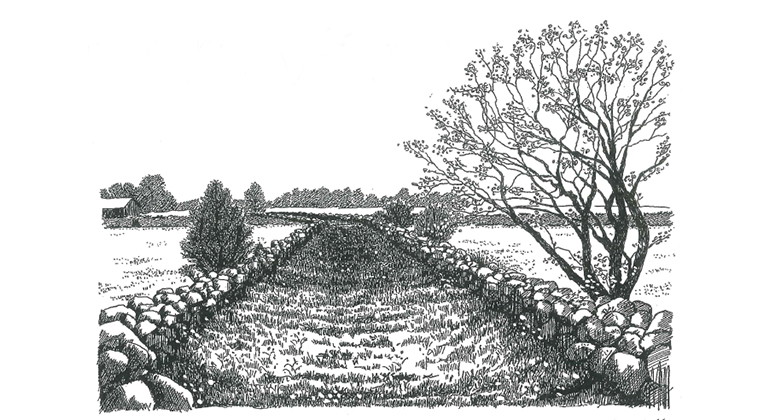
As the picture above shows, the road has been lined with stone walls or vastar, as they are called here in the south of the island. Proper fencing along the lanes was vital. Without them, the animals would have eaten everything, both their own winter fodder growing in the meadows and the people's food in the fields. If that happened, everyone on the farm would starve.
In the morning and evening, the cattle were driven back and forth along this road to the pasture in the forest. Already in the Iron Age, there were such pastures. Animals from different farms grazed in the forest and there were no fences. So the animals had to be looked after and herded all day long. This was often the work of children.
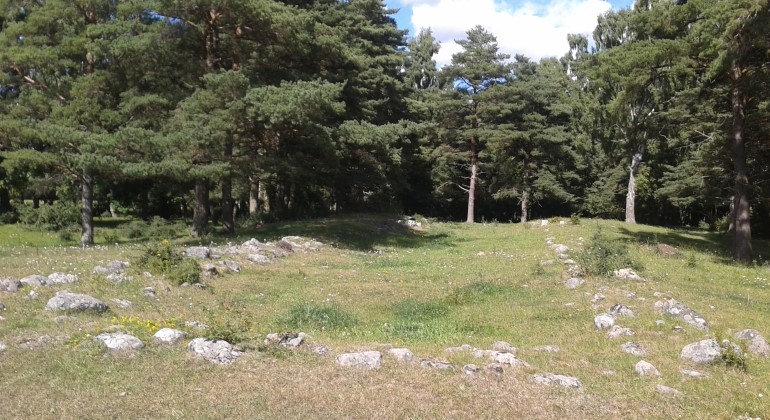
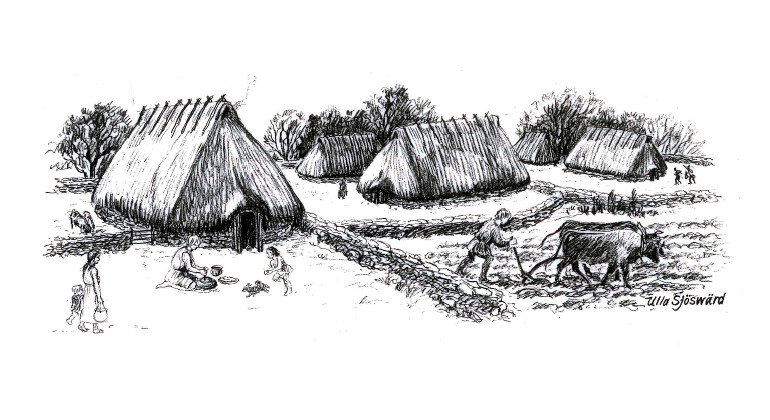
The house foundation known as Stavars hus is over 60 meters and Gotland's largest. It was investigated by archaeologists in the 1930s. It dates to the Early Iron Age, long before Stavar's time. The house had two rooms, of which the one to the north was a living room. Many finds were found at the hearth, including mills, sledgehammers, weaving looms, clay strainers and pieces of pottery. In one corner, someone had been working with iron, as there was smelting waste, slag and iron objects. There were also many finds of textile tools and household ceramics. The house had also been used for ironwork. In a pile of rubbish outside the house, archaeologists found pieces of glass and pottery. Under the floor of the house they found two more house foundations, one older than the other.
Good to know for visitors
- Parking is available at Stavgard. For further information about Stavgard, please visit www.stavgard.se
- From the parking lot to Stavar's house it is about 650 meters. To get to the remains you need to pass the stile.
- The path to Stavars hus goes through pastures and forest. There are animals grazing in the pastures.
- The relic is located on private land, remember to show consideration when you are on the site.
Aktiviteter og fasiliteter
- Gammelt monument/kulturminne
Fakta
Parish: Burs
Character: House plot, fenced street
Landowner: Private
Type of protection: Ancient monument
Veibeskrivelse
Car: from Visby - take road 143 towards Roma. Turn towards Lye. In Lye, take road 144 right towards Stånga. Turn left towards Burs, then Närshamn, Häffinds/Vanges and turn in at Stavgard. The ancient site is on the right side a few hundred meters before Stavgard.
Bike: Gotlandsleden passes nearby.
Kontakt
E-postadresse
Länsstyrelsen i Gotlands läns naturvårdsförvaltning
Organisasjonens logotype

Jeg har vært her
Jeg ønsker å dra hit
Spørsmål og svar
Still et spørsmål til andre brukere av Naturkartan.
Omtaler
0 anmeldelser
- 5 :
- 4 :
- 3 :
- 2 :
- 1 :
Brukernes bilder
Ingen brukerbilder ennå. Bli den første til å dele!