
Kyllaj
- Gammelt monument/kulturminne
- Fylke: Gotlands län
- 6972.93 km fra deg
Handlinger
Beskrivelse
The glory days of the stone industry are still evident in Kyllaj. While you're here, take a trip up to the edge of the cliff and look at the breathtaking view and the mighty rauks.
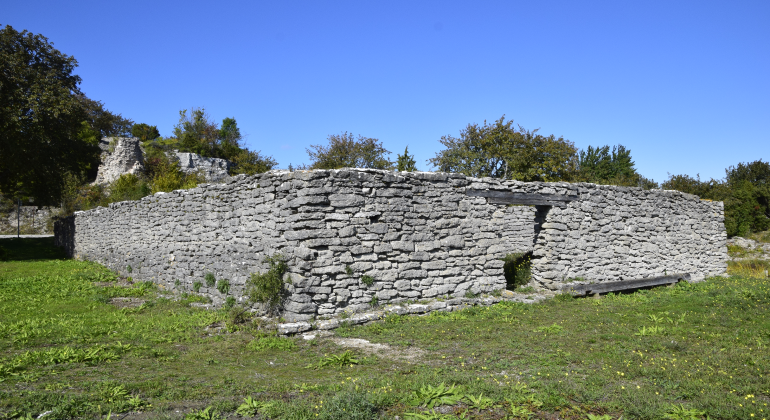
As early as the 17th century, Kyllaj began to be used as a port for shipping lime. The stone was quarried in local limestone quarries and transported by horse and cart to the lime kilns where it was burned. The burnt lime was then stored in lime barns down by the harbor. Today, the ruins of the lime barns still remain, revealing the volumes of lime that were handled in the area.
Some of the lime was slaked with water and packed into barrels, which were then shipped on ships to various ports in the Baltic Sea. Some lime was packed unleached in barrels, sometimes resulting in shipwrecks at sea.
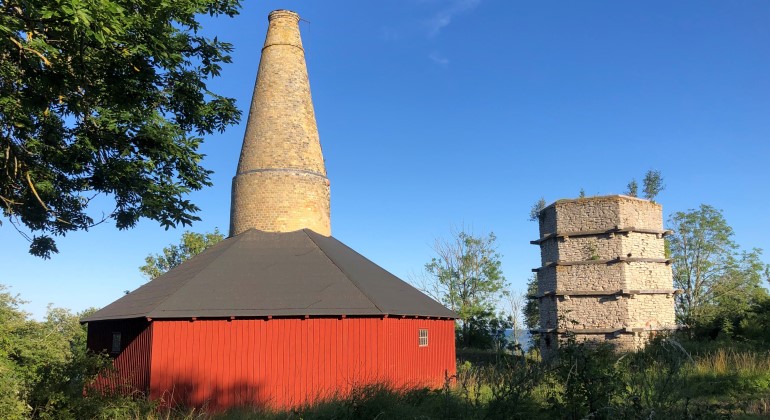
There are several lime kilns in the area. At the cliff you can see older ruins from the kilns where the lime was burned. Further down by the harbor is a hexagonal kiln built in the early 1800s. Adjacent to it is the youngest kiln from the turn of the century 1900 and built in brick.
Some of the lime used in the industry came from the Kyllaj hajdar rocky area a short distance away. Nature is fascinating here. The land is almost completely flat and treeless. Perhaps fuel for the lime kilns was obtained here. The protected little sand lily, with its white, star-shaped flowers, is one of the few plants. There are small, shallow limestone quarries in several places. In the dense spruce forest between the heaths and the rauks grows the purple orchid purple bundle root. In July, you can see it bloom and smell its special vanilla scent.
The community around the stone industry
Around the stone and lime industry at Kyllaj, a community developed with bosses' and workers' houses, shops and more. An oblong house above the harbor was the home of a lime patron, one of the burghers from Visby who moved out to the mill he owned. During the 18th century, the house was converted into a skipper's residence and inn.
The stone industry was closed down in the 1910s, but the harbour continued to be an important centre for pilotage and customs activities. There are five pilot houses and a pilot lookout from 1923 to see in Kyllaj.
Between 1650 and 1826, several generations of customs officers worked here, known as beach knights, to protect the area from illegal trade and smuggling. One of them, Johan Ahlbom, eventually became a lime patron. He lived in Strandridaregården north of the harbor. Carl Linnaeus also lived here when he was traveling around Gotland.
Good to know for you as a visitor
- The lime kiln barns are directly adjacent to the parking lot. The area around the lime kilns is somewhat hilly but the kilns are clearly visible from the gravel road.
- The harbor at Kyllaj is run by the Kyllaj harbor association.
Aktiviteter og fasiliteter
- Gammelt monument/kulturminne
Fakta
Parish: Hellvi
Characteristics: Stone industry
Landowner: Private
Type of protection: Ancient monument
Veibeskrivelse
From Visby: Drive road 148 north. Immediately after Lärbro community, follow signs towards Hellvi. After passing the church on the left, follow signs to Kyllaj.
Forskrifter
Under the Cultural Environment Act, permission from the County Administrative Board is required to disturb, remove, excavate, cover, alter or damage an ancient monument.
Remember that a land area around each ancient monument is also protected. Even a newly discovered ancient monument has immediate protection.
If you are unsure how large the protected area is, you can contact the County Administrative Board.
Kontakt
E-postadresse
Länsstyrelsen i Gotlands läns naturvårdsförvaltning
Organisasjonens logotype

Jeg har vært her 1

Jeg ønsker å dra hit
Spørsmål og svar
Still et spørsmål til andre brukere av Naturkartan.
Omtaler
0 anmeldelser
- 5 :
- 4 :
- 3 :
- 2 :
- 1 :
Brukernes bilder
Ingen brukerbilder ennå. Bli den første til å dele!