
-
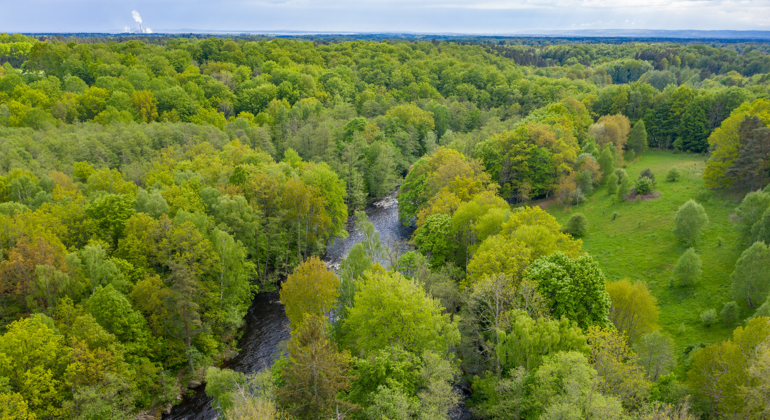
Drönarbild över Mörrumsån med omgivande marker vid Vittskövle-Kylingaryd.
Foto: Robert Ekholm/Länsstyrelsen -
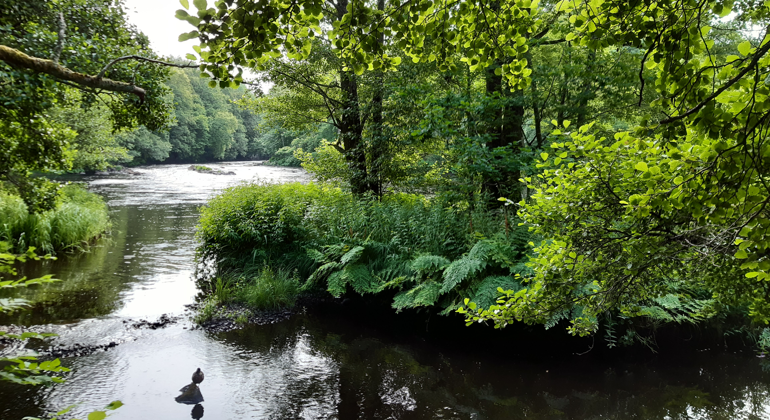
En svämö vid lågvatten.
Foto: Elisabet Wallsten -
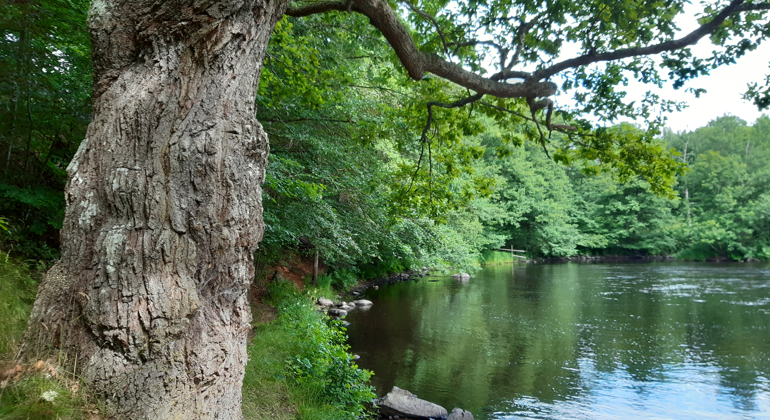
Grov ek vid Mörrumsån.
Foto: Elisabet Wallsten/Länsstyrelsen -
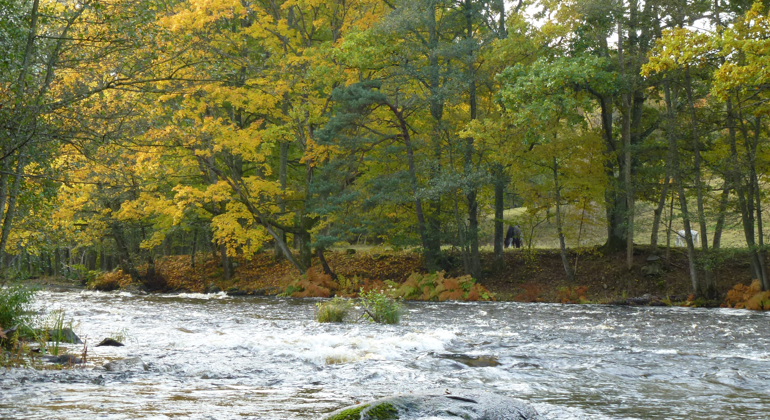
Betande hästar vid Mörrumsån.
Foto: Ulrika Widgren -
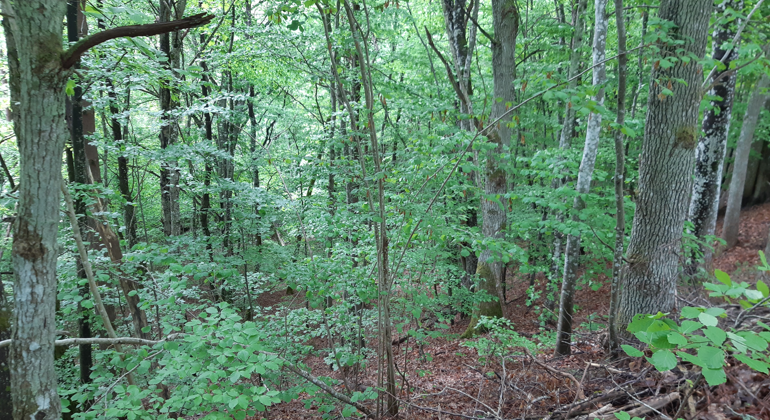
Brant med ädellövskog.
Foto: Elisabet Wallsten -
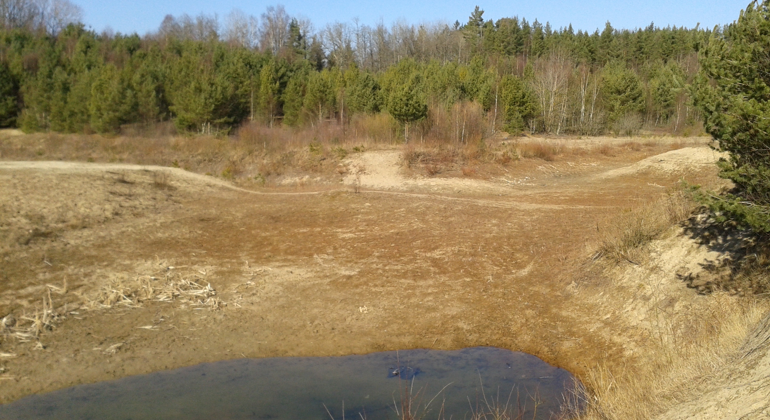
Före detta sandtäkt och ett småvatten.
Foto: Elisabet Wallsten -
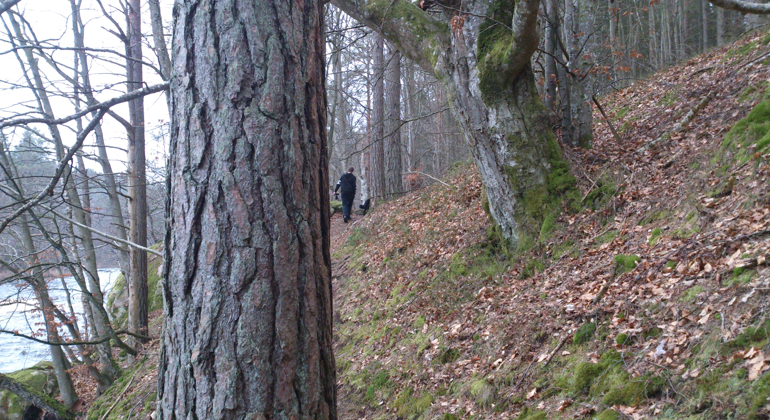
Vandrare i skog med tall och bok.
Foto: Elisabet Wallsten -
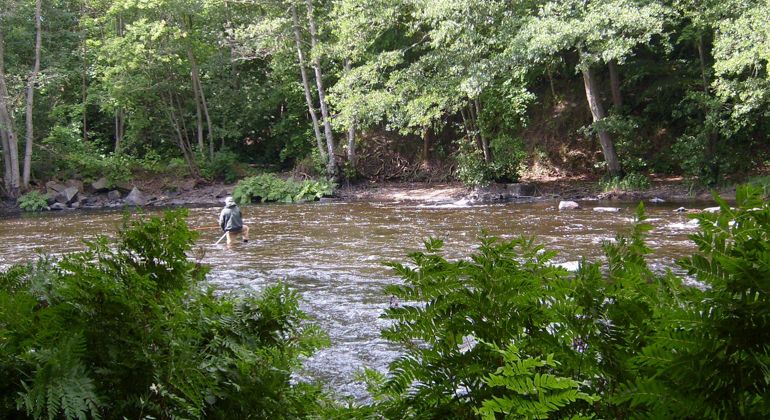
Fiskare i ån och safsa som växer vid stranden.
Foto: Elisabet Wallsten
Mörrumsåns nedre dalgång, Naturreservat
- Naturreservat
- Fylke: Blekinge län
Handlinger
Beskrivelse
Welcome to a nature reserve along one of Sweden's most species-rich and well-known waterways - Mörrumsån. In the lower valley of Mörrumsån you can walk in deciduous and pine forests, pastures and sandy soils along the alternately rushing and calmly flowing river.
The Mörrumsån Lower Valley Nature Reserve stretches for about seven kilometers along the Mörrumsån rift valley, from Mörrum in the south to Svängsta in the north. Karlshamn municipality's Laxaleden hiking trail leads along the river through the entire area. There are also a number of paths along the Mörrum Kronolaxfiske fishing routes, as well as shelters and parking lots.
Istida river and species-rich river
The nature reserve extends along a more or less prominent rift valley, whose precipices rise up to 25 meters above the valley floor. In the lower parts, Mörrumsån winds its way through alternating rapids and calmer sections. During the Ice Age, mighty ice rivers flowed along the valley, leaving sandy deposits in the form of deltas, terraces and ridges.
Mörrumsån is one of Sweden's most species-rich watercourses and is of great importance as a habitat and future source of dispersal for several sensitive species, which today have declined or disappeared in many other parts of the country. All native limnic large mussels are found in the river, including the highly threatened thick-shelled mussel, which in Mörrumsån has one of its largest populations in the country. More than half of Sweden's species of freshwater fish are also found in the river, such as the well-known Mörrum salmon. Bottom fauna inventories in the nature reserve have recorded more than 100 species, including several that require clean water and are sensitive to acidification.
Arctic grayling, common tern, great crested grebe and common snipe like to stay along the river, as well as the exotically colorful kingfisher. If you are lucky, you may also see otters, which are now found all along the Mörrum River, right down to the coast.
On islands in the river and along low-lying banks, there are occasionally flooded floodplain forests with elements of seashore scrub and tall herb flora. They are also rich in species and these low-lying areas are particularly important during dry periods, as they often remain lush and abundantly flowering despite dry surroundings.
Natural forests, spring-fed streams, pastures and open sand
The steep and gentle slopes of the valley are dominated by oak, beech and pine forests. There are plenty of fungi, lichens and mosses here that are only found in forests with high natural values and where the land has been covered with broadleaf or pine forests for a very long time. In some places along the valley sides, strong spring flows emerge and downstream of these, alder-dominated floodplain forests stand on the slopes. There are a number of mosses and vascular plants associated with spring and floodplain environments.
Along the Mörrum River there are also species-rich tree-bearing and open pastures, with a large number of flowering herbs and grasses that thrive in unfertilized pastures and hayfields. Endangered lichens, mosses and fungi grow on the pasture trees, which need old, coarse broadleaf trees that are sunlit or semi-open.
In the north-eastern part of the nature reserve there is a former sand extraction area with elements of exposed sand surfaces and small waters. Open sand is an important habitat for many insects, not least pollinators, and the area has been found to be home to the large sandfly bee, among others.
Man and the Mörrum River
The Mörrumsån river has long been important to people, as a source of food with its rich salmon fishing, as a transportation route and as a source of hydropower. There are settlement remains dating back to the Stone Age and written sources mention fishing in the river as early as 1231, in the Danish King Valdemar II's land book. Within the nature reserve there are a large number of cultural-historical traces and remains in the form of, among other things, house foundations, stone walls, older roads and stone bridges, remains of fixed fisheries, rafting, milling, sawmill and salmon farming facilities, as well as stone-cleaned areas in the river and on farmland.
Rock clearing and channelization of the river have a negative impact on many fish and other aquatic organisms. In recent years, restoration measures have therefore been carried out in the river to recreate more natural structures and functions. The measures are carried out in collaboration between nature and cultural environment interests. Many cultural heritage sites are protected by law and it is important to preserve the river's valuable cultural history, while also protecting its high natural values.
Rich outdoor life along Mörrumsån
Within the nature reserve there are good opportunities for hiking, partly along the Laxa Trail, which runs along the river along the entire length of the reserve between Mörrum and Svängsta, and partly along several other trails that are also in the area. Mörrums Kronolaxfiske has parking lots and shelters along its fishing routes. There are also some suspension bridges and a couple of fixed bridges that you can cross the river on along the stretch. Fishing in Mörrumsån is private, but it is possible to buy fishing licenses from Mörrums Kronolaxfiske on their stretches. Some of the private fishing rights holders also arrange fishing on their stretches.
Directly north of the nature reserve Mörrumsåns lower valley, the nature reserve Mörrumsåns dalgång takes over. Along Mörrumsån, it is then followed further north by the nature reserves Käringahejan, Mörrumsån Ebbamåla bruk, Mörrumsåns övre dalgång and Åmma, up to Blekinge's county border with Kronoberg County.
Aktiviteter og fasiliteter
- Naturreservat
Fakta
Protection year: 2022
Municipality: Karlshamn
Characteristics: Rift valley landscape, Mörrumsån, river valley, deciduous forest, mixed forest, pastures, sandy soils, outdoor life, geology, cultural history
Area: 157 hectares, of which 131 hectares are land and 26 hectares water
Landowners: State, municipality, Church of Sweden, company, private
Manager: Blekinge County Administrative Board
Form of protection: Nature reserve and partly Natura 2000
Veibeskrivelse
The nature reserve is located along the Mörrum River and extends from the northern parts of Mörrum town (at Grinderna) to the southern parts of Svängsta town (just south of Marieberg). The Laxaleden hiking trail, which runs along Mörrumsån from Elleholm in the south to the Blekinge-Kronoberg county border in the north, leads through the entire nature reserve along the river. You can also park at the Kronolaxfisket parking lots, on the west side of the river at Åkroken, Persa Kvarn, Rosendala or Vittskövle, or on the east side of the river at Hästhagen.By public transport, you can get to the nature reserve via bus stops in Mörrum or Svängsta, or along Svängstavägen (road 569), which is just west of the river.
Forskrifter
You are welcome to visit the lower valley of Mörrumsån, but please note that it is not allowed to
- drill, hack, blast, carve, dig, paint or otherwise damage rock, soil or stone, on land or in water
- redepositing or removing rock
- panning for gold or other minerals
- damaging stone walls, cairns or other cultural and historical remains
- unreasonably disturb wildlife
- damaging living or dead, standing or lying trees and bushes, removing or burning dead wood
- digging up plants
- pick mosses, lichens or wood-living fungi, other than what is reasonably necessary for species identification
- planting, sowing or spreading plants, animals, fungi or other organisms
- drive motorized vehicles other than on roads open to motorized traffic and in specially designated areas open to motorized traffic, where such areas exist
- ride or cycle other than on existing roads and paths, and then only in ways that do not cause wear and tear on the land, disturb nature or other outdoor recreation in the area. Riding and cycling may also take place on specially designated trails or in specially designated areas, if such exist
- camping or otherwise setting up camp for more than 2 days
- set up a motorhome, caravan, trailer or equivalent other than in parking spaces allocated for the purpose, and there for a maximum of 1 day
- light fires or use barbecues, other than in specially prepared barbecue areas
- moor or moor a boat or other watercraft for more than 1 day.
Without permission from the county administrative board, you may not
- carry out scientific surveys involving sampling, marking, trapping, installation of equipment or any form of impact on plant or animal life. Collecting by destructive methods, such as destroying substrates, is prohibited
- using the area for competitions, exercises, events or other organized activities that may disturb nature or the public's outdoor life
- put up a board, poster, poster, sign, signpost, trail marking, inscription or similar device, other than temporarily (maximum 1 week) in connection with hunting or in connection with organized outdoor activities.
Kontakt
E-postadresse
Länsstyrelsen Blekinge
Organisasjonens logotype
Jeg har vært her
Jeg ønsker å dra hit 1

Spørsmål og svar
Still et spørsmål til andre brukere av Naturkartan.
Omtaler
0 anmeldelser
- 5 :
- 4 :
- 3 :
- 2 :
- 1 :
Brukernes bilder
Ingen brukerbilder ennå. Bli den første til å dele!