
-
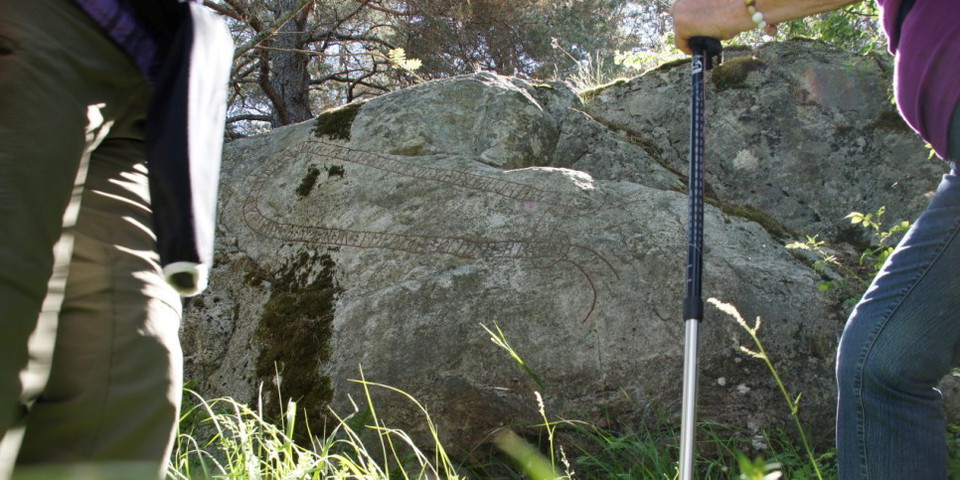
Foto: Christian Grässer
Livstens ristning - Livstens-leden
- Pilgrimservice
- Lyd
- Amt: Stockholms län
- 6825.46 km fra dig
Handlinger
Beskrivelse
Livsten built bridges for himself and his wife. He lived on Torsholma and his men lived in Rolsta. The bridges go to Helgö, where it is thought that his ship may have been moored. We can see that Livsten was a Christian from the crosses on the carvings and from the fact that one of his sons had an unusual name for the time, Niklas.
Livsten's carving is also known as Näshällen and was made in the early 12th century. It was rediscovered in 1928 when some boys from the neighboring farms went canoeing on the rocks in the forest and accidentally scraped off moss from the rock carving.
Two years later, Professor Otto von Friesen came to look at the boys' discovery, and had no problem interpreting the writings in the horseshoe-shaped loops, both of which are adorned with a cross: "Livsten had the bridges made into a shrine for himself and his wife Ingerun and his sons Jorund and Nikulas and Luden."
He owned a farm in Torsholma and a ship's help in Rolsta.
Who was Livsten? We understand that he was a Christian. He carves crosses and builds bridges for spiritual prayer for both himself and his family. In addition, one of his sons has a rather unusual name for the time: Nikulas, Niklas, i.e. St. Nicholas, the saint of seafarers and the model for Santa Claus - our Santa Claus.
From the rune stone we understand that Livsten lived in Torsholma. Frösunda was a parish in Hundare Seminghundra, which belonged to Attundaland. Hundare is a Viking administrative area. The word härad meant that the people armed an army, while hundare stood for sea battles. Each Hundare had to have four ships when the king called for a ledung, i.e. a naval campaign.
Livsten was responsible for one such ship, but he did not have enough men to run his boat, so he had 'ship's help' from Rolsta. So a bridge was needed between Rolsta and Helgö, but also one between Torsholma and Helgö. What is now fine farmland was at that time marshland and Helgö was really an island.
Livsten had road banks built, the bridges of the time. Thanks to them, Livsten and his men could easily reach the harbor where the boat was moored and the water that connected the Trälhavet with the sailing route to Uppsala. However, researchers are somewhat divided as to whether the ship was actually in a harbor, or whether it was next to the farms.
In addition to Livsten's easier access to his ship on Helgö, the animals could also use the bridge to graze in the pastures on Helgö.
Aktiviteter og faciliteter
- Pilgrimservice
- Lyd
Kontakt
Adresse
Telefon: 08-587 850 00 Besök: Kulturhuset, Allévägen 1, Vallentuna
E-mailadresse
Vallentuna kommun
Organisationens logotype

Jeg har været her 1
Jeg vil gerne derhen
Spørgsmål og svar
Stil et spørgsmål til andre Naturkartan-brugere.
Anmeldelser
0 anmeldelser
- 5 :
- 4 :
- 3 :
- 2 :
- 1 :
Brugernes billeder
Der er endnu ingen brugerbilleder. Vær den første til at dele et!