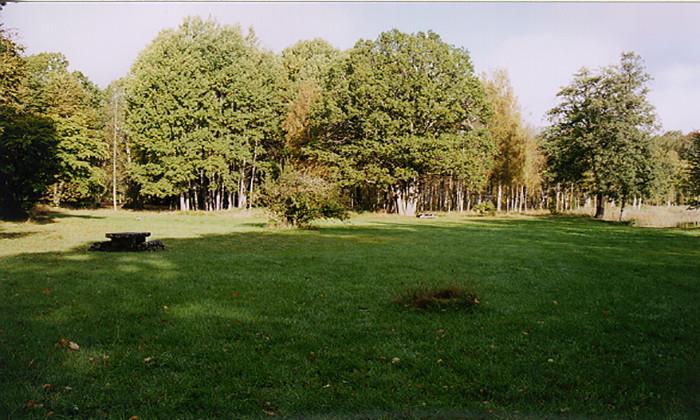
In this reserve, deciduous forest grows on old farmland. Some open areas have been preserved to this day. As you walk through these, notice all the stone piles. The mounds are remnants of the farming era and are called cultivation cairns.
From open to closed
In most of this reserve you walk through lush deciduous forest. The forest has grown up on old farmland. Where there used to be fields, hay meadows and pastures, oak, ash, beech, lime and maple now thrive. A small part of the agricultural landscape remains in the form of an old field that is mown every year and grazed with sheep in late summer. From the parking lot there is a passage through the fence for hikers.
Flowers and fungi
In the spring, carpets of wood anemones spread out in the lush deciduous forest. First, bluebells appear among the brown leaves of last year. This is followed by white anemones in abundance. In summer and into fall, white, orange, yellow and red waxwings can be found in the open fields. One of these is the scarlet waxwing, a species that has declined in recent years. This is because it does not thrive on fertilized land and many open pastures and hayfields have disappeared.
Småland lime trees
In the southern and western parts of the reserve there are several cairns. A cairn is a pile of stones that farmers have laboriously cleared from the field. Here in Ekensberg, the stone piles have been placed next to lime trees and are therefore called lime cairns. Lindrösen are typical of stony Småland, especially the eastern part of the landscape.