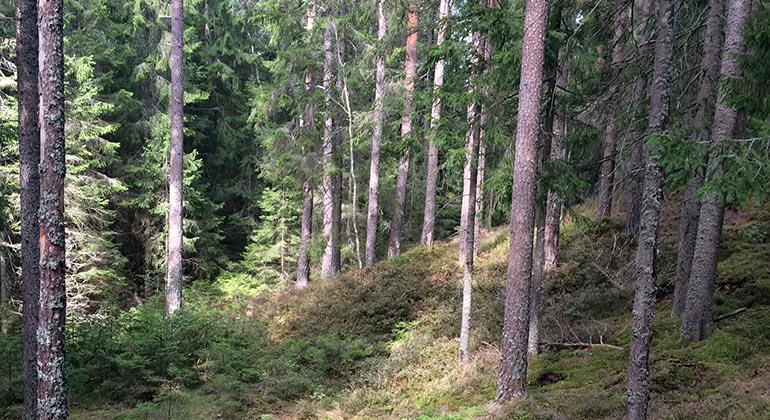
• Jönsaskogen.
    Jönsaskogen.
    Foto: Rolf Wedding

Jönsaskogen, Naturreservat

  • Naturreservat
av 5 stjerner

Handlinger

  • Veibeskrivelse

Beskrivelse

The Jönsaskogen nature reserve consists of a wild, old-growth forest area on the edge of Kilsbergen. There are plenty of moisture-demanding fungi, lichens and mosses as well as rare birds.

Bergslagsbygd

The name of the nearby village of Hällshyttan testifies to the area's history of mining within the so-called Lekebergslagen. The area's large differences in altitude and many watercourses created good conditions for building both smelting works and hammer forges. Many crofts and cottages around the smelters housed people who made their living by producing large quantities of charcoal and transporting coal, iron and ore to and from the smelters and forges. In the reserve there are traces of coal production in the form of at least one coal pit. Just next to the northeastern boundary of the reserve are the remains of the Asphöjden hut, which was reportedly inhabited until a few years into the 20th century. The forest was used intensively during the mining period, mainly for coal production but also for forest grazing, but has since been left mainly without forestry measures and developed into a natural forest-like state.

Varied old-growth forest

Jönsaskogen is part of a larger contiguous natural forest-like forest area with a great wealth of moisture-demanding cryptogams, i.e. fungi, mosses, lichens, ferns and others that reproduce with spores instead of seeds. The area's herb-rich spruce forest types are particularly valuable, not least because they are unusual in the county's other protected nature areas. The reserve consists of a long, narrow old-growth forest parcel that contains several forest types. The upland parts, not far from the Tväggelåten tarn, are dominated by sparse pine forest. While high-stemmed shady moist spruce forest closes on the slopes to the southeast. Several ridges run through the area in a north-south direction. Between these are swamp forest strips. On the most fertile slopes in the lower stream valley, the spruce forest has grown considerably. The tallest spruces here reach over 30 meters. Deciduous trees are sparse in the area, of which aspen is the most common, and there are several really large aspens in the area. At Asphöjden there are a couple of larger maples and in wetter areas birch and alder grow. The age of the trees also varies greatly in the reserve. The oldest trees are somewhere around 180 years old and there is plenty of dead wood. Examples of rare species that have been found in the area are the knotweed, the common crow, the three-toed woodpecker and the starry-throated fungus.

Accessibility

Jönsaskogen belongs to level 1 in the county administrative board's leveling of the county's nature reserves, which means that the reserve has a wilderness character and lacks outdoor recreation facilities.

Værvarsel (kl. 12.00)

Laster…

Kom hit med offentlig transport

Aktiviteter og fasiliteter

  • Naturreservat

Fakta

Municipality: Lekeberg

Decision year: 2018

Area: 15.4 hectares

Landowner: Private

Reserve creator: County Administrative Board

Reserve manager: County Administrative Board

Natura 2000: parts of the area are part of the EU's network of protected nature, SE0240121 Jönsaskogen

Veibeskrivelse

The Jönsaskogen nature reserve is located just north of Hällshyttan, about 2.5 km north of Lekhyttan.

Forskrifter

In the nature reserve it is forbidden to:

  • drill, hack, blast, dig, carve, paint or otherwise damage rock, the earth's surface, stones or boulders, or to move or remove stones or boulders,
  • drive a motorized vehicle other than on roads
  • felling, removing or otherwise damaging living or dead, standing or fallen trees and bushes
  • make fires other than in the designated place and then only with firewood brought along or provided by the reserve manager,
  • damage vegetation, for example by picking or digging up plants such as rice, grass, herbs, mosses or lichens and fungi
  • disturbing wildlife in any way other than what normally occurs when hunting,
  • collect plants, animals, lichens or fungi without the permission of the County Administrative Board,
  • without the permission of the County Administrative Board, put up a permanent board, sign, poster or similar device or mark out tracks,
  • without the permission of the County Administrative Board, use the area for organized competitions or exercises, camp activities or similar,
  • without the permission of the County Administrative Board, carry out scientific studies or conduct environmental monitoring that involves marking, collection, trapping or other impact on the natural environment.

But it is permitted to:

  • pick berries, edible mushrooms and flowers for your own use, but not protected or red-listed species.

Kontakt

E-postadresse

Jeg har vært her

Jeg ønsker å dra hit

Omtaler

—

0 anmeldelser

av 5 stjerner

5 :
0.0%
4 :
0.0%
3 :
0.0%
2 :
0.0%
1 :
0.0%

Spørsmål og svar

Still et spørsmål til andre brukere av Naturkartan.

Brukernes bilder

Del bildene dine fra stedet!
Naturkartan

Åpne dette i appen