
-
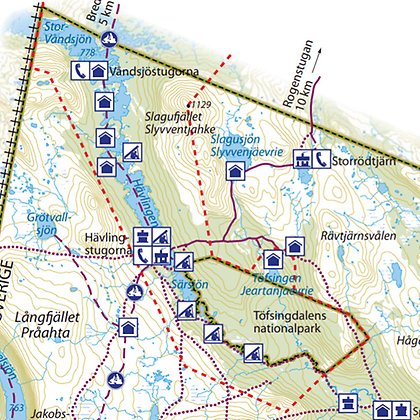
Karta som visar område med restriktioner för tält och eldning -
-
-
-
-
-
-
-
-
-
Långfjället, Naturreservat
- Naturreservat
- Fylke: Jämtlands län
Handlinger
Beskrivelse
The Långfjället Nature Reserve, with the Grövelsjön mountain station and the Södra Kungsleden trail, is a popular mountain destination. Together with adjacent protected areas—Rogen in Jämtland and Femundmarka in Norway—it forms Gränslandet, a large area of great natural and recreational value. Near Lake Hävlingen, there are several rental cabins close to Töfsingdalen National Park.
Photo: Dalarna County Administrative Board
What can you do here?
Outdoor Activities in Summer and Winter
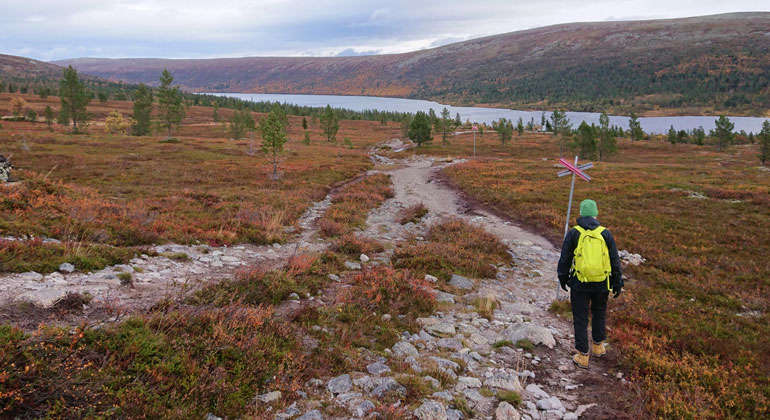
In Långfjället, you can go mountain hiking, skiing, and biking, as well as fishing, canoeing, picking berries, and much more. There are a large number of snowmobile, winter, and summer trails that start from Grövelsjön and Lövåsen and lead to Storvätteshågna or the Hävlingen cabins. Near Hävlingen, the County Administrative Board has several cabins available for rent.
Special Rules Within the Red-Outlined Area
Within the red-outlined area on the map—around Hävlingen, Storån, and Töfsingdalen—you may only camp and build fires at designated sites.
On the map, these sites are marked with symbols for rest shelters (rest huts) and windbreaks. On the Swedish Mapping, Cadastral, and Land Survey’s mountain map, these sites are marked with a triangle.
NOTE! You may not camp near the rental cabins.
Rental Cabins and Overnight Cabin
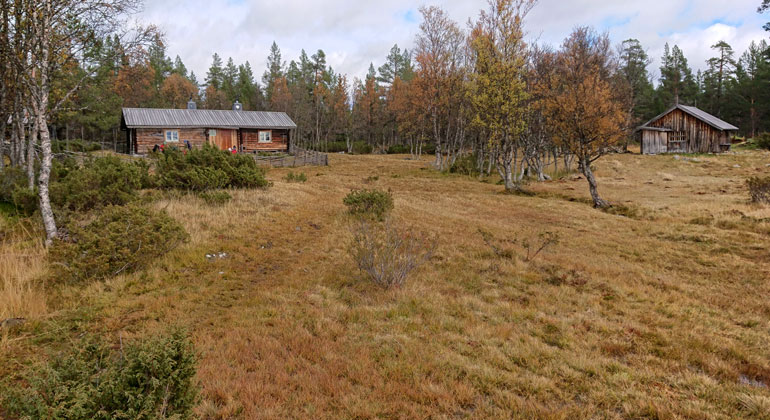
In Långfjället, there are cabins that the County Administrative Board rents out for both short- and long-term stays. At the Hävlinge cabins in Långfjället, the County Administrative Board has its own cabin host on site during the season. You cannot book individual beds in the cabins; instead, the entire cabin is rented out. If you are traveling alone and do not want to rent an entire cabin, there is an overnight cabin in Hävlingen that is rented out by the bed. Read more about the cabins under “Cabins in Långfjället.”
Rest Shelters
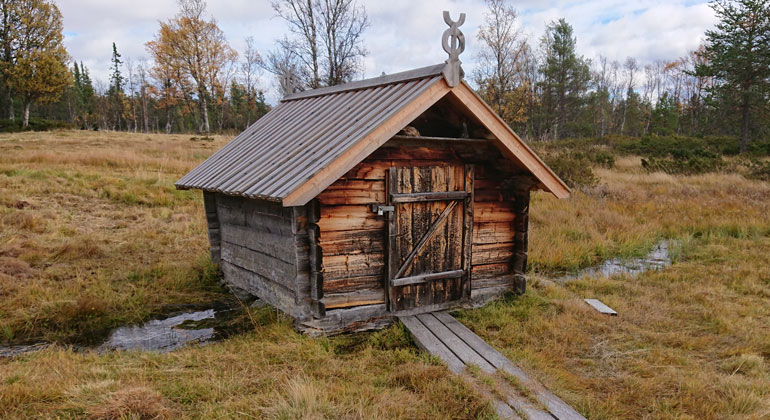
In Långfjället, there are several rest shelters (day-use shelters) in various locations. The rest shelters are equipped with a stove, benches, and tables for resting. You may not spend the night in the rest shelters except in emergencies. Rest shelters are located around Lake Hävlingen, Töfsingen, Slagufjället, Lake Slagusjön, Valdalsbygget, Olån, Oskarsstugan, Fiskebäcksstugan, the hunting cabin at Foskan, Särsjöbäcken, as well as at Spångkojan and Siljanskojan along the Storån River.
Visit Valdalsbygget, on the border with Norway
What makes this place unique?
A Glimpse of Långfjället
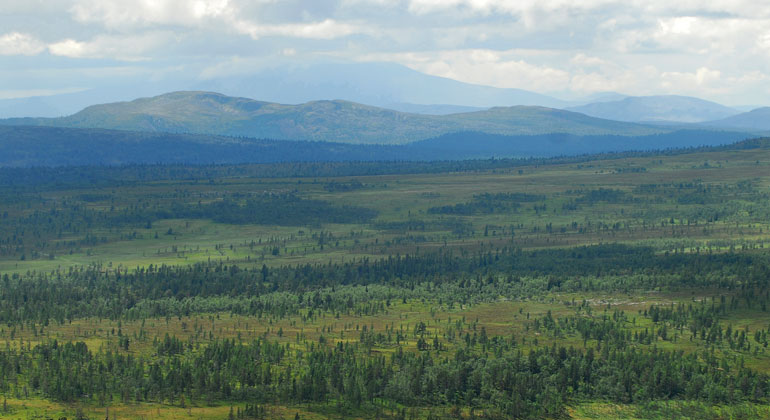
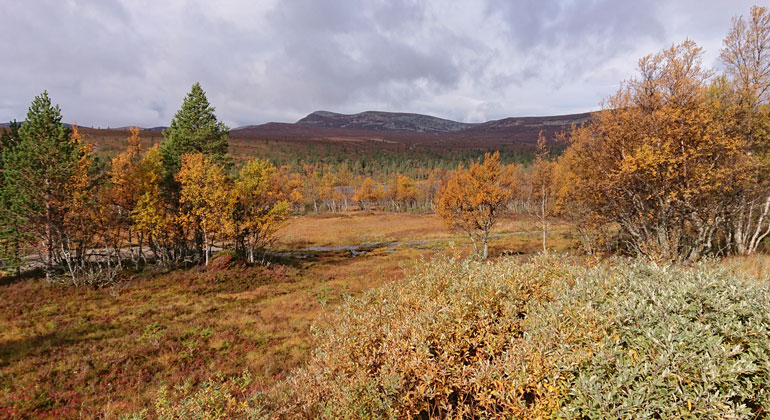
Långfjället consists of three mountain ridges, separated by the Grövlans, Storån-Hävlingen, and Hågan valleys. They consist of gentle, low mountains, forested valleys, and a large marshland area in the far east. Most of the mountains are around 1,000 meters high, while Storvätteshågna, Svealand’s highest point, reaches 1,204 meters above sea level.
Species-poor vegetation, but very old trees
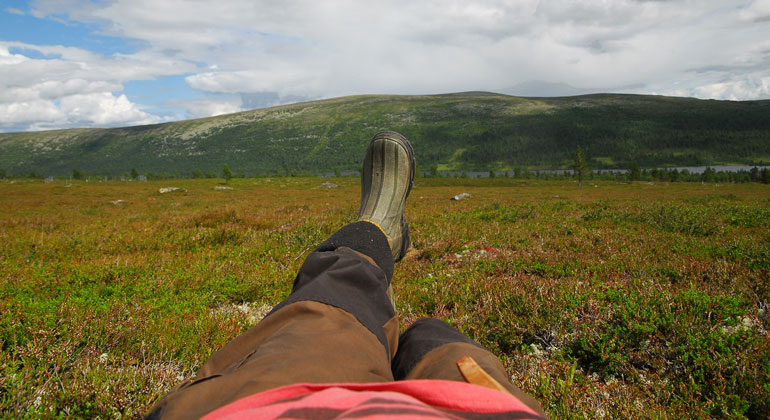
On the bare mountain slopes, there are species-poor heathlands. Along the watercourses, the vegetation is richer, with flowers and lush grass. Mountain birch forests are found in the north along Hävlingen-Våndsjön. In some places, such as north of Töfsingdalen National Park, there is also a lush and more species-rich meadow birch forest. Of particular interest is the pine-birch forest in the western parts, for example on Dyllen. Here, the tree line consists of alternating stands of pine and birch. Below the mountains, pine forests dominate, while spruce forests are found primarily in smaller areas along watercourses and in valleys.
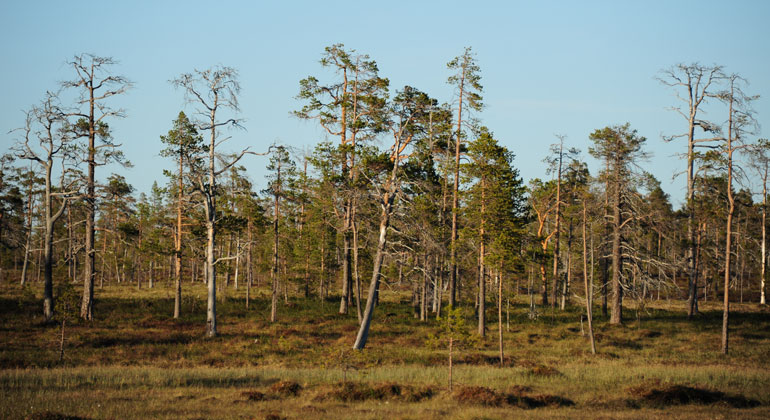
Near the tree line, there is a significant presence of primeval and natural forests, and pine trees older than 500 years can be found in several places. Large areas of primeval-like forest are found in several locations throughout the reserve.
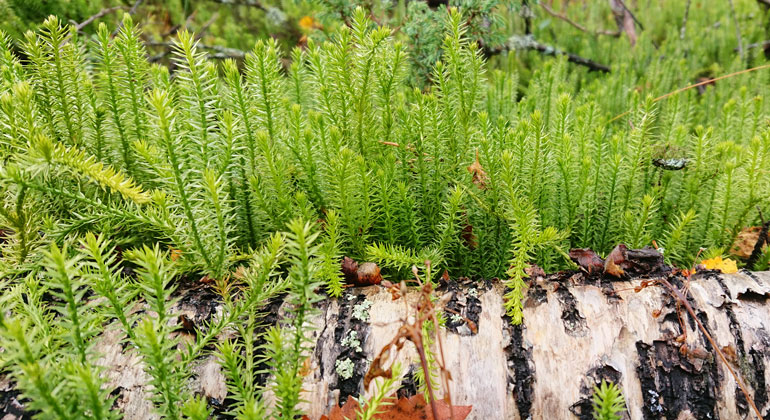
In terms of flora, the area is species-poor. However, there are exceptions in the Stora Olån valley, as well as in smaller areas in the Töfsing Valley and on the slopes of Hällsjövålen. Certain northern mountain plants have their only occurrences in the Dalarna region within Långfjället. A few rare lichen species have been found here, among which the wolf lichen is a common and striking species on old, dead pine trunks. Wood-decay fungi that require old-growth forest conditions are found primarily in Töfsingdalen.
Bird, Fish, or Something in Between?
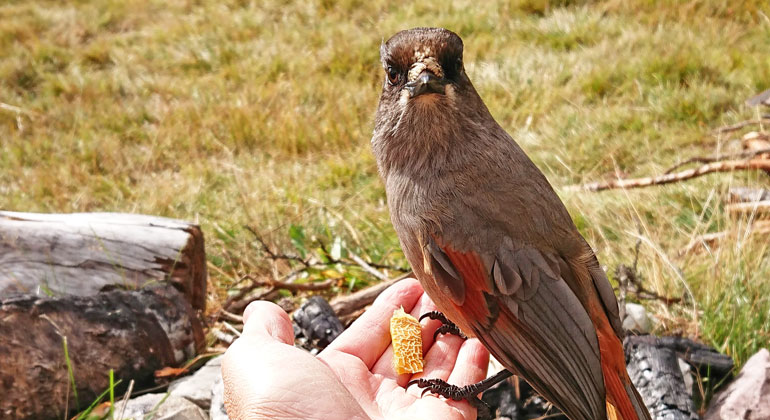
The alpine marshes within the area are of great value to birdlife. The most important bird area is Juttulslätten, where a number of rare northern bird species have been observed. In the dry, open landscape, the golden plover, meadow pipit, and wheatear are common visitors. The spotted redshank is most often seen in bogs within forested areas; the Siberian jay is common in coniferous forests; and the redstart can be found in pine forests. You may also encounter moose, hares, squirrels, martens, minks, weasels, and red foxes. Fish stocks in lakes and waterways are abundant.
Landforms of the Past
The bedrock consists of rocks from the Scandinavian mountain range. These rocks are usually very nutrient-poor, though there are exceptions. Of great geomorphological interest are the so-called rogen moraines in the Storån valley and along the lakes northward to Våndsjön.
Classic examples are the glacial lake shorelines along Grövelsjön, which were already mentioned by Linnaeus. In the mountains, various types of formations created by the inland ice sheet can be found. On the Juttulslätten, a plateau at approximately 750 meters above sea level, there is a so-called ice-dividing zone. Here, the ice was at its thickest and moved the least. Consequently, various landforms from earlier ice ages “survived the winter” and were preserved beneath the ice sheet.
Cultural-Historical Conditions
The area contains several older settlements that are valuable from a biological perspective. Relatively well-preserved mountain pastures include Gjoten, Valdalsbygget, Ulvsätern, Foskdalen, and Västra Fjätvallen. Grunddagen and Yttre Hågådalen were once mountain farms, which have now been demolished. The only remaining mountain farm is Ovre Hågådalen. Around these settlements, the vegetation has been influenced by activities such as woodcutting, grazing, and controlled burning. In addition, the surrounding marshes and grassy lands have been used for haymaking, which can still be seen in the remaining hayracks and hay barns.
Traces of the country’s southernmost Sami settlements can be found in the form of remnants of the Sami camps built around the turn of the century. Isolated huts and other structures can be found at the Slagufjället Sami camp, the Hävlinghällorna Sami camp, the Hågå camp, and Grövelsjön. Throughout the area, old systems of trapping pits can also be found.
Reindeer Herding
The reserve lies within the lands of the Idre Sami community, which are used year-round. In this area, the community is permitted to keep approximately 2,000 reindeer plus calves. Reindeer fences follow the national border to the west and the Fjätån River to the northeast. Reindeer pastures are located at Storvätteshågna, Fjätvallsåsen, Jakobshöjden, and Huskläppen, as well as near Grötvallssjön, Slugusjön, and Töfsingen. In addition, there are several reindeer herders’ cabins.
Please remember to show consideration for the reindeer; disturbing them is prohibited under the Reindeer Husbandry Act. Be especially careful during the calving season, which runs from mid-April to mid-June.
Fishing from a boat or on the ice
Fishing is most extensive in the Storån-Hävling system, but there is also active fishing in Hågån, Foskan, Grövlan, and other larger lakes and waterways.
A number of facilities have been set up for recreational fishing. Cottages are available for rent at Särsjön, Hävlingstugorna, and Stor-Våndsjön. The cottages are heavily used in both summer and winter. Rowboats and canoes can be rented at Hävlingstugorna. Boat ramps connecting the lakes make the entire lake system—from Särsjön in the south to Våndsjön in the north—accessible.
At Grövelsjön, boat rentals are available next to Sjöstugan. The lake is also open to snowmobile traffic, and in winter, ice fishermen make frequent use of this mode of transportation.
Photos in the slideshows: Maria Jons, Alf Halvarsson, Stefan Hamreus, and Sebastian Kirppu.
Valdalsbygget, on the border with Norway
Photos in the slideshow: Maria Jons, Alf Halvarsson, Stefan Hamreus, and Sebastian Kirppu.
Photo: Dalarna County Administrative Board
Aktiviteter og fasiliteter
- Naturreservat
Fakta
Bildades: 1973/1993/2002Storlek: 67800 haKommun: ÄlvdalenFörvaltare: LänsstyrelsenNatura 2000: Ingår i EU-s nätverk av skyddad natur. Om Natura 2000
Veibeskrivelse
You can get to Grövelsjön in the north by bus or car.
Hällsjön in the east can be reached by car via Foskros.
Forskrifter
The following activities are not permitted in the reserve:
- Within the area marked on the map below (Interactive Map/Reserve Map—pink-dashed line), camping and building fires are permitted only at designated campsites.
- Climb nesting trees or intentionally come within 100 meters of a bird of prey’s nest, den, or lair.
- Damage the ground or geological features.
- Damage living or dead trees and shrubs, dig up plants, or remove mosses and lichens.
- Drive off-road with a motorized vehicle.
- Use an ice drill powered by an internal combustion engine.
- When building a fire, use anything other than fallen branches, fuel brought into the reserve, or fuel provided on-site for that purpose.
- Park vehicles or set up trailers anywhere other than in a specially designated area.
- Use closed roads.
- Engage in rock climbing on cliffs.
- Land aircraft or operate them on lakes other than Lake Grövelsjön and within certain areas indicated on the map below.
Exceptions for off-road motor vehicles:
- Snowmobiles may be driven on the trail between Grövelsjön and Hävlingen, as well as on the ice of Lake Hävlingen through April 25.
- See the markings on the map further down this page.
- Riding on other snowmobile trails and on Lake Grövelsjön is permitted through the first Sunday in May.
- See the markings on the map below.
- Owners or users of vacation homes or summer pastures located within the nature reserve may ride snowmobiles in winter on snow-covered ground from the nearest road or snowmobile trail to and from the vacation home or summer pasture, but no later than the first Sunday in May. The route must be chosen in such a way as to avoid damage to the natural environment.
- Off-trail snowmobiling is also prohibited in the regulated area.
- See the interactive map below. Please note that this extends beyond the nature reserve, around the Grövelsjön mountain station.
Kontakt
Adresse
E-postadresse
Organisasjonens logotype

Jeg har vært her 7


Jeg ønsker å dra hit 10

Spørsmål og svar
Still et spørsmål til andre brukere av Naturkartan.
Omtaler
0 anmeldelser
- 5 :
- 4 :
- 3 :
- 2 :
- 1 :
Brukernes bilder
Ingen brukerbilder ennå. Bli den første til å dele!