
-
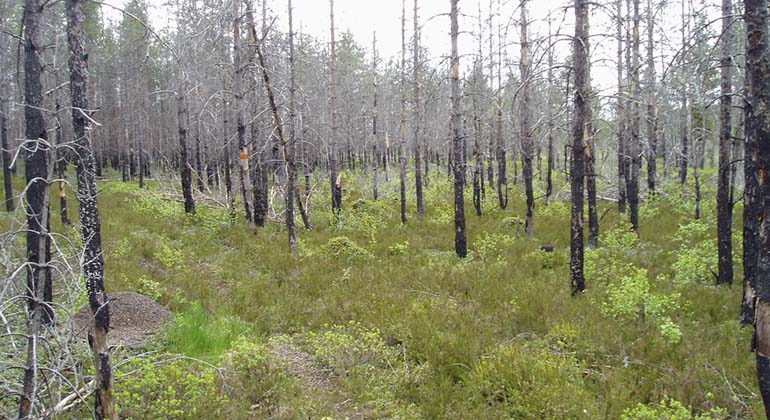
Nittälvsbrännan år 2006.
Foto: Elisabeth Karlsson
Nittälvsbrännan, Naturreservat
- Naturreservat
- Landsdel: Örebro län
Handlinger
Beskrivelse
The Nittälvsbrännan nature reserve is an area of pine forest that was ravaged by a forest fire in 2000. Today, the fire area has been transformed into an exciting nature reserve, one of the reserves adjacent to the beautiful Nittälven river in northern Örebro County. A trail runs around the most interesting parts of the burnt areas and there is also a fire pit along the way.
The nature reserves in Nittälvsdalen
A large, continuous wilderness area with many nature reserves extends along the Nittälven river.
Nittälven
The Nittälven meanders through sandy sediments that formed in an ice-river delta during the final stages of the Ice Age. The banks are raised banks (levees) that are occasionally flooded. Beyond these are damp, often flooded areas that were once used for haymaking. Further away from the river, the ground becomes firmer, and there are elongated hills running north-south. The hills are home to a mixed coniferous forest dominated by pine. The river is one of the few undeveloped rivers in the county, and it was used for rafting early on. On calm evenings, trout can be seen waking in the surface water.
The forest fire on Nittälvsheden
In early spring 2000, a forest fire occurred on Nittälvshedarna a few kilometers north of Dansarbacken. The fire started at an ignited car on a forest road west of the Nittälven river and spread in a north-easterly direction, where it was eventually contained. Fire on the sandy Nittälven heaths is nothing new. There are numerous traces of older forest fires, mainly in the form of so-called "fire sounds" - indentations in the bases of old pine trees, as well as stumps bearing traces of charred wood. Spruce is sensitive to fire and is usually destroyed, while pine is more resistant and usually survives. The young forest that burned in 2000 was planted in the mid-1960s after extensive clear-cutting. Forest fires can be a major disaster for individual landowners, but in a broader perspective, fires are one of the natural disturbances that have shaped the forest landscape in large parts of the country. The most common cause of forest ignition was of course lightning, but often our ancestors set fire to the forest to create good grazing conditions for livestock, or to allow for leaf harvesting on the lush deciduous burns that occur after a forest fire.
In the past, the forest often burned
It is estimated that one-half to two percent of the Swedish forest burned each year. On some drier soils, fires could sweep through several times every century, while in wetter forest types fires were very rare or never. Today, forest fires are rare. This is because forests now contain a small amount of dead wood and a well-developed network of forest roads, which also makes it easier to contain and extinguish forest fires. Many of the tree species in the coniferous forest have adapted to recurrent forest fires. After a fire, a deciduous phase usually sets in on the fire ground. Aspen, birch, rowan, willow, alder and pine quickly establish themselves. More shade-tolerant trees, especially spruce, then gradually replace the pioneer trees.
Leaf scorch
When a forest burns, not all the trees die, so the new forest in the area will be a mix of older and younger trees. The nutrient-rich ash is a good place for new seedlings to grow. Birch seeds germinate very easily on burnt land, so the forest will be more leafy than before the fire. As a result of forest fires, large areas of pure stands of deciduous trees sometimes emerge over a few decades. These are known as broadleaf burns. These areas often have a rich flora and fauna. Some fungi, lichens, vascular plants and insects depend entirely on forest fires for their survival. Fireweed and fireweed are two plants whose seeds need a temperature of over 50 degrees to start germinating. Their seeds can remain viable for over a hundred years while resting in the soil. Many beetle species also benefit from forest fires, as do several butterfly species. Raspberry, rhododendron, pine needlewort and cleavers are some of the species that invade burnt areas early. The three-toed woodpecker benefits from the rich supply of dead wood where beetle larvae live. Redstart, blackcap and black tit can be seen in the reserve and if you walk carefully along the herb-rich river banks there are good opportunities to see beavers and beaver felled trees. If you are lucky, you may see traces of wolves.
Fire as nature conservation management
In the past, forest fires were a common occurrence in our forests, here and there in the reserve you will find traces of old pines after older forest fires. Fire is a necessity for a large number of plants and animals, which over the millennia have adapted to the habitat provided by fire. In order to benefit and preserve the area's fire-favoring species, the County Administrative Board carries out controlled conservation burns in the nature reserve.
More information about conservation burning
Current conservation burns
During April-August 2025, a conservation burn is planned in the southwestern corner of the nature reserve. The burn area covers 10.4 hectares and consists of pine forest that was shaped in various ways by a fire in 2000.
Completed conservation burns
In June 2023, a conservation burn was carried out in an area from Dansarbacken in the Kaljoxadalen nature reserve to the southwestern part of the Nittälvsbrännan nature reserve:
Life2Taiga
During the years 2022-2028, parts of the area are included in a project with conservation burning in focus, Life2Taiga.
Internationally valuable Ramsar site
Sweden has designated the Nittälven River as a Ramsar site, which includes the Nittälvsbrännan nature reserve. The Ramsar Convention is an international agreement aimed at achieving conservation and sustainable use of wetlands. Among other things, the countries that have signed the convention must designate the most valuable wetland and aquatic environments in the country as Ramsar sites and ensure that they are preserved.
Aktiviteter og faciliteter
- Naturreservat
Fakta
Municipality: Ljusnarsberg
Year established: 2002
Area: 105 hectares
Landowner: Swedish Environmental Protection Agency
Manager: County Administrative Board
Reserve creator: County Administrative Board
Natura 2000: The area is part of the EU's network of protected nature, SE0240117 Nittälvsbrännan
Ramsar: The area is included in the global nature conservation convention Ramsar
Rutevejledning
The nature reserve is located 15 km northwest of Kopparberg. The area is most easily reached if you go from Kopparberg to the northwest on road 793 and just after the crossing of the Nittälven, west of Uvbergsbron, go south for a few more kilometers at the sign "Dansarbacken". Keep right at Y-junction. Parking is after 3.4 km.
Regler
In the nature reserve it is forbidden to:
- damage the surface of the ground
- bring an unleashed dog
- disturbing wildlife
- picking flowers, lichens or woody fungi or otherwise damaging the vegetation (berries and edible mushrooms may be picked)
- collect insects or other invertebrates
- making carvings on dry trees or bark or damaging lying tree trunks
- light a fire other than in a designated place and with designated wood
- camping
- driving a motor vehicle or riding a bicycle
- put up a board, poster, poster, sign or similar
- set up orientation controls or organize marked trails
Kontakt
E-mailadresse
Organisationens logo
Jeg har været her 3

Jeg vil gerne derhen 1
Spørgsmål og svar
Stil et spørgsmål til andre Naturkartan-brugere.
Anmeldelser
0 anmeldelser
- 5 :
- 4 :
- 3 :
- 2 :
- 1 :
Brugernes billeder
Der er endnu ingen brugerbilleder. Vær den første til at dele et!