
-
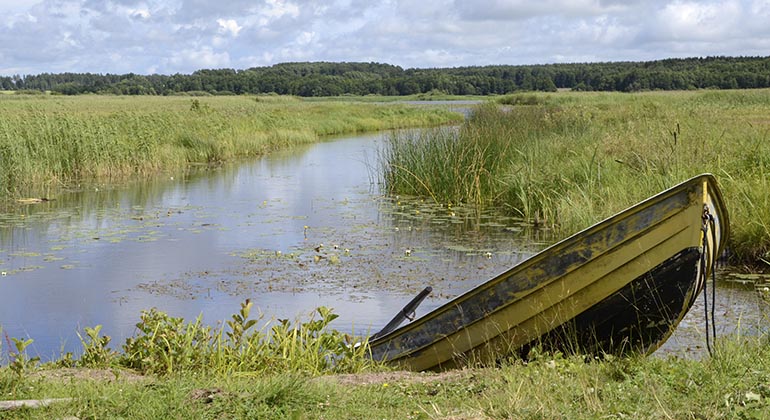
Tysslingen, vid Norra Svalnäs.
Foto: Elisabeth Karlsson
Tysslingen, Naturreservat
- Naturreservat
- Amt: Örebro län
Handlinger
Beskrivelse
The Tysslingen nature reserve consists of one of central Sweden's finest bird lakes. The shallow and nutrient-rich plain lake attracts a variety of bird species that nest on the shore meadows or rest before flying on.
Restricted area at the southern tower
Parts of the area next to the former transformer station with nature information south of Lake Tysslingen are cordoned off as the embankment may be unstable after previous floods. Please respect the closure and do not go up on the embankment!
A nutrient-rich lake is home to a lot of life
Lake Tysslingen is six kilometers long but just under a meter deep. Its water comes from the plain in the north and from streams in Kilsbergen. The shores are lined with meadows and reed beds, as well as a small amount of shore forest. Unlike the brown and species-poor lakes and tarns of the forest, Tysslingen is much more nutritious and teeming with life. The open water surface is largely covered by yellow and white water lilies. Beneath the surface, a variety of fish, bugs and aquatic plants provide a perfect restaurant for the rich bird life that lives around the lake.
Popular resting place and nursery
Tysslingen is perhaps best known for the large number of whooper swans that rest on the lake's northern shore meadows during February-March. Lake Tysslingen is perfect for a few weeks of rest and food breaks before the journey continues. But it's not just the swans that are traveling through Sweden during spring. Greylag geese, cranes, spoonbills, ruffs and ringed plovers also like to take a break at Tysslingen. Towards the summer, when the migratory birds have moved on, the lake is hardly empty of birds. Instead, the shore meadows are now teeming with all the breeding pairs of birds, i.e. those that form families, build nests and raise their young here, such as yellow wagtails, meadow pipits, skylarks and lapwings.
From bay to lake
The fertile soils of the Närkes plain were formed during the last ice age, when fine-grained material was brought here by the melting ice. Slowly the land rose and what was a bay of the sea became a lake. The old seabed provided fertile soil and the lake had plenty of fish. As early as the Stone Age, people came here to hunt and fish. Stone axes of our ancient ancestors have been found in several places around the lake. Perhaps they were dropped during a fishing trip here in the bay? Over time, people became more settled, started to farm and keep livestock. The wetter land was mainly used for haymaking and grazing livestock.
The bird lake that disappeared - and came back
For a long time, Tysslingen was one of the many lakes and wetlands of the Närkes Plain. But the population grew and the land had to support more and more people. The agricultural landscape changed dramatically, especially in the 19th century, when most of the lakes and wetlands of the Närkes Plain were lowered and drained. Lake Tysslingen was lowered in the 1860s when its surface area was halved. The aim was to provide farmers with new and more arable land. But for all the plants and animals in the wetlands, the measures were disastrous, as the habitats of a large number of animals and plants virtually disappeared. The next blow to bird life came when grazing ceased on the salt meadows. Soon, reeds and shrubs began to spread along the lake shores. But since the 1980s, landowners and nature conservationists have been working together to restore the open water meadows and keep the reeds at bay. Today, cows are once again grazing along the lake's shores and, where necessary, we use machinery to help maintain the vegetation around the lake.
Accessibility and facilities
There are no hiking trails in the reserve, but there are several viewing towers and platforms that bring you closer to the lake.
Viewing towers and platforms
- Åkerbymaden on the south-eastern side of the lake is reached by an accessible viewing platform via a paved path. This path has some parts with a slightly steeper slope (helpers may be needed for wheelchair users).
- The northern viewing tower at Rånnesta gives you a nice view of the lake. The first two floors are reached via accessible ramps. Adjacent to the tower is a spacious outhouse, although not fully accessible.
Exhibition
At the southern end of Tysslingen there is a small exhibition about the nature, ecology and cultural history of the lake housed in the former brick transformer station. The exhibition is open during the summer.
Resting cabin
Adjacent to the nature reserve at Svalnäs on the western side of Tysslingen, there is an open rest cabin for visitors that is accessed via a paved path from parking lots by the road. The cabin can be booked in the evening (managed by Örebro municipality).
Café and visitor center
Adjacent to the northern end of the nature reserve is the Tysslingen Nature Center in Rånnesta with a café, exhibitions, swan counting and more (run by the Tysslingen Nature Center Foundation in Rånnesta).
Listen to a guide about Tysslingen
Audio guide about Tysslingen
4 Jordbrukslandskapet restaureras
Production: Thomas Öberg/Natur i Norr (production and speaker), Louise Turner (English speaker), Sten Wahlström (bird sounds from the CD Fågelsång).
Sign interpreted information
The water level in Lake Tysslingen is regulated
In 1997, a water judgment was decided for Tysslingen. The water judgment was a basic prerequisite for being able to recreate the open grazing landscape around Tysslingen and to bring back the rich bird life that so long characterized the wetland landscape.
The Reclaim restoration project
Tysslingen was restored during the years 2012-2018 within the LIFE project Reclaim .
Aktiviteter og faciliteter
- Naturreservat
Fakta
Municipality: Örebro
Year established: 2008, expanded in 2015
Area: 540.7 hectares
Landowners: Individuals and the Swedish Environmental Protection Agency
Manager: County Administrative Board
Reserve creator: County Administrative Board
Natura 2000: parts of the area are part of the EU's network of protected nature, SE0240156 Tysslingen
Decision extension nature reserve Tysslingen 2019 Pdf, 750.1 kB, opens in new window
Rutevejledning
The Tysslingen nature reserve is located in Örebro municipality, about one mile west of the town of Örebro. From Örebro to the southern end of the lake: turn off the E20 at the exit signposted to Garphyttan. Drive Karlslundsgatan west. Just after Gräve you have the information tower and the southern viewing tower on the right side of the road. From Örebro to Rånnesta: turn off the E20 at the exit signposted to Närkes Kil. Drive Ekersgatan northwest and then follow white signs towards Tysslingen.
Regler
Welcome as a guest in nature, remember that:
- do not disturb the birds during the nesting period (approximately April 1 - July 15), therefore do not go out on the meadows during this time
- cows graze on the meadows, be sure to close the gates behind you
- keep your dog on a leash
- take your rubbish with you
- do not go so close to houses that you disturb the residents
- do not walk where crops are grown
Kontakt
E-mailadresse
Organisationens logotype

Jeg har været her 1
Jeg vil gerne derhen 1

Spørgsmål og svar
Stil et spørgsmål til andre Naturkartan-brugere.
Anmeldelser
0 anmeldelser
- 5 :
- 4 :
- 3 :
- 2 :
- 1 :
Brugernes billeder
Der er endnu ingen brugerbilleder. Vær den første til at dele et!