
-
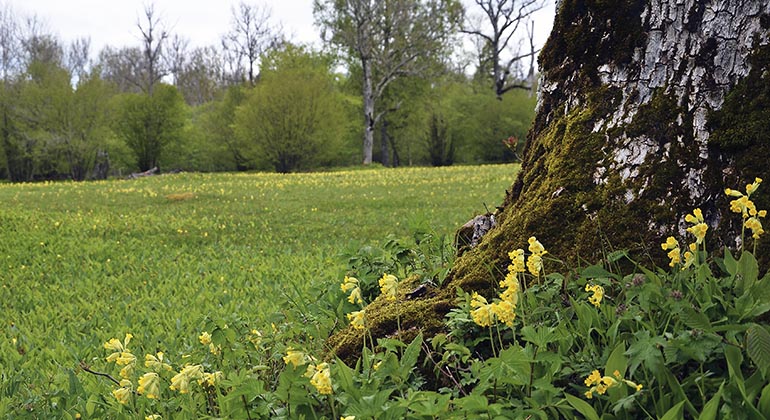
Herrfallsäng.
Foto: Elisabeth Karlsson -
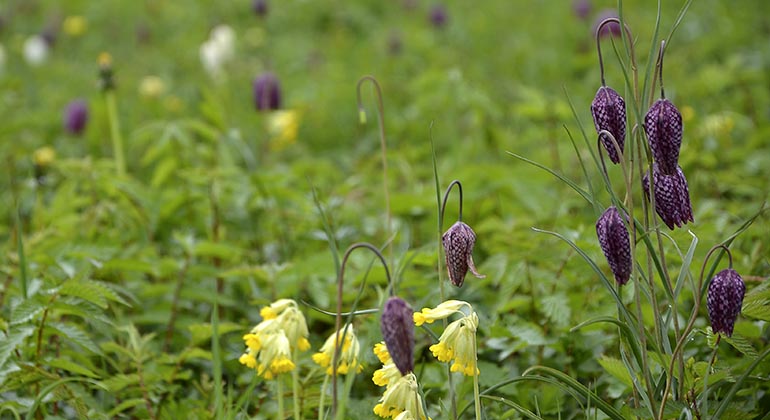
Gullvivor och kungsängsliljor i Herrfallsäng.
Foto: Elisabeth Karlsson -
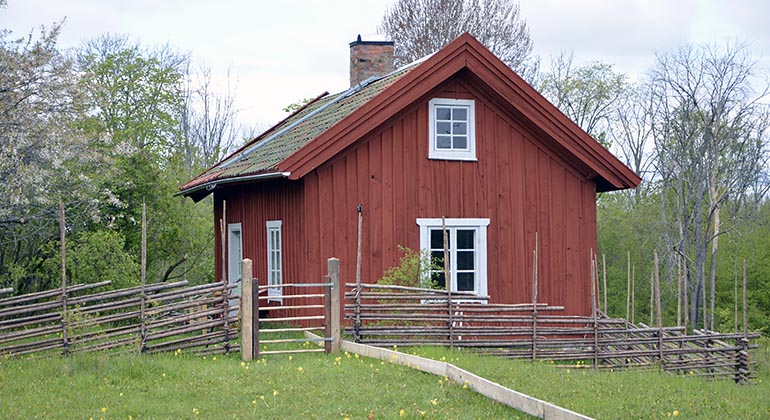
Raststugan i Herrfallsäng.
Foto: Elisabeth Karlsson -
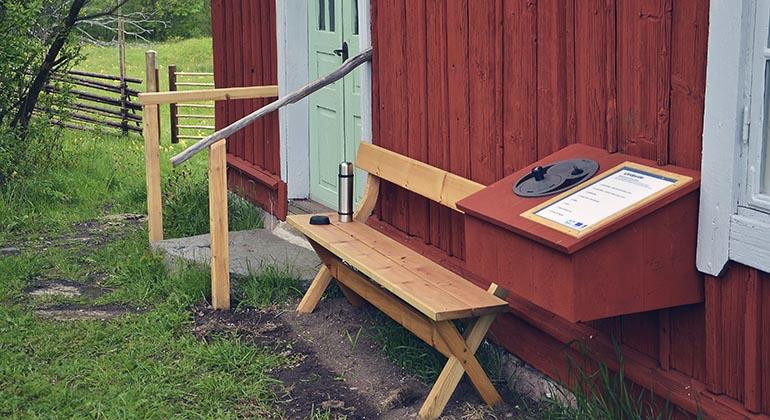
Rastbänk och vevspelare med ljudguider vid raststugan i Herrfallsäng.
Foto: Elisabeth Karlsson -
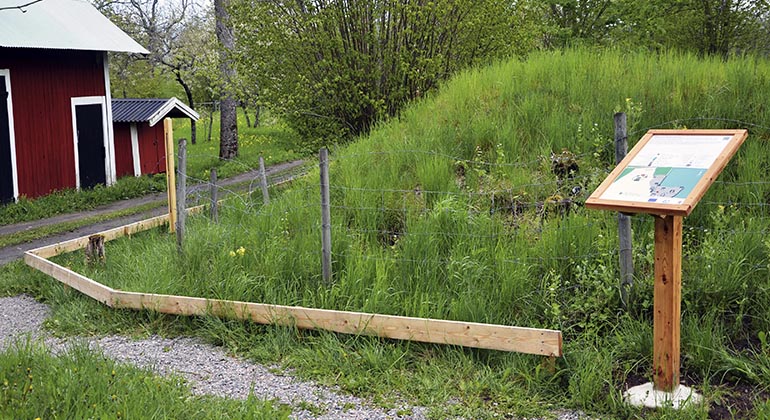
Ledstråk och taktil karta i Herrfallsäng.
Foto: Elisabeth Karlsson
Herrfallsäng, Naturreservat
- Naturreservat
- Amt: Örebro län
Handlinger
Beskrivelse
In the Herrfallsäng nature reserve, you can experience the splendor of flowers and birdsong along an easy path through open fields. Here, the limestone-rich soil, together with centuries of mowing and grazing, has created a very species-rich meadow environment, with as many as 300 different vascular plants. But the reserve also contains deciduous groves, cold springs and a rich marsh with many orchids.
Calcareous soil
Herrfallsäng is located on the lean bedrock, on the edge of a fault. The area slopes down to the north towards Närkeslätten, which rests on a younger bedrock of limestone. A few kilometers further north, at Yxhult, there is a larger limestone deposit. When the ice sheet slid from north to south, it carried limestone with it and spread it out as a layer of soil over the bedrock here south of the plain. This is why the soil in Herrfallsäng is rich in limestone. The hillside location creates a rich flow of groundwater. It is these conditions that together have contributed to the area's rich vegetation. Herrfallsäng was so rich and beautiful that it was protected as early as 1934 and became a nature reserve in 1973.
The deciduous forest became an agricultural landscape
The open, bright landscape at Herrfallsäng is largely man-made. Dense deciduous forests once grew on the hillside, but over time people cut down the forest and began to farm the land. The land at Herrfallsäng may well have been farmed since the Iron Age. The oldest written evidence and maps date from the 18th and 19th centuries and show that the area was used by farmers for several hundred years. Herrfallsäng was previously part of the farms Herrefallet and Melsätter, but later came to belong to the Bresätter farm. At that time, today's nature reserve consisted of a pasture garden with deciduous trees to the east and tree- and shrub-bearing meadows to the west. The two current pastures have in recent times been arable land, but were previously used as meadows. Part of the southwestern grove area was also cultivated at the beginning of the 19th century.
The peat at Herrfallsäng
There have been four crofts in Herrfallsäng. Two of these remain today. Lundbomstorpet was built as a soldier's croft in the early 1800s, while the current settlement at Enebacken was built after 1874. Lundblomstorpet is today open to the public as a rest house, while the other croft is used by the Swedish Society for Nature Conservation. A soldier lived in a soldier's cottage, usually with his family. Having a croft with some land to farm was a salary benefit for the soldier, because he was available to go to war. The farmers who were commissioned by the King to equip and pay a soldier were known as the red men. Peasants who were not soldiers were allowed to farm their land in return for work on the farm to which the peasant belonged.
Hay harvest in a meadow and side meadow
It was from the meadow that the hay was collected, which was then saved as winter feed for the cattle. During the summer, the animals could go out to graze, but in winter they were kept inside the stables and barn. In Herrfallsäng, groups of hazel bushes and deciduous trees grow in the meadow, known as a deciduous meadow. The shrubs and trees pump up nutrients from the soil and at the same time shade the grass and herbs sufficiently so that they do not dry out so easily. The trees should be spaced out so that the sunlight can still warm the ground. In the past, fresh twigs were often cut from trees to dry for animal feed. This was called pollarding and gave the trees a special shape, a sturdy trunk with a ball of young twigs. Hay was also collected from the reserve's fen in the past. The rick marsh is a type of meadow that is usually called a sidewall meadow. Today the meadow is mowed by machine, but no earlier than the end of July so that the meadow plants have had time to go to seed. The hay is removed so that it does not fertilize the ground. On the old arable land to the east and west of the meadow, cows graze during the summer. In late summer, after mowing in the meadow, the cows are let out to graze afterwards to keep the grass short into the fall.
Flowers and butterflies
Meadows that are mown are among the most species-rich habitats that exist. Here at Herrfallsäng, 300 different species of vascular plants have been counted, i.e. plants with roots, stems and leaves. If you come here in April before the leaves burst, you will find lots of bluebells and wood anemones. On the edges of the forest you will find the peculiar water lily and the flowering thistle, whose pink flowers appear on bare twigs before the green leaves. Later in spring, cowslips, lilies of the valley, spring peas, lungwort and meadowsweet appear. Followed by the early summer flowers of buttercups, midsummer flowers and orchids such as St. Peter's keys and night violet. In the marsh, meadowsweet, wood anemone and the little cowslip with its small pink flowers are in bloom. You are sure to see the occasional butterfly flying around among the flowers, everything from lemon butterflies and odoriferous grass butterflies to fieldfare antennae moths and six-spotted bastard swarmers.
Birds, fungi and land snails
But it is not only flowers that thrive in Herrfallsäng. Many fungi and animals also thrive in the calcareous soils. Among the somewhat rare fungi in Herrfallsäng, you can find, for example, candelabra mushrooms, hedgehog mushrooms and veil mushrooms. In the fen there is another rarity, the tiny limpet, only a few millimeters in size and almost impossible to spot without a microscope. Whatever time of year you visit the reserve, you are guaranteed to be joined by a bird. In winter, you might hear a great tit, a greenfinch, a nuthatch and a woodpecker. In spring, new voices come from chaffinches, robins, blackbirds and starlings. Later in the summer, the chorus expands to include warblers, green warblers and perhaps a stonechat.
The species-rich deciduous forest
The reserve was expanded in 2021 with a forest area south of the road. This part has also previously been much more open and is used as meadow and pasture land, as evidenced by lingering meadow plants. There are also many lime-favored so-called grove plants that are typical of deciduous forest areas, such as witch hazel, water lily and soapwort. The area contains spruce plantations and drained marshes that will gradually be restored by clearing, closing ditches and fencing to finally become pasture again.
Accessibility
In parts of the nature reserve we have invested extra in increased accessibility. In the parking lot there is a reserved place for people with disabilities and an accessible picnic table with a protruding table top and backrest.
Tactile map and trails
In addition to information signs about the reserve, there is a tactile map adjacent to the reserved parking lot. From the tactile map/parking lot, a trail for technical canes (approx. 185 m) extends to Lundblomstorpet.
Rest cabin
In the Lundblomstorpet there is an open rest cabin with fireplaces, tables and benches (note, steps in and thresholds). Outside the croft there is a bench and a crankable mp3 player with audio guides that tell about the nature reserve's plant and animal life and history. There is also an accessible picnic table with a protruding table top and backrest.
Path
The paths through the non-hilly meadowland are easy to walk, most paths/walkways are grassy (trimmed several times during the summer season) but some are covered with gravel. No paths/walkways are hardened. There are two privies in the reserve, but without special adaptations. At certain times of the year there are grazing animals inside the pastures. Along an approximately 2 km long trail in the reserve there are 10 posts with fold-out signs with information about the reserve's plants, animals and history. Each pole has a sign at a lower height with information aimed at children.
Audio guides about Herrfallsäng
Production and narrator: Thomas Öberg, Natur i Norr. The audio guide has been partly financed with funds from European Agricultural Fund for Rural Development Link to another website.
Sign interpreted info
This is how Herrfallsäng can sound during a bird year
The woodpeckers call and drum
With spring comes new voices
That's the sound of summer
If you're lucky you can hear...
Aktiviteter og faciliteter
- Naturreservat
Fakta
Municipality: Hallsberg
Established in: 1934 (natural monument), 1973 nature reserve, expanded in 2021
Area: 58.8 hectares
Landowner: Swedish Environmental Protection Agency and individual
Manager: County Administrative Board
Reserve creator: County Administrative Board
Natura 2000: parts of the area are included in the EU's network of protected nature, SE0240053 Herrfallsäng
Rutevejledning
The reserve is signposted from the road between Hallsberg and Pålsboda. Coordinates to the parking lot: 59.0730426,15.2468499 (WGS84) , 6548211.56,514152.03 (SWEREF99).
Regler
In the nature reserve north of the road (according to decision 1973) it is forbidden to:
- destroy or damage fixed natural objects or surface formations,
- pick, dig up or otherwise damage flowers or other plants,
- pitching a tent or caravan
- start a fire
- drive a motor vehicle or ride a bicycle
- parking other than in a designated place
- put up a board, poster, inscription or similar.
In the nature reserve south of the road (according to decision 2021) it is forbidden to:
- drill, hack, blast, dig, carve, paint or otherwise damage rock, the earth's surface, stones or boulders, or to move or remove stones or boulders,
- drive a motorized vehicle
- felling, removing or otherwise damaging living or dead, standing or fallen trees and bushes
- make a fire other than in the designated place and then only with firewood brought along or provided by the reserve manager,
- damage vegetation, e.g. by digging up plants such as rice, grass, herbs, mosses or lichens and fungi
- riding a bicycle or horse
- disturbing wildlife in other ways than what normally occurs when hunting,
- collect plants, animals, lichens or fungi without the permission of the County Administrative Board,
- without the permission of the County Administrative Board, put up a permanent board, sign, poster, or comparable device or to cut tracks,
- without the permission of the County Administrative Board, use the area for organized competitions or exercises, camp activities or similar,
- without the permission of the County Administrative Board, carry out scientific or other studies or conduct environmental monitoring that involves marking, collection, trapping or other impact on the natural environment.
Kontakt
E-mailadresse
Organisationens logotype

Jeg har været her 7


Jeg vil gerne derhen 1
Spørgsmål og svar
Stil et spørgsmål til andre Naturkartan-brugere.
Anmeldelser
0 anmeldelser
- 5 :
- 4 :
- 3 :
- 2 :
- 1 :
Brugernes billeder
Der er endnu ingen brugerbilleder. Vær den første til at dele et!